
Part 3: Tourist Site Less Traveled To

On a high summer’s day, I visited the Robert Frost Stone House Museum in Shaftsbury, Vermont.

This historic homestead is where Frost lived — and wrote — from 1920 to 1929. His poems penned here include “Nothing Gold Can Stay” and “Fire and Ice” and, in 1923, his first of four Pulitzer Prize-winning volumes, “New Hampshire.”

Serendipity smiled at me, and widely, when I mentioned to the docent, a friendly college-aged woman, that I had long ago been inspired to become a writer in no small measure by a university class focused fully on Mr. Frost. After I finished perusing the modest home-turned-museum, the docent presented me a surprise: a small treasure trove of artifacts, not kept on public display, she had retrieved from locked safekeeping.
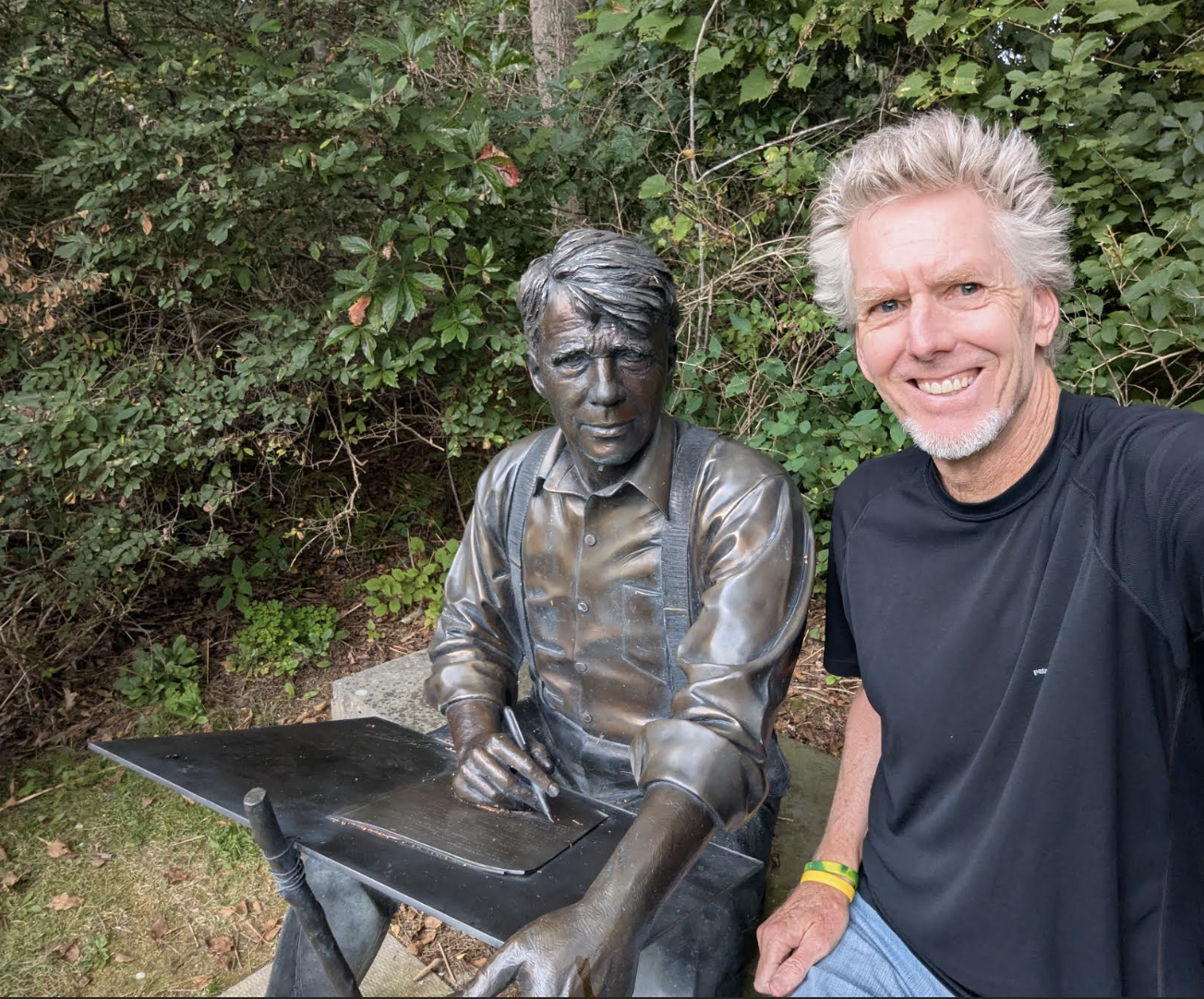
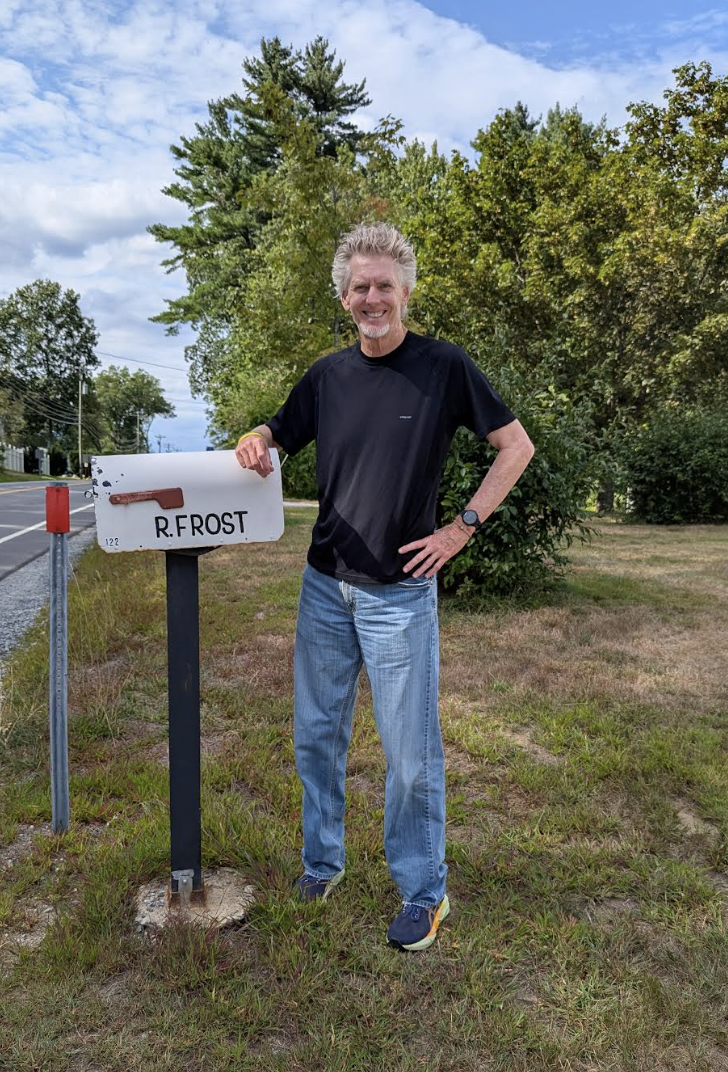
With Robert Frost’s likeness outside his Stone House in Shaftsbury, Vermont.

With her blessing I had the uncommon privilege of handling, carefully and with breath-held awe, a rare volume of “The Cow’s In The Corn: A One-Act Irish Play In Rhyme.” Thin as a thick pamphlet, with pages weathered at the edges, its age-worn hardcover features a geometric print of orange, yellow, and black squares and circles, sans any printed text of title or author.

As commonly advised, do not judge a book its cover. Inside, it is hand-numbered “66” out of only “ninety-one copies” and bears the poet’s signature, crisp and legible and flowing in dark pencil that remains unfaded.

Frost possessed a typewriter, naturally, but rarely used it other than to teach his children to type. He preferred to write by hand, in pencil, and so a one-page manuscript draft at the Stone House was magical to behold — in my mind’s eye I could see him writing and revising, crossing out and inserting, thinking anew and polishing.

Enchanting as this was, equally so was simply gazing out the dining room window and imagining my poet hero composing one of his best-known works, “Stopping by Woods on a Snowy Evening.” Surprisingly, Frost wrote this gem not on a vapor-breath snowy evening, but rather here on his dining table in the gleaming morning, chronicled as being a warm day in June 1922 — quite similar, very likely, to the sunny pre-noon hour of my wife Lisa’s and my August visit.

Something gold that will also stay in my memories happened as we were leaving. A quarter mile down the driveway, past a barn dating back to Frost’s time, near the homestead’s connection to Vermont Route 7A, a rural two-lane road, I spotted a simple black-and-white sign bolted to a weathered wooden post: Welcome To The Robert Frost Trail.

The signage was easy to miss; indeed, we had not seen it when driving in; and its location echoed Frost’s most famous poem, “A Road Not Taken.” Instead of two roads diverging, the gravel driveway and a freshly mowed trail — “Because it was grassy and wanted wear” one stanza states — parted.

Despite having gone for a long run at daybreak, I decided to give this grassy path some wear and went for a short impromptu jiggy-jog before we got back on the road driving.

The Robert Frost Trail passes through remnants of his old apple orchards and stands of red pines. As I traveled it, another line from “The Road Not Taken” resonated poignantly with me and still does today: “I doubted if I should ever come back.”

Though I doubt I will ever make it back to the Robert Frost Stone House, I remain grateful to have visited — and run where its namesake enjoyed taking long walks.

* * *

Essay copyrights Woody Woodburn
Woody’s new novel “The Butterfly Tree” is now available in paperback and eBook at Amazon (click here), other online bookstores, and is orderable at all bookshops.

*

Woody writes a weekly column for The Ventura County Star and can be contacted at WoodyWriter@gmail.com. Follow him on Twitter and Instagram at @woodywoodburn.

Part 2: Summer Day Filled With Frost

My visit of Emily Dickinson’s Homestead in Amherst, Massachusetts, was followed by a roadtrip to bookend homes of poetry — the Robert Frost Stone House Museum in Shaftsbury, Vermont in late morning, and then due east 140 miles to the Robert Frost Farm in Derry, New Hampshire that afternoon.

I shall begin at the endpoint, at the farmhouse, where Frost lived from 1900 to 1911. The drive there from the Stone House, with My Much Better Half in the passenger seat and Google Maps in her palm offering navigation, took a full three hours — and took us through big farmlands and small towns, over skeletal steel bridges and past a wooden covered bridge, a lovely antique in the modern world and a visual time machine back to Frosts’s period.

We traveled roads less taken than highways, narrow and winding and undulating, like a gentle pastoral rollercoaster almost. It was the best kind of drive, one where we were in no rush at all, in no traffic to speak of, just a Sunday ride enjoying the bucolic scenery. We would get there when we got there.

At the Robert Frost Farm in Derry, New Hampshire.

And so we looked out the rental car’s windows at sizable ponds and slow streams, at farmers working their fields and children at play in schoolyards, at cows and horses and signs warning of moose crossing the road.

Eventually, we came to an old tunnel-style steel mail box, painted white and mounted atop a wooden post set in cement two paces off the side of the tree-dotted rural route. On the side of the mailbox, just above the red flag noting outgoing mail that was not raised, were black letters, all caps, with no space between the initial and the last name: R.FROST

Beneath a faded-jeans sky patched with clouds, and bright with sunshine, we had arrived at the farmhouse of a man who was greatly unsuccessful at farming but did not fail at poetry, winning four(!) Pulitzer Prizes in 1924, 1931, 1937 and 1943.

Interestingly, Frost’s failure to sell some farm goods in town in Derry in order to buy Christmas presents for his children in 1905 on the winter solstice — “the darkest evening of the year” he later recalled in verse — caused him to halt his horse besides the woods, weeping, and was the real-life inspiration for “Stopping by Woods on a Snowy Evening.”

Remarkably, Frost did not write this masterwork poem until nearly two decades later, in Shaftsbury.

More remarkably, he did so on a July morning, looking out his Stone House dining room window at a snowless summertime landscape.

Most remarkably, he claimed to have composed it in one sitting.

Earlier on our summer day here, in the morning, I stood beside the dining room table where he composed that iambic tetrameter magic, my imagination wandering as I gazed out the same window.

Back to our afternoon in New Hampshire. In the farmhouse gift shop, a converted old barn that still smells authentic, I bought a thick volume of Frost’s poems. It is a nice book, although certainly no match for the slim, at just 20 pages, 1936 first edition of “From Snow To Snow” I already owned. While the latter’s cloth hardcover looks like it was once left outside through a snowy winter, the pristine title page bears a pencil signature, dark and clear, albeit a little shaky, in the author’s hand.

This prized volume, however, pales to the rare book I saw — and held — earlier in the day at Robert Frost’s Stone House, which I will share here next week.

* * *

Essay copyrights Woody Woodburn

Woody’s new novel “The Butterfly Tree” is now available in paperback and eBook at Amazon (click here), other online bookstores, and is orderable at all bookshops.

*

Woody writes a weekly column for The Ventura County Star and can be contacted at WoodyWriter@gmail.com. Follow him on Twitter and Instagram at @woodywoodburn.

Being Good Neighbors Vital Now

FOLLOW ME ON INSTAGRAM: @woodywoodburn
*

Being Good Neighbors

Is Vital Now

            Freshman year in college, to fill an English requirement I got stuck in a class I had no desire to take. What a lucky break.

“The Poetry of Robert Frost” proved to be my favorite class of all four years. Partly it was the professor; largely it was the wordsmithery of the four-time Pulitzer Prize winner.

I recently retrieved Frost’s complete and unabridged works from my bookcase because, probably like you, I have extra time on my hands during these COVID-19 days and nights of self-isolation.

While “The Road Not Taken” remains my favorite Frost masterpiece, the poem I had foremost in mind to reread was “Mending Wall” with the closing line: “Good fences make good neighbors.”

One interpretation of the poem is that a wall, or stone fence between farms, is good because it separates people and livestock.

The following lines, however, offer a wink towards an opposite interpretation as the narrator notes of his neighbor beyond the hill: “He is all pine and I am apple orchard. / My apple trees will never get across / And eat the cones under his pines, I tell him.”

Frost is playfully observing that apple and pine trees do not need a wall to keep them apart.

Shortly thereafter, the narrator continues: “Before I built a wall I’d ask to know / What I was walling in or walling out, / And to whom I was like to give offense.”

Here especially “Mending Wall” seems powerfully pertinent today. Through social distancing and self-isolation we are all being asked to build fences between ourselves and fellow citizens.

A week ago, not greeting a neighbor or friend with a handshake or hug felt rude because they were “like to give offense.” Similarly, by self-quarantining were we walling coronavirus out or walling ourselves in?

The important truth, we now know, is that we are using a metaphoric wall to “flatten the curve” of infections in an attempt to prevent our healthcare system from being overwhelmed.

Some people, for the good of all, must breach the wall – healthcare professionals, truckers, grocery and pharmacy workers, for example. Others need to go over the shelter-in-place wall to seek medical care, buy food, help at-risk neighbors.

It makes the news and goes viral on social media when selfish boors hoard toilet paper and fight over hand sanitizer, but I remain convinced most people share, give, help.

My friend Dave told me a story that I like to think is the Dog-Bites-Man non-headline norm. An elderly couple in their 80s sat in their car in a supermarket parking lot for 45 minutes, afraid to go inside and risk getting COVID-19.

Finally, they worked up the courage to ask a stranger to do their shopping. A young woman passerby gladly took their grocery list and money. She returned and set down the bags – and change – outside their car.

This suggests to me a new 2020 interpretation for “Mending Wall” with the narrator being a young, healthy farmer while his neighbor is in a vulnerable group – perhaps over age 65, or has a compromised immune system, or has asthma.

For the neighbor, balancing the “boulders that have fallen to each / And some are loaves and some so nearly balls” back in place on the wall is potentially life-saving.

If we view the mended wall as a metaphor for serious social distancing, it is indeed true that “Good fences make good neighbors” – at least for now.

The day will eventually return when it is more neighborly to shake hands across the fence. Or, better yet, hop over it and embrace.

 *   *   *

Woody Woodburn writes a weekly column for The Ventura County Star and can be contacted at WoodyWriter@gmail.com. Follow him on Twitter and Instagram at @woodywoodburn. His books are available at www.WoodyWoodburn.com.

Check out my memoir WOODEN & ME: Life Lessons from My Two-Decade Friendship with the Legendary Coach and Humanitarian to Help “Make Each Day Your Masterpiece” and my essay collection “Strawberries in Wintertime: Essays on Life, Love, and Laughter” …