
Part 3: Tourist Site Less Traveled To

On a high summer’s day, I visited the Robert Frost Stone House Museum in Shaftsbury, Vermont.

This historic homestead is where Frost lived — and wrote — from 1920 to 1929. His poems penned here include “Nothing Gold Can Stay” and “Fire and Ice” and, in 1923, his first of four Pulitzer Prize-winning volumes, “New Hampshire.”

Serendipity smiled at me, and widely, when I mentioned to the docent, a friendly college-aged woman, that I had long ago been inspired to become a writer in no small measure by a university class focused fully on Mr. Frost. After I finished perusing the modest home-turned-museum, the docent presented me a surprise: a small treasure trove of artifacts, not kept on public display, she had retrieved from locked safekeeping.
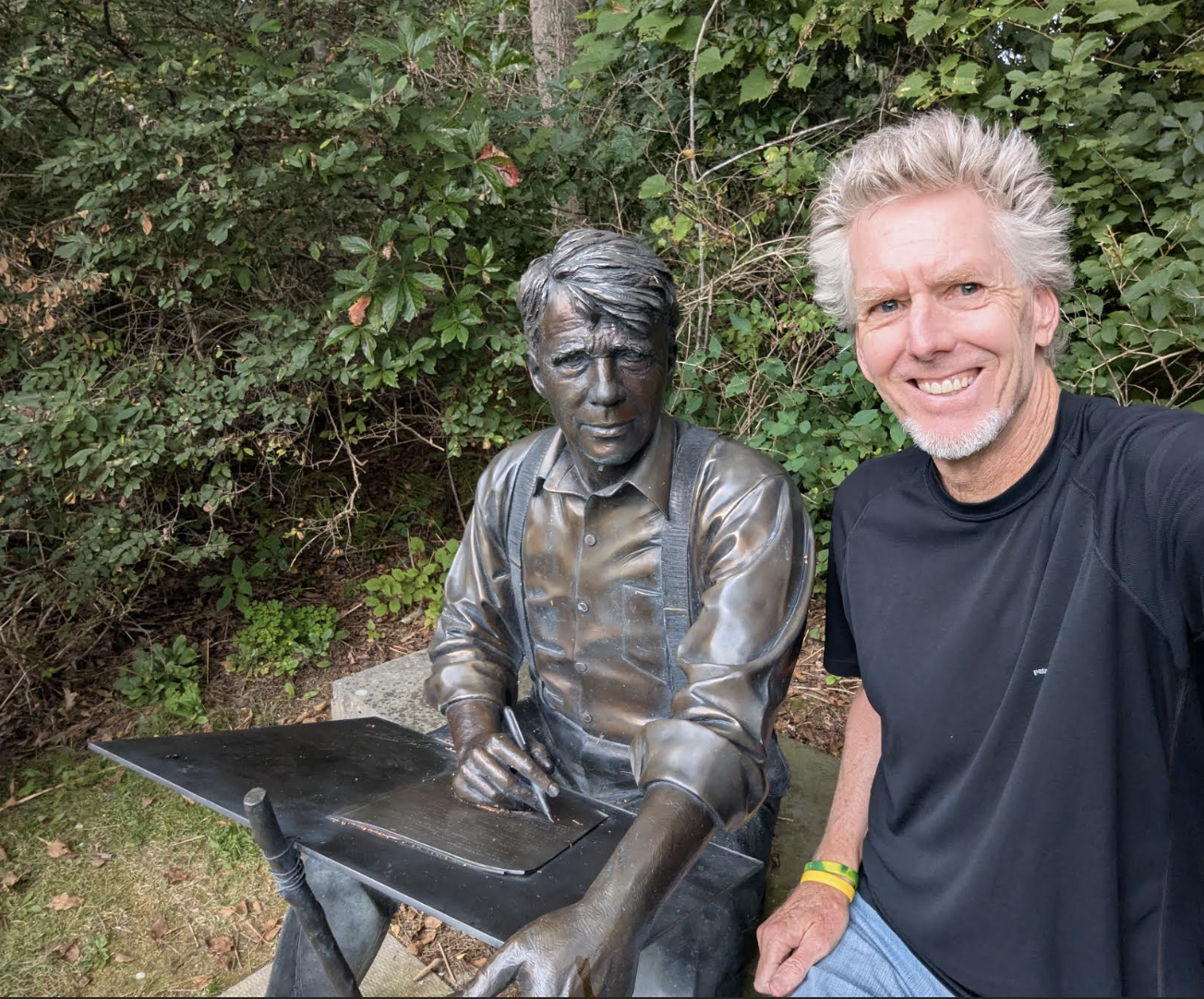
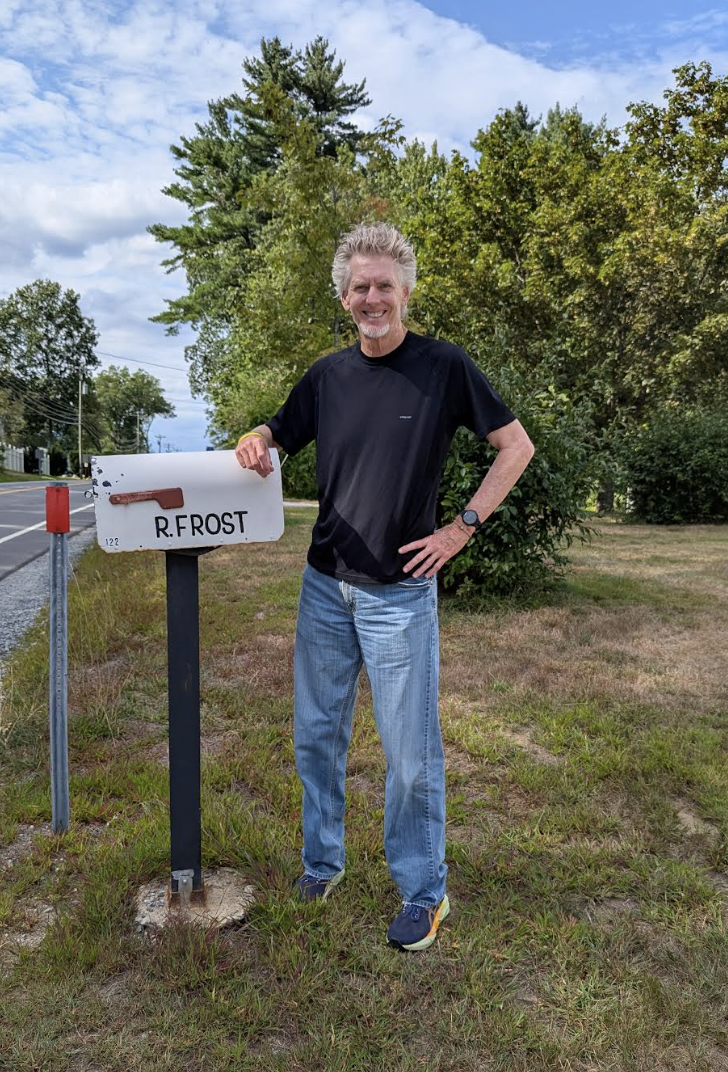
With Robert Frost’s likeness outside his Stone House in Shaftsbury, Vermont.

With her blessing I had the uncommon privilege of handling, carefully and with breath-held awe, a rare volume of “The Cow’s In The Corn: A One-Act Irish Play In Rhyme.” Thin as a thick pamphlet, with pages weathered at the edges, its age-worn hardcover features a geometric print of orange, yellow, and black squares and circles, sans any printed text of title or author.

As commonly advised, do not judge a book its cover. Inside, it is hand-numbered “66” out of only “ninety-one copies” and bears the poet’s signature, crisp and legible and flowing in dark pencil that remains unfaded.

Frost possessed a typewriter, naturally, but rarely used it other than to teach his children to type. He preferred to write by hand, in pencil, and so a one-page manuscript draft at the Stone House was magical to behold — in my mind’s eye I could see him writing and revising, crossing out and inserting, thinking anew and polishing.

Enchanting as this was, equally so was simply gazing out the dining room window and imagining my poet hero composing one of his best-known works, “Stopping by Woods on a Snowy Evening.” Surprisingly, Frost wrote this gem not on a vapor-breath snowy evening, but rather here on his dining table in the gleaming morning, chronicled as being a warm day in June 1922 — quite similar, very likely, to the sunny pre-noon hour of my wife Lisa’s and my August visit.

Something gold that will also stay in my memories happened as we were leaving. A quarter mile down the driveway, past a barn dating back to Frost’s time, near the homestead’s connection to Vermont Route 7A, a rural two-lane road, I spotted a simple black-and-white sign bolted to a weathered wooden post: Welcome To The Robert Frost Trail.

The signage was easy to miss; indeed, we had not seen it when driving in; and its location echoed Frost’s most famous poem, “A Road Not Taken.” Instead of two roads diverging, the gravel driveway and a freshly mowed trail — “Because it was grassy and wanted wear” one stanza states — parted.

Despite having gone for a long run at daybreak, I decided to give this grassy path some wear and went for a short impromptu jiggy-jog before we got back on the road driving.

The Robert Frost Trail passes through remnants of his old apple orchards and stands of red pines. As I traveled it, another line from “The Road Not Taken” resonated poignantly with me and still does today: “I doubted if I should ever come back.”

Though I doubt I will ever make it back to the Robert Frost Stone House, I remain grateful to have visited — and run where its namesake enjoyed taking long walks.

* * *

Essay copyrights Woody Woodburn
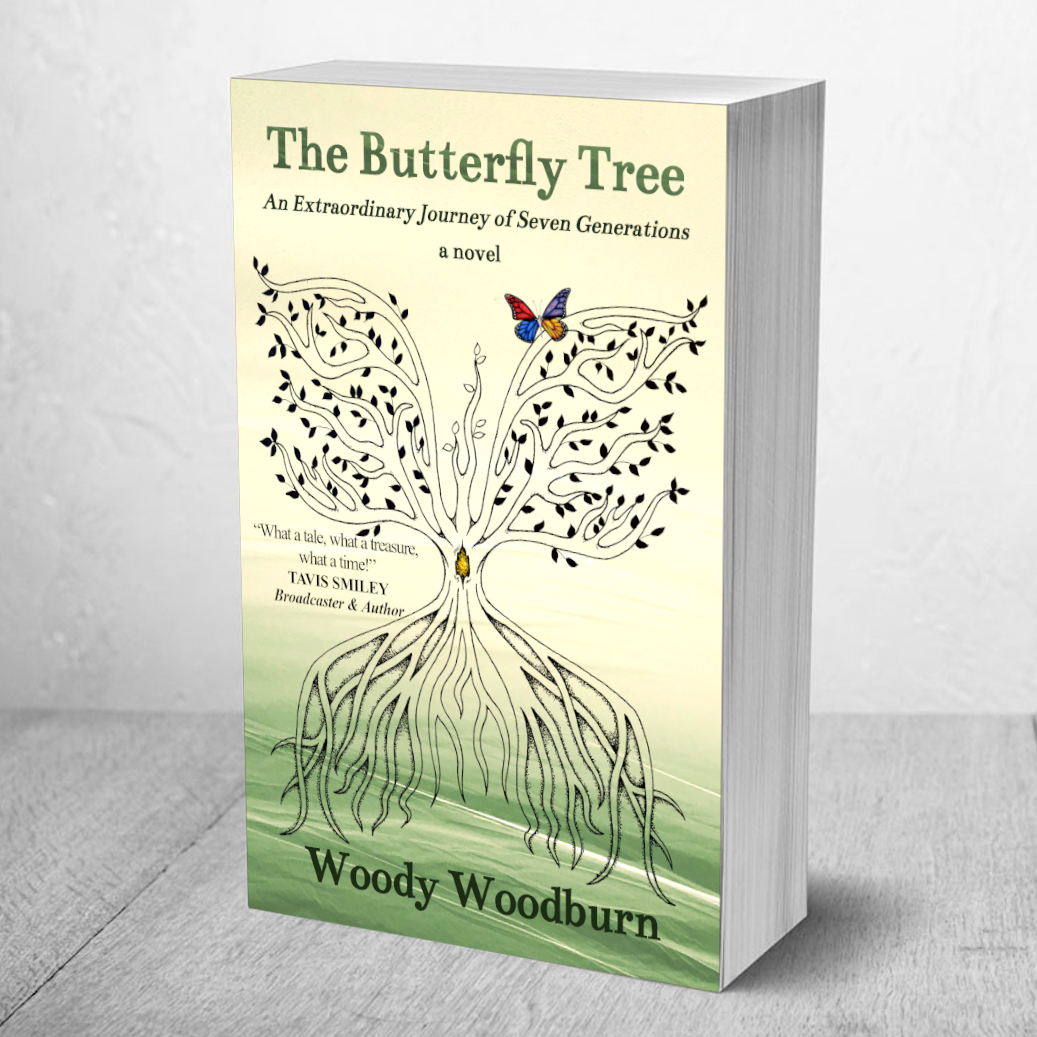
Woody’s new novel “The Butterfly Tree” is now available in paperback and eBook at Amazon (click here), other online bookstores, and is orderable at all bookshops.

*

Woody writes a weekly column for The Ventura County Star and can be contacted at WoodyWriter@gmail.com. Follow him on Twitter and Instagram at @woodywoodburn.
Part 2: Summer Day Filled With Frost

My visit of Emily Dickinson’s Homestead in Amherst, Massachusetts, was followed by a roadtrip to bookend homes of poetry — the Robert Frost Stone House Museum in Shaftsbury, Vermont in late morning, and then due east 140 miles to the Robert Frost Farm in Derry, New Hampshire that afternoon.

I shall begin at the endpoint, at the farmhouse, where Frost lived from 1900 to 1911. The drive there from the Stone House, with My Much Better Half in the passenger seat and Google Maps in her palm offering navigation, took a full three hours — and took us through big farmlands and small towns, over skeletal steel bridges and past a wooden covered bridge, a lovely antique in the modern world and a visual time machine back to Frosts’s period.

We traveled roads less taken than highways, narrow and winding and undulating, like a gentle pastoral rollercoaster almost. It was the best kind of drive, one where we were in no rush at all, in no traffic to speak of, just a Sunday ride enjoying the bucolic scenery. We would get there when we got there.

At the Robert Frost Farm in Derry, New Hampshire.

And so we looked out the rental car’s windows at sizable ponds and slow streams, at farmers working their fields and children at play in schoolyards, at cows and horses and signs warning of moose crossing the road.

Eventually, we came to an old tunnel-style steel mail box, painted white and mounted atop a wooden post set in cement two paces off the side of the tree-dotted rural route. On the side of the mailbox, just above the red flag noting outgoing mail that was not raised, were black letters, all caps, with no space between the initial and the last name: R.FROST

Beneath a faded-jeans sky patched with clouds, and bright with sunshine, we had arrived at the farmhouse of a man who was greatly unsuccessful at farming but did not fail at poetry, winning four(!) Pulitzer Prizes in 1924, 1931, 1937 and 1943.

Interestingly, Frost’s failure to sell some farm goods in town in Derry in order to buy Christmas presents for his children in 1905 on the winter solstice — “the darkest evening of the year” he later recalled in verse — caused him to halt his horse besides the woods, weeping, and was the real-life inspiration for “Stopping by Woods on a Snowy Evening.”

Remarkably, Frost did not write this masterwork poem until nearly two decades later, in Shaftsbury.

More remarkably, he did so on a July morning, looking out his Stone House dining room window at a snowless summertime landscape.

Most remarkably, he claimed to have composed it in one sitting.

Earlier on our summer day here, in the morning, I stood beside the dining room table where he composed that iambic tetrameter magic, my imagination wandering as I gazed out the same window.

Back to our afternoon in New Hampshire. In the farmhouse gift shop, a converted old barn that still smells authentic, I bought a thick volume of Frost’s poems. It is a nice book, although certainly no match for the slim, at just 20 pages, 1936 first edition of “From Snow To Snow” I already owned. While the latter’s cloth hardcover looks like it was once left outside through a snowy winter, the pristine title page bears a pencil signature, dark and clear, albeit a little shaky, in the author’s hand.

This prized volume, however, pales to the rare book I saw — and held — earlier in the day at Robert Frost’s Stone House, which I will share here next week.

* * *

Essay copyrights Woody Woodburn

Woody’s new novel “The Butterfly Tree” is now available in paperback and eBook at Amazon (click here), other online bookstores, and is orderable at all bookshops.

*

Woody writes a weekly column for The Ventura County Star and can be contacted at WoodyWriter@gmail.com. Follow him on Twitter and Instagram at @woodywoodburn.
Part 1: Poetic Addition to a Collection 

My family tree bears a Dickinson lineage, three generations before me, but tracing these roots deeper has, to my great disappointment, unearthed no direct kinship to the famous poet Emily.

No matter, it was still a thrill not long ago to visit my non-relative’s relatively regal residence in Amherst, Massachusetts.

To see where Emily Dickinson penned such celebrated poems as “Hope Is the Thing with Feathers” was indeed a feather in my cap because in the fashion some people accumulate national park roadtrips, or collect rare comic books or vintage wines or special antiques, I collect pilgrimages to the homes of rare, vintage, special writers.

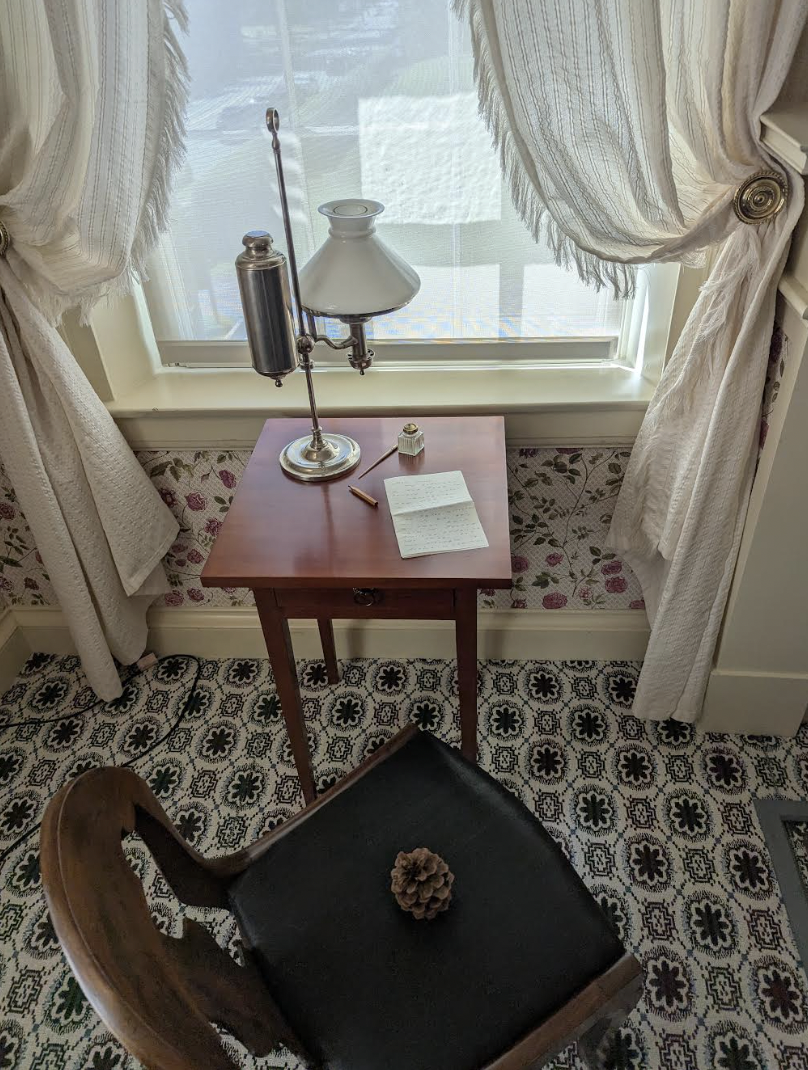
The tiny desk where big poetry magic happened.

My literary wine cellar, so to speak, includes modest to mansion quarters of: Mark Twain, Ernest Hemingway, John Steinbeck (New York and California), John Muir (California and Scotland), Robert Frost (Vermont and New Hampshire), Robert Louis Stevenson, Harriet Beecher Stowe, Henry Wadsworth Longfellow, Charles Dickens, Tennessee Williams, William Faulkner, Edgar Allen Poe, Eugene O’Neill, Thornton W. Burgess, Ralph Waldo Emerson, and Henry David Thoreau.

My novel pursuit brought me most recently to “The Homestead” at 280 Main Street; to a three-story brick house, buttery yellow in color with forest-green shutters on every window, and there are many, with a grand porch and elegant portico at the front entrance; to where Emily Elizabeth Dickinson was born in the winter of 1830, where she grew up and remained and wrote most of her 1,789 lifetime poems, and where she died 140 springs ago.

The three-acre estate, once totaling 14 acres and now a recognized historical landmark, is breathtakingly bucolic. A towering white oak, planted by Emily’s grandfather and today lovely as a poem, holds sentinel near the main residence.

The postcard scene is further decorated with maples and pines, elms and chestnuts, as well as fruit trees of apple, cherry, plum, and pear. Too, importantly, there is a garden in the side yard that still grows vegetables and, pleasingly, pink roses that match the wallpaper in Emily’s bedroom.

It was in this garden that many of Dickinson’s poem sprouted as notes, initially scribbled in pencil on scraps of paper, both of which she always kept in her dress pockets so as to never be without when inspiration blossomed.

Later, in her bedroom, she would would cull lines and thoughts from these jottings and compose polished poems, in ink, on legal stationery purloined from her father’s downstairs study.

This second-floor sanctuary, in the southwest corner at the back of the house, was the highlight of the tour. Specifically, just beyond the foot of the sleigh bed, to the left of a small fireplace, directly below a white-curtained window overlooking the backyard: a tiny table, only eighteen inches square, and side chair.

This is where the writing magic happened, often by candlelight or illumination from an oil lamp, long after the rest of the household was asleep.

To see Emily’s nib pen and glass inkwell resting on the cherrywood tabletop was to see, as I have, Steinbeck’s favored pencils or Hemingway’s Royal typewriter, and set my imagination flying free as if with feathered wings from her poem about Hope.

Outside on a gorgeous summer day, our guide Brenda, who had already recited a dozen Dickinson poems in full, bid me goodbye with one more: “There Is Another Sky” with 14 lines that include these two: “Here is a brighter garden, / Where not a frost has been.”

Next on my itinerary, coincidentally, was a homestead where Frost — Robert — long ago had been, and which I will share next week.

* * *

Essay copyrights Woody Woodburn

Woody’s new novel “The Butterfly Tree” is now available in paperback and eBook at Amazon (click here), other online bookstores, and is orderable at all bookshops.

*

Woody writes a weekly column for The Ventura County Star and can be contacted at WoodyWriter@gmail.com. Follow him on Twitter and Instagram at @woodywoodburn.

Lovely ‘Poem’ Turned Into Woodchips

Woody’s new novel “The Butterfly Tree” is available at Amazon (click here), other online retailers, and orderable at all bookshops.

From Woody’s column archives, spring 2013, evoked by recently seeing a fallen tree…

*

A century and change ago, Joyce Kilmer penned “Trees” with one of the most widely familiar opening couplets in America poetry:

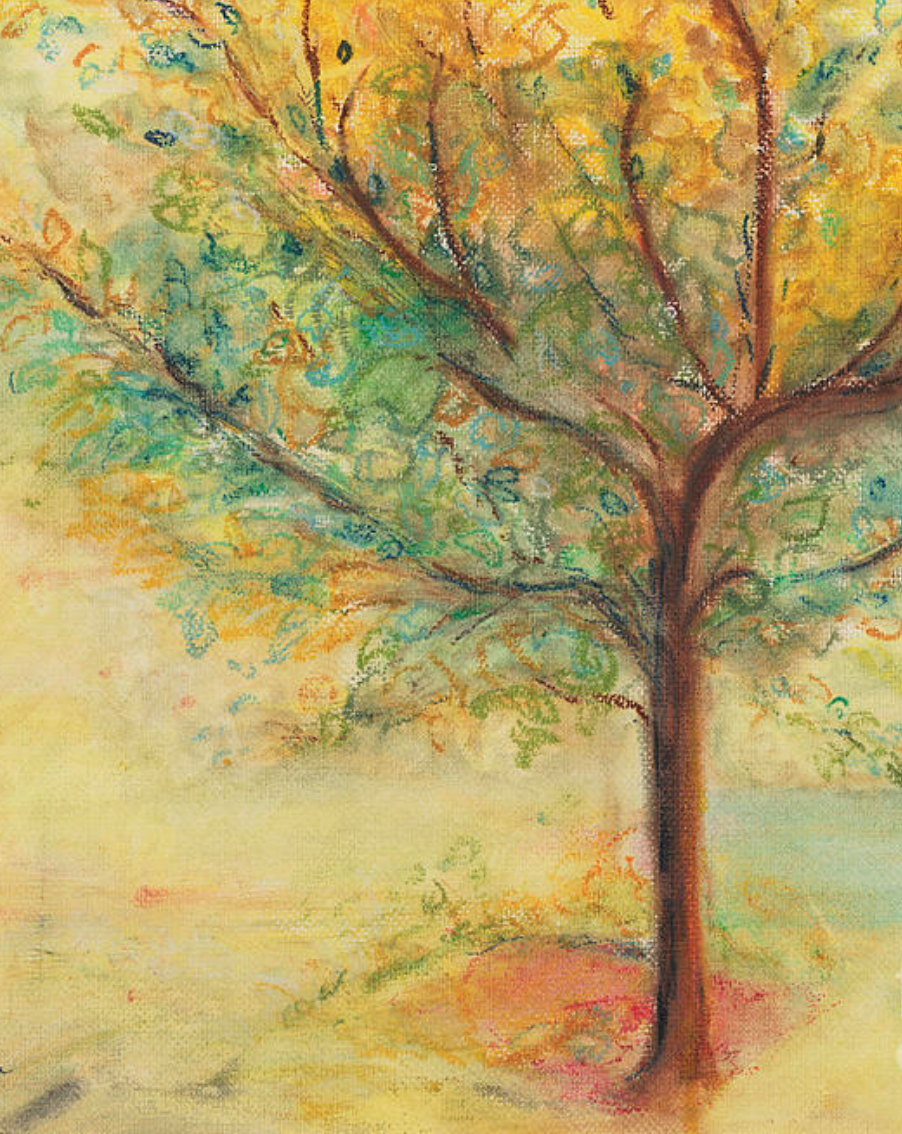
I think that I shall never see / A poem lovely as a tree.

The other morning I gazed out my window and across the street as a lovely “poem” got sawed down, cut up, turned into woodchips, and trucked away. It was like witnessing a theatrical street version of Shel Silverstein’s classic children’s book “The Giving Tree” starring two workmen in white hardhats and optic-yellow vests.

Actually, this story was even sadder for this tree’s limbs would not be used to build a house for the grown boy; its trunk not crafted into a boat to sail the seas. When the workmen’s work was finished, there remained not even a stump to sit and rest upon.

This tree had soared majestically, perhaps 70 feet into the clouds, tall and leafy, with a trunk too thick to reach one’s arms around. Alas, it had become a botanical Leaning Tower of Pisa, cracking and raising a section of sidewalk and in danger of falling across a busy street.

And so at 9 a.m. on a May gray day, a whining chainsaw made the morning more leaden. Standing in the basket of a gargantuan cherry-picker, a workman amputated the large branches one by one by one as he hydraulically rose higher Higher HIGHER.

Far below, the felled branches were cut into manageable lengths and fed into a woodchipper roaring loud as a jet engine. Lines of a lovely “poem” went in, lousy mulch came out.

Lastly, the towering tall barren trunk came down, made not into long lumber for a home or boat, but into short logs to be burned in fireplaces. This was not a heartwarming thought.

Start to finish, what had taken many decades of the four seasons to become living poetry was erased in a less than four hours. It was tree-mendously sad.

Kilmer again: A tree that may in summer wear / A nest of robins in her hair.

No more birds will nest in the lovely tree I used to admire out my kitchen window, looking east, the sun lifting above it in the late mornings of springtime.

The melancholy event gave me pause to think about a handful of memorable trees from my life: the evergreen beside the driveway of my earliest boyhood home that my two older brothers and I attempted blind shots over while playing H-O-R-S-E; the sturdy buckeye, near a swimming pond, with a hanging rope we swung on like Tarzan; the apple tree I picked snacks from on a shortcut home from grade school; the orange tree my two then-young kids and I planted; the giant redwoods we saw, in awe, as a family; and on and on.

I think “poems” fill our lives more than we often realize. We draw trees in kindergarten and as older kids climb trees and hopefully one day we plant a tree in deference to this Greek proverb: “A society grows great when old men plant trees whose shade they know they shall never sit in.”

Kilmer once more: Poems are made by fools like me, / But only God can make a tree.

Afterwards, this curious fool sought to determine how old the tree had been by counting its rings, but the stump was cut off below ground level and covered with dirt.

I may be overestimating by half, but I like to imagine this poetic tree had sprouted in 1913 – the same year “Trees” came into the world.

* * *

Essay copyrights Woody Woodburn

Woody’s new novel “The Butterfly Tree” is now available in paperback and eBook at Amazon (click here), other online bookstores, and is orderable at all bookshops.

*

Woody writes a weekly column for The Ventura County Star and can be contacted at WoodyWriter@gmail.com. Follow him on Twitter and Instagram at @woodywoodburn.

Lovely ‘Poem’ Becomes Woodchips

One hundred nine rings in an oak stump ago, Joyce Kilmer penned “Trees” with one of the most widely familiar opening couplets in America poetry:

I think that I shall never see / A poem lovely as a tree.

I thought of these words as I looked out my window and across the street as a lovely “poem” got sawed down, cut up, turned into woodchips and trucked away.

It was like seeing a theatrical street version of Shel Silverstein’s classic children’s book “The Giving Tree” starring two workmen in white hardhats and optic-yellow vests. Actually, this story was even sadder for this tree’s limbs would not be used to build a house for the grown boy; its trunk not crafted into a boat to sail the seas; when the workmen’s work was finished, there was not even a stump left to sit and rest upon.

Majestically tall, its trunk too thick to reach one’s arms around, the tree had become a botanical Leaning Tower of Pisa that was in danger of being toppled by a strong wind.

And so, beginning at 9 o’clock, a loud-crying chainsaw turned morning into mourning as a workman in a gargantuan cherry-picker amputated the branches one by one by one, thicker to smaller, as he hydraulically rose higher, higher, higher.

The felled branches were next cut into manageable lengths and fed into a woodchipper. The lines of a “poem” went in, mulch came out.

Lastly, the towering barren trunk came down. Instead of being made into long lumber for a home or boat, it was sawed into short logs to be burned in fireplaces. This was not a heartwarming thought.

It was not my tree, not in my yard, and yet all the same it was mine, and yours too, because trees are for all of us to enjoy. From start to finish, what took many decades to become living poetry was erased in less than four hours. It was tree-mendously sad.

Kilmer again: A tree that may in summer wear / A nest of robins in her hair.

            No more birds will nest in the lovely tree I used to see out my east-facing kitchen window, the rising sun climbing its branches each day.

The melancholy event gave me pause thinking about a handful of memorable trees in my life: The evergreen beside the driveway of my first boyhood home that my two older brothers and I attempted blind shots over during games of H-O-R-S-E. The sturdy buckeye we swung Tarzan-style from a rope near a pond. The apple tree I picked snacks off of on a shortcut home from grade school. The orange tree my two kids helped me plant when they were in grade school. The giant redwoods we saw, in awe, as a family. And on and on.

I think “poems” fill all our lives more than we generally realize. We draw trees in kindergarten and climb trees as older kids and hopefully at least once plant a tree, for as the Greek proverb states: “A society grows great when old men plant trees whose shade they know they shall never sit in.” Old women, too.

Kilmer once more: Poems are made by fools like me, / But only God can make a tree.

Afterwards, this fool walked over to determine how old the tree had been by counting its rings, but the stump was cut off below ground and covered with dirt. I may be overestimating its age by half, but I like to think it sprouted in 1913 – the same year “Trees” came into being.

 *   *   *

Essay copyrights Woody Woodburn

Woody writes a weekly column for The Ventura County Star and can be contacted at WoodyWriter@gmail.com. Follow him on Twitter and Instagram at @woodywoodburn. His SIGNED books are available at www.WoodyWoodburn.com.

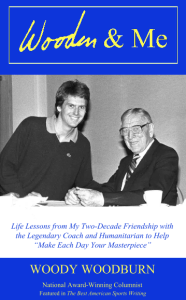
Personalized Signed copies of WOODEN & ME: Life Lessons from My Two-Decade Friendship with the Legendary Coach and Humanitarian to Help “Make Each Day Your Masterpiece” and  “Strawberries in Wintertime: Essays on Life, Love, and Laughter” are available at WoodyWoodburn.com

 

Making Friendship A Fine Art

FOLLOW ME ON INSTAGRAM: @woodywoodburn

*

Making Friendship

A Fine Art

My friend Kurt phoned out of the blue the other morning for no other reason than to say “hi” and catch up. His timing was perfect as I was in need of a little pick-me-up. By the time he said “ciao” my socks were filled with helium.

After hanging up, my mind drifted to Coach John Wooden – whose birth date, coincidentally, is this coming Wednesday – and some lessons on friendship he taught me during the two decades I knew him.

The first time I joined Coach on his daily four-mile morning walk some 30 years ago, he gave me a laminated card featuring his father’s “Seven-Point Creed” that includes “Make friendship a fine art.”

In an effort to be such an artist, the next time I visited Coach I brought along a small gift. Knowing his love of poetry, I selected a hardback collection by Rumi. Shortly thereafter, I received a handwritten thank-you note and a copy of a poem authored by Coach titled On Friendship:

At times when I am feeling low, / I hear from a friend and then

My worries start to go away / And I am on the mend

No matter what the doctors say – / And their studies never end

The best cure of all, when spirits fall, / Is a kind word from a friend

More prized than the signed poem is that over the ensuing years Coach turned those stanzas into curing words, and deeds, when my spirits fell – particularly after my mom passed away and later when I was nearly killed by a drunk driver.

Coach also had a gift for raising my spirits when they were already high. For example, when I next visited him he recited a poem from the gift Rumi book. I must confess I did not know who he was quoting until he told me. Fittingly, the selection was titled “Love” which Coach insisted was the most important word in the English language.

The poem recital was a thoughtful gesture of rare grace and a lesson through example that saying “thank you” is nice, but to show thanks is far better. In other words, wear a new sweater or necklace the next time you see the person who gave it to you; put a gift vase on proud display before the giver visits; memorize a poem or line from a book given to you.

Another life lesson put into practice was how Coach always gave his full attention on the phone and never seemed in a hurry to hang up. Indeed, if he was too busy to talk he would simply not answer in the first place rather than risk the prospect of having to be in a rude rush.

I fondly remember visiting Coach once when the phone rang and he let the call go through to his answering machine. It was his way of telling me I was his guest and merited full attention. This unspoken kindness became even more meaningful seconds later after the “Beep!” when a very familiar voice could be heard leaving a message.

“That’s Bill Walton!” I said, excitedly. “You’d better answer it!”

Coach Wooden did not reach for the phone and instead told me with a devilish smile: “Heavens no! Bill calls me all the time. If I pick up he’ll talk my ear off for half an hour and then you and I won’t get to visit. I’ll talk with him later.”

I’m glad I did not have a visitor when Kurt phoned the other day while making friendship a fine art.

 *   *   *

Woody Woodburn writes a weekly column for The Ventura County Star and can be contacted at WoodyWriter@gmail.com. Follow him on Twitter and Instagram at @woodywoodburn. His books are available at www.WoodyWoodburn.com.

Check out my memoir WOODEN & ME: Life Lessons from My Two-Decade Friendship with the Legendary Coach and Humanitarian to Help “Make Each Day Your Masterpiece” and my essay collection “Strawberries in Wintertime: Essays on Life, Love, and Laughter” …

Part 2: Typing Free Verse For Tips

Is your Club or Group looking for an inspiring guest speaker or do you want to host a book signing? . . . Contact Woody today!

* * *

1StrawberriesCoverWooden-&-Me-cover-mock-upFor a Personalized Autographed copy of “STRAWBERRIES IN WINTERTIME” or “WOODEN & ME” mail a check for $25 to:

Woody Woodburn

400 Roosevelt Court

Ventura, CA 93003

* * *

Part 2: Poet Types Free Verse For Tips

Shannon, the vagabond street poet I met in New Orleans and wrote about last week in recognition of April being National Poetry Month, has collected half a dozen typewriters.

A couple of her manual machines, including a beloved Royal Aristocrat, are in distant repair shops waiting for her to pick up. Three more are stored with friends in different cities, also awaiting her return visit.

Her sixth portable, a white Smith-Corona Corsair made in the 1960s, is what she was typing on when I met her along a French Quarter sidewalk.

“It’s a conversation starter,” Shannon said, noting that a fair portion of her customers stop originally to ask her about her various vintage typewriters.1TyprwriteMural

As an acoustic guitar is to a subway singer, so is a portable typewriter to Shannon. Indeed, her fingers create music on the keyboard:

Click-clack-click-clack-clack go the keys and typeslugs striking paper.

DING! goes the margin bell.

Ziiiiiip! goes the return carriage sliding back to the right to begin another line.

The composing done, Shannon’s performance is not yet complete. Using a disposable lighter she melts a red blob of envelope sealing wax, about the size of a quarter, onto the bottom left corner of the stationary. Next, while it is still molten, she uses a stamp to imprint the image of a full-leaved tree – in reverence, I took it, to Joyce Kilmer’s famous line: “I think that I shall never see / A poem lovely as a tree.”

Shannon’s poem written for me, you will see, was plenty lovely.

Surprisingly, she does not make carbon copies nor snap cell-phone photos of her poetry to keep for remembrance.

“I want to release my art into the world,” Shannon explained. “Letting go reflects the impermanence of my life.”

She did not say this darkly.

“I hope to do this my entire life,” Shannon said of writing poetry for tips. “I love to travel. I love to meet people. And I make a good enough living.”

Asked how much she is typically paid for a poem, she replied, perhaps inflating the figures to prime the pump: “Twenty bucks is the average, I’d say. Some pay only five or ten, which is fine.”

She flashed a toothpaste-ad smile and added: “I’ve gotten a hundred dollars a few times.”

I asked if she had a repertoire of poems that she alters, twists and shoehorns to fit the topics people choose. She was half-insulted: “Oh no, never. My poems are all original content.”

The topic I gave Shannon was “running.” Here is what she clack-clack-click-clack-DING!-ziiiiip composed and then theatrically read aloud:

*

RUNNING

I am devoted to the moment

My legs make good time

With my body, and I move

Forward, through the wind

I feel the breeze on my cheeks

My heart beats fast

Soil, earth beneath

I seem to ascend

My potential, limitless, without

Bounds, I am running

Free and nothing can stop me

But the racing of my heart

The only way I can get

My mind to silence

Is to go for a run

I’ll allow the world to

Fade away, I’ll consider only

My steps and I’ll tap in

To the great enigma of

Existence then

Running

Is freedom

*

It may not be of Robert Frost or Maya Angelou fame, but it is fairly wonderful all the same – all the more so for having been typed on the fly in less than 10 minutes with no rewriting or XXXX strikeouts.

Indeed, I tried to be generous and still believe the original poem I received from Shannon was a bargain at the price.

* * *

Woody Woodburn writes a weekly column for The Ventura County Star and can be contacted at WoodyWriter@gmail.com.

Wooden & Me Kickstarter Front PhotoCheck out my memoir WOODEN & ME: Life Lessons from My Two-Decade Friendship with the Legendary Coach and Humanitarian to Help “Make Each Day Your Masterpiece” and my essay collection “Strawberries in Wintertime: Essays on Life, Love, and Laughter” …

Tree-mendous emails

Aussie emails are Tree-mendous

Trees have inspired much superb writing, such as Joyce Kilmer’s beautiful poem “Trees” that begins, “I think that I shall never see / A poem lovely as a tree” and ends, “Poems are made by fools like me, / But only God can make a tree.”

Also in stanza, Henry Wadsworth Longfellow penned: “I hear the wind among the trees / Playing the celestial symphonies;

“I see the branches downward bent, / Like keys of some great instrument.”1Tree

John Muir, among volumes on the subject, wrote: “It has been said that trees are imperfect men, and seem to bemoan their imprisonment rooted in the ground. But they never seem so to me. I never saw a discontented tree.”

While writing about trees is a familiar age-old practice, what about writing to a tree?

This is actually happening in Melbourne, Australia, where the city has assigned ID numbers and email addresses to its trees so that citizens can easily report problems such as dangerous dangling branches.

A tree-mendous thing followed: people began writing love-letter emails –and you just know trees, unlike people, greatly prefer emails over handwritten notes on, egads!, paper – by the thousands, to their favorite trees.

“My dearest Ulmus,” began one love note to a green-leaf elm. “As I was leaving St. Mary’s College today I was struck, not by a branch, but by your radiant beauty. You must get these messages all the time. You’re such an attractive tree.”

*

Here is another. “To: Algerian Oak, Tree ID 1032705

“Dear Algerian Oak,

“Thank you for giving us oxygen. Thank you for being so pretty. I don’t know where I’d be without you to extract my carbon dioxide. Stay strong; stand tall amongst the crowd. You are the gift that keeps on giving. Hopefully one day our environment will be our priority.”

*

From a student. “To: Green Leaf Elm, Tree ID 1022165  

“Dear Green Leaf Elm,

“I hope you like living at St. Mary’s. Most of the time I like it too. I have exams coming up and I should be busy studying. You do not have exams because you are a tree. I don’t think that there is much more to talk about as we don’t have a lot in common, you being a tree and such. But I’m glad we’re in this together.

“Cheers, F.”

*

I especially like this sweet note from an admirer of a golden elm.

“Dear 1037148,

“You deserve to be known by more than a number. I love you. Always and forever.”

*

Like Tree-No.1037148-Hugger, I have loved always and forever many trees in my life. If they had their own email addresses, here are some notes I would like to send them.

Dear Evergreen Beside My Boyhood Home Driveway,

Do you remember when I was small how I used to pretend you were a basketball defender and I would hoist shots over you with all my little-boy might? I imagine you are so tall now there is not a shooter alive whose shot you cannot block!

*

Dear My Favorite Majestic Tree in Ojai’s Libbey Park,

Thank you for the cool shade you have provided me over the decades during the Ojai Tennis Tournament.

*

Dear Mariposa Grove Sequoia Sempervirens,

I had never before seen trees like you / Tall as skyscrapers from a sidewalk’s view

Oxygen you give and my breath you take / Awesomeness like thee only God could make

*

Dear “Two Trees”,

Thank you, thank you for your aesthetic beauty and for holding vigilant twin sentinel over Ventura.

*

Dear Mighty Oak In My Grade School Friend Jim’s Backyard,

Thank you for so perfectly holding up the best tree house I have ever been in.

*

Dear Birch In My Front Yard,

You stand a little bent and crooked, like an elderly woman in need of a cane, and yet you are still lovely and strong and I love the way your leaves filter the evening sunlight before it comes through the window. I look forward to hearing the wind play celestial symphonies on your downward branches for decades to come.

With love,

Woody

* * *