

My visit of Emily Dickinson’s Homestead in Amherst, Massachusetts, was followed by a roadtrip to bookend homes of poetry — the Robert Frost Stone House Museum in Shaftsbury, Vermont in late morning, and then due east 140 miles to the Robert Frost Farm in Derry, New Hampshire that afternoon.
I shall begin at the endpoint, at the farmhouse, where Frost lived from 1900 to 1911. The drive there from the Stone House, with My Much Better Half in the passenger seat and Google Maps in her palm offering navigation, took a full three hours — and took us through big farmlands and small towns, over skeletal steel bridges and past a wooden covered bridge, a lovely antique in the modern world and a visual time machine back to Frosts’s period.
We traveled roads less taken than highways, narrow and winding and undulating, like a gentle pastoral rollercoaster almost. It was the best kind of drive, one where we were in no rush at all, in no traffic to speak of, just a Sunday ride enjoying the bucolic scenery. We would get there when we got there.
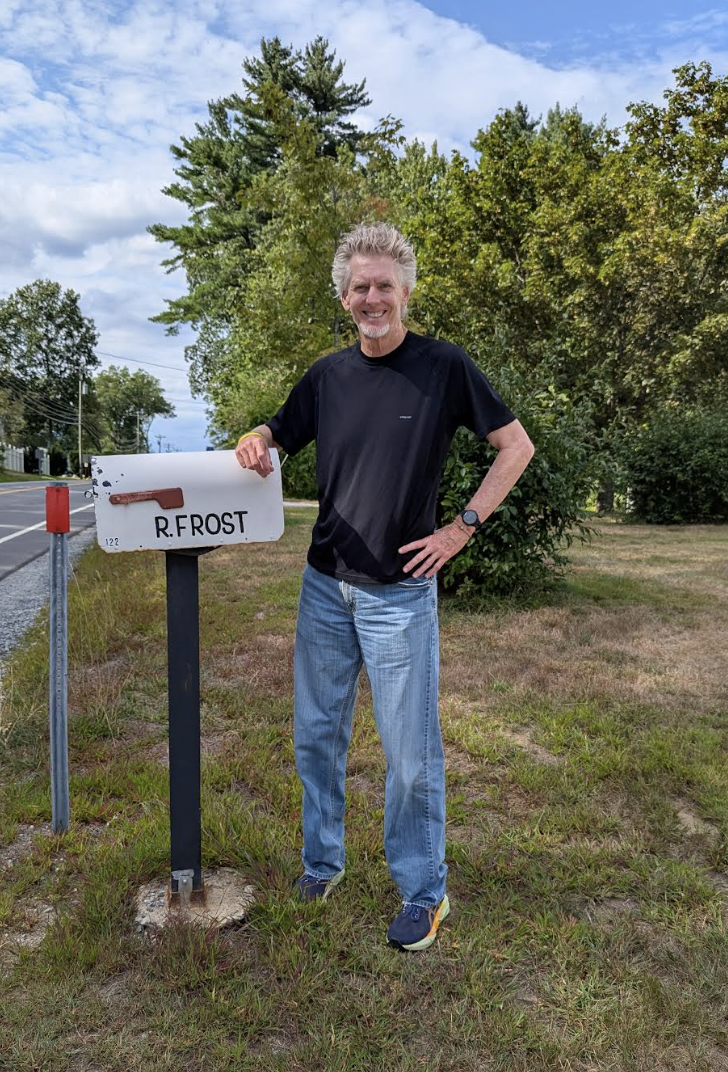
And so we looked out the rental car’s windows at sizable ponds and slow streams, at farmers working their fields and children at play in schoolyards, at cows and horses and signs warning of moose crossing the road.
Eventually, we came to an old tunnel-style steel mail box, painted white and mounted atop a wooden post set in cement two paces off the side of the tree-dotted rural route. On the side of the mailbox, just above the red flag noting outgoing mail that was not raised, were black letters, all caps, with no space between the initial and the last name: R.FROST
Beneath a faded-jeans sky patched with clouds, and bright with sunshine, we had arrived at the farmhouse of a man who was greatly unsuccessful at farming but did not fail at poetry, winning four(!) Pulitzer Prizes in 1924, 1931, 1937 and 1943.
Interestingly, Frost’s failure to sell some farm goods in town in Derry in order to buy Christmas presents for his children in 1905 on the winter solstice — “the darkest evening of the year” he later recalled in verse — caused him to halt his horse besides the woods, weeping, and was the real-life inspiration for “Stopping by Woods on a Snowy Evening.”
Remarkably, Frost did not write this masterwork poem until nearly two decades later, in Shaftsbury.
More remarkably, he did so on a July morning, looking out his Stone House dining room window at a snowless summertime landscape.
Most remarkably, he claimed to have composed it in one sitting.
Earlier on our summer day here, in the morning, I stood beside the dining room table where he composed that iambic tetrameter magic, my imagination wandering as I gazed out the same window.
Back to our afternoon in New Hampshire. In the farmhouse gift shop, a converted old barn that still smells authentic, I bought a thick volume of Frost’s poems. It is a nice book, although certainly no match for the slim, at just 20 pages, 1936 first edition of “From Snow To Snow” I already owned. While the latter’s cloth hardcover looks like it was once left outside through a snowy winter, the pristine title page bears a pencil signature, dark and clear, albeit a little shaky, in the author’s hand.
This prized volume, however, pales to the rare book I saw — and held — earlier in the day at Robert Frost’s Stone House, which I will share here next week.
* * *
Essay copyrights Woody Woodburn
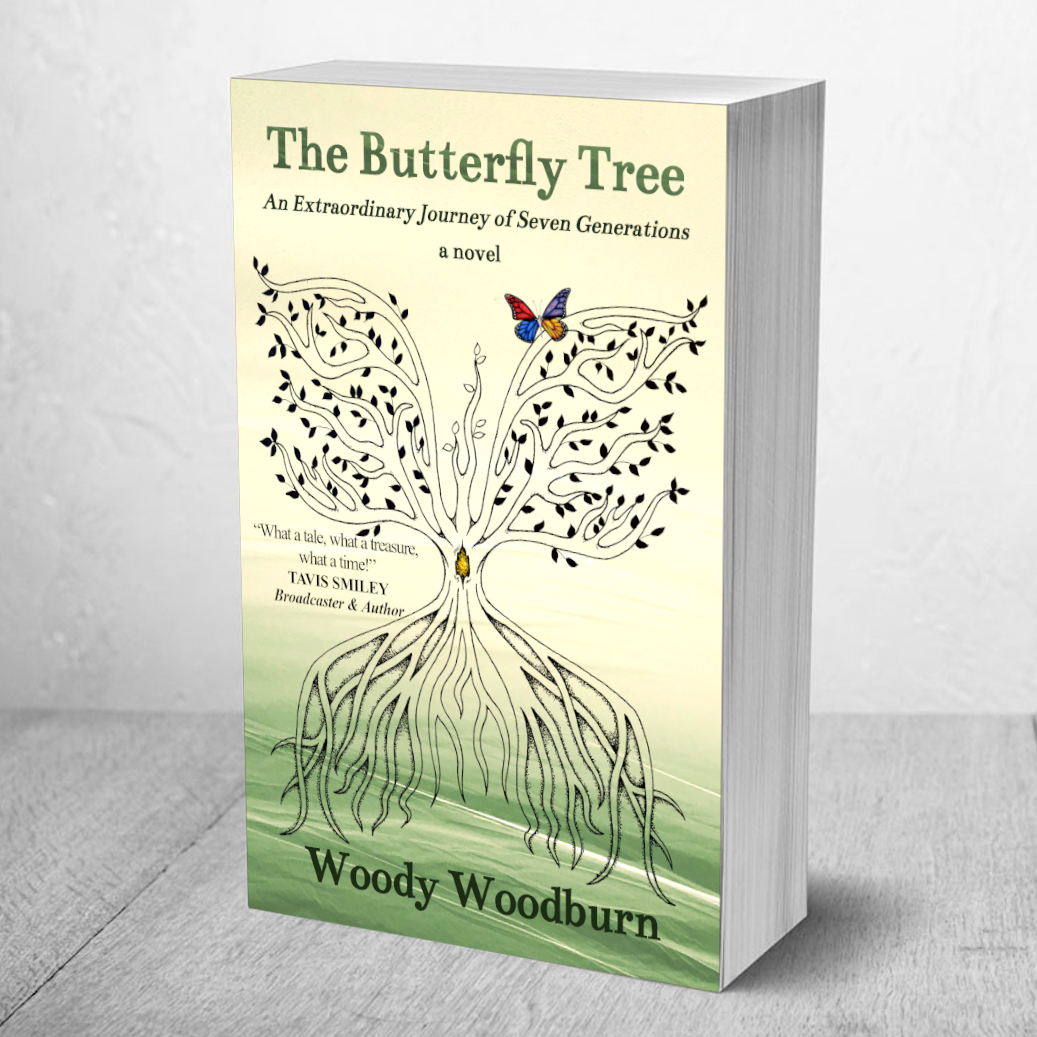
Woody’s new novel “The Butterfly Tree” is now available in paperback and eBook at Amazon (click here), other online bookstores, and is orderable at all bookshops.
*
Woody writes a weekly column for The Ventura County Star and can be contacted at WoodyWriter@gmail.com. Follow him on Twitter and Instagram at @woodywoodburn.