

My family tree bears a Dickinson lineage, three generations before me, but tracing these roots deeper has, to my great disappointment, unearthed no direct kinship to the famous poet Emily.
No matter, it was still a thrill not long ago to visit my non-relative’s relatively regal residence in Amherst, Massachusetts.
To see where Emily Dickinson penned such celebrated poems as “Hope Is the Thing with Feathers” was indeed a feather in my cap because in the fashion some people accumulate national park roadtrips, or collect rare comic books or vintage wines or special antiques, I collect pilgrimages to the homes of rare, vintage, special writers.
My literary wine cellar, so to speak, includes modest to mansion quarters of: Mark Twain, Ernest Hemingway, John Steinbeck (New York and California), John Muir (California and Scotland), Robert Frost (Vermont and New Hampshire), Robert Louis Stevenson, Harriet Beecher Stowe, Henry Wadsworth Longfellow, Charles Dickens, Tennessee Williams, William Faulkner, Edgar Allen Poe, Eugene O’Neill, Thornton W. Burgess, Ralph Waldo Emerson, and Henry David Thoreau.
My novel pursuit brought me most recently to “The Homestead” at 280 Main Street; to a three-story brick house, buttery yellow in color with forest-green shutters on every window, and there are many, with a grand porch and elegant portico at the front entrance; to where Emily Elizabeth Dickinson was born in the winter of 1830, where she grew up and remained and wrote most of her 1,789 lifetime poems, and where she died 140 springs ago.
The three-acre estate, once totaling 14 acres and now a recognized historical landmark, is breathtakingly bucolic. A towering white oak, planted by Emily’s grandfather and today lovely as a poem, holds sentinel near the main residence.
The postcard scene is further decorated with maples and pines, elms and chestnuts, as well as fruit trees of apple, cherry, plum, and pear. Too, importantly, there is a garden in the side yard that still grows vegetables and, pleasingly, pink roses that match the wallpaper in Emily’s bedroom.
It was in this garden that many of Dickinson’s poem sprouted as notes, initially scribbled in pencil on scraps of paper, both of which she always kept in her dress pockets so as to never be without when inspiration blossomed.
Later, in her bedroom, she would would cull lines and thoughts from these jottings and compose polished poems, in ink, on legal stationery purloined from her father’s downstairs study.
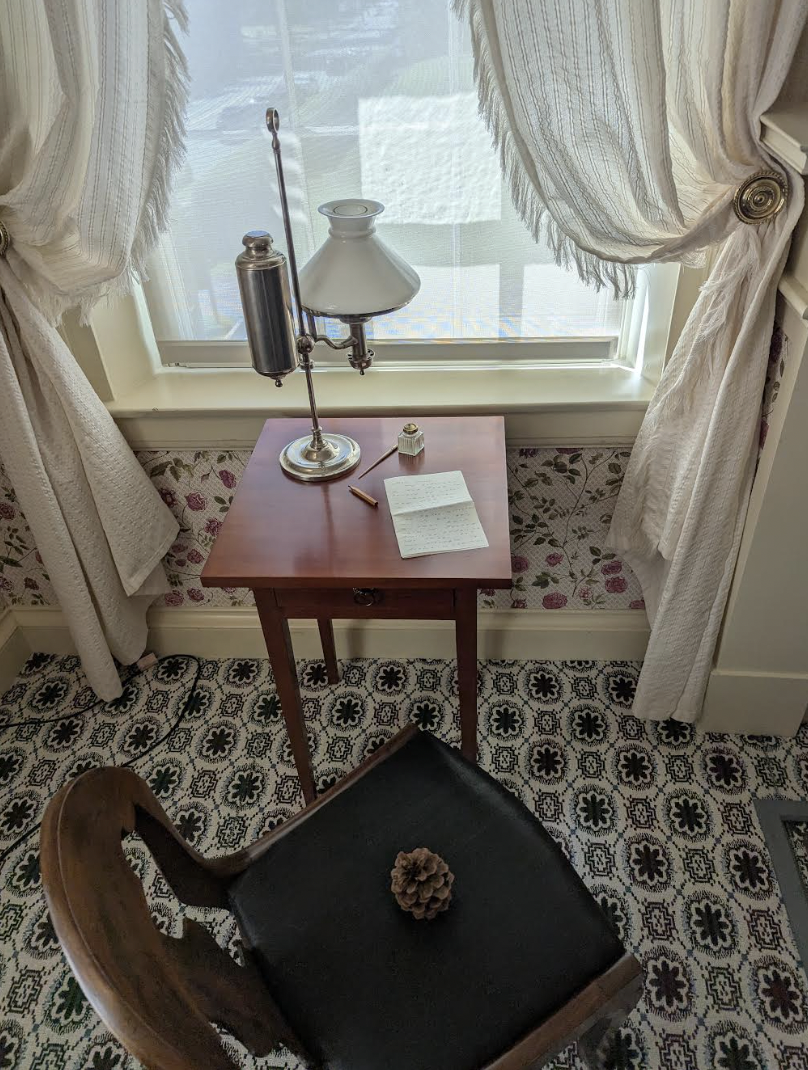
This second-floor sanctuary, in the southwest corner at the back of the house, was the highlight of the tour. Specifically, just beyond the foot of the sleigh bed, to the left of a small fireplace, directly below a white-curtained window overlooking the backyard: a tiny table, only eighteen inches square, and side chair.
This is where the writing magic happened, often by candlelight or illumination from an oil lamp, long after the rest of the household was asleep.
To see Emily’s nib pen and glass inkwell resting on the cherrywood tabletop was to see, as I have, Steinbeck’s favored pencils or Hemingway’s Royal typewriter, and set my imagination flying free as if with feathered wings from her poem about Hope.
Outside on a gorgeous summer day, our guide Brenda, who had already recited a dozen Dickinson poems in full, bid me goodbye with one more: “There Is Another Sky” with 14 lines that include these two: “Here is a brighter garden, / Where not a frost has been.”
Next on my itinerary, coincidentally, was a homestead where Frost — Robert — long ago had been, and which I will share next week.
* * *
Essay copyrights Woody Woodburn
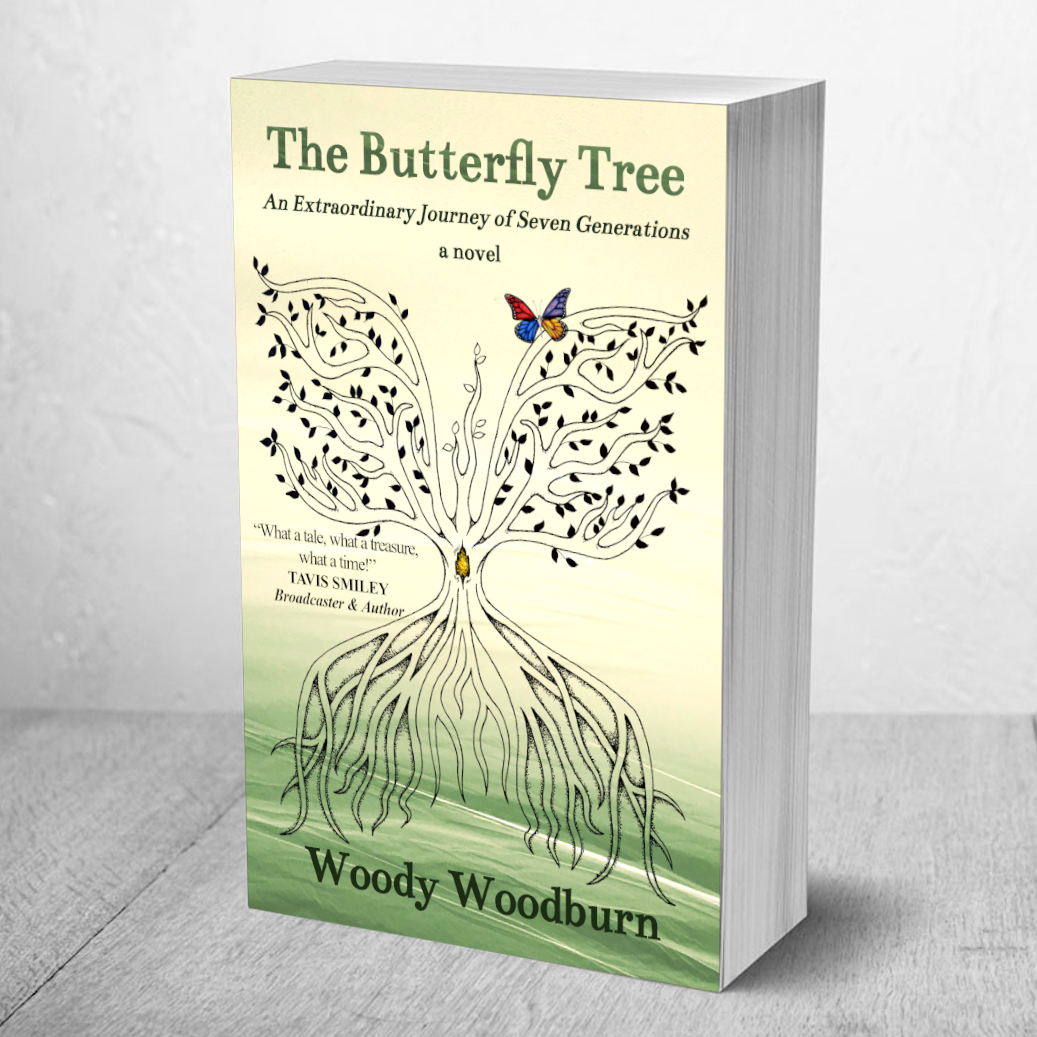
Woody’s new novel “The Butterfly Tree” is now available in paperback and eBook at Amazon (click here), other online bookstores, and is orderable at all bookshops.
*
Woody writes a weekly column for The Ventura County Star and can be contacted at WoodyWriter@gmail.com. Follow him on Twitter and Instagram at @woodywoodburn.