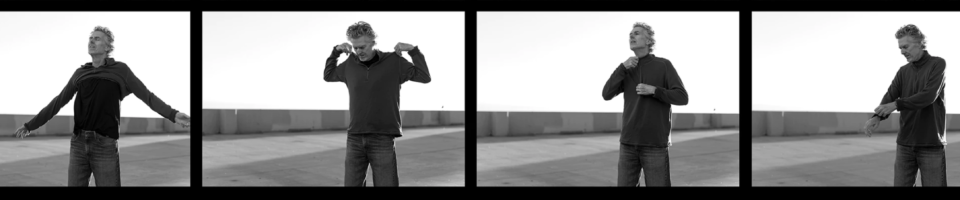

Music Between Sightseeing Highlights

“The music is not in the notes,” Wolfgang Amadeus Mozart is widely attributed to have noted, “but in the silence between.”

Similarly, the magic of travel is sometimes surprisingly found between landmark sites and famous sights.

So it was on a recent trip My Much Better Half and I took to New Zealand and Australia. The magic began in the airport, in a terminal restaurant, in a booth next to a father having dinner with two of the most adorable children imaginable – a daughter perhaps age 5 and a son surely not yet 1.

This family of three was just a delight to watch; the father held the boy lovingly in one arm as he ate with the other; the daughter, sitting across the table, had the manners and charm to match the princess-like dress she was wearing; when her brother, wearing a bow tie on this obviously special occasion, began to fidget, she made him giggle with an elixir of dancing facial expressions and a voice on the edge being a song.

Many, many years ago, on a trip when my daughter and son were not much older than this pair, a sweet stranger secretively paid the restaurant tab for us. Now, alas, the server said their bill had already been settled. Instead, I could only offer the father a compliment on his beautiful family.

And here came the real magic, for he said, nodding at the boy: “We just got him today.”

Was this an adoption homecoming trip? I did not ask, but I knew this: Our trip Down Under had just begun with our lips turned up into smiles.

*

A bookend airport scene filled with love occurred two days later, for we skipped a full date in flight, upon our arrival in Auckland.

As MMBH and I crossed the threshold into the arrivals reception area, a man I guessed to be in his 50s raced ahead of us into the open arms of a similarly aged man eagerly awaiting him. It was a vision out of a movie, complete with a long embrace that lifted one of the two off his feet; an embrace that went on and on; an embrace that was accompanied by wet eyes.

It was, I surmised initially, a lovers’ embrace. Or, perhaps, two long-lost old friends reunited? No and no – siblings, it turned out, for as I walked by I overheard one call the other, “Little Brother.”

My new smile widened further when I imagined, half a century from now, the young girl from the LAX restaurant running through an airport to happily and tearfully embrace her little brother.

*

Of the many unexpected sounds of music between the notes on this trip, here is one more.

New Zealand is renowned for its wines, and so MMBH and I toured a handful of wineries. The smallest one, off the beaten path, proved to be our favorite.

Its wonderful nectars, however, were not the reason.

With the seating all taken, we found an open spot against a wall to stand and sample two flights. Before either of us had finished our first small pour, a young woman walked across the room to invite us to join her party of four at their table.

“Party,” literally, because these friendly Kiwis – two sisters, one brother, and a husband – were celebrating a 30th birthday. The birthday boy kid brother, naturally, was the playful target of much laughter, and it was a joy to be included in this special occasion.

Indeed, singing “Happy Birthday” was more unexpected music on this trip.

* * *

Essay copyrights Woody Woodburn

Woody’s new novel “The Butterfly Tree” is now available in paperback and eBook at Amazon (click here), other online bookstores, and is orderable at all bookshops.

*

Woody writes a weekly column for The Ventura County Star and can be contacted at WoodyWriter@gmail.com. Follow him on Twitter and Instagram at @woodywoodburn.
Ghosts in the Dressing Rooms

The only thing special about the doorway was how un-special it appeared. Yet to enter was to pass through a portal as magical as the wardrobe in the beloved novel by C. S. Lewis.

Instead of traveling to Narnia, I not long ago stepped across a threshold from 2026 into 1878.

A white sign above the entryway, in a simple print font in black, read: “AWAY Dressing Room.” Along with its antiquated “HOME” counterpart, the visitor’s quarters are located inside the original Members Pavilion of the historic Sydney Cricket Ground and date back to the first cricket match played in the stadium 148 years ago. Nearly unchanged now from then, both Spartan rooms are still used by today’s stars.

The away dressing room is not a locker room for it has no lockers. Instead, wooden cubby units, each about a foot wide and five-feet high with one shelf at the top, line the walls with uncomfortable wood-slatted benches between groupings of two. Above every bench are three simple metal hooks, a modern upgrade from once-upon-a-time nails.

The cubbies are not without some magic for they are adorned with names and initials carved by pocketknives or scratched with nails, and also written in pencil and markers of blue and red and black. One can almost feel ghosts in the room and imagine not only yesteryear, but yester-century.

The rectangular dressing area is about the size of a wealthy man’s walk-in closet and connects, up four red-tiled steps, to a smaller room with showers, sinks, toilets.

The brick walls throughout are covered by layer upon layer of paint, thick as face makeup on an aging stage actress, the current color being the same cream as throwback cricket flannels.

A couple windows and a single fan hanging from high overhead serve as air conditioning. The ceiling, covered with pressed tin tiles, also features bare metal pipes running along two sides. Only a short florescent tube light betrays the 19th century.

The home dressing room and showers are larger, but not grandly so, although it does have true locker stalls and padded benches. “The home-team advantage,” our tour guide said unapologetically.

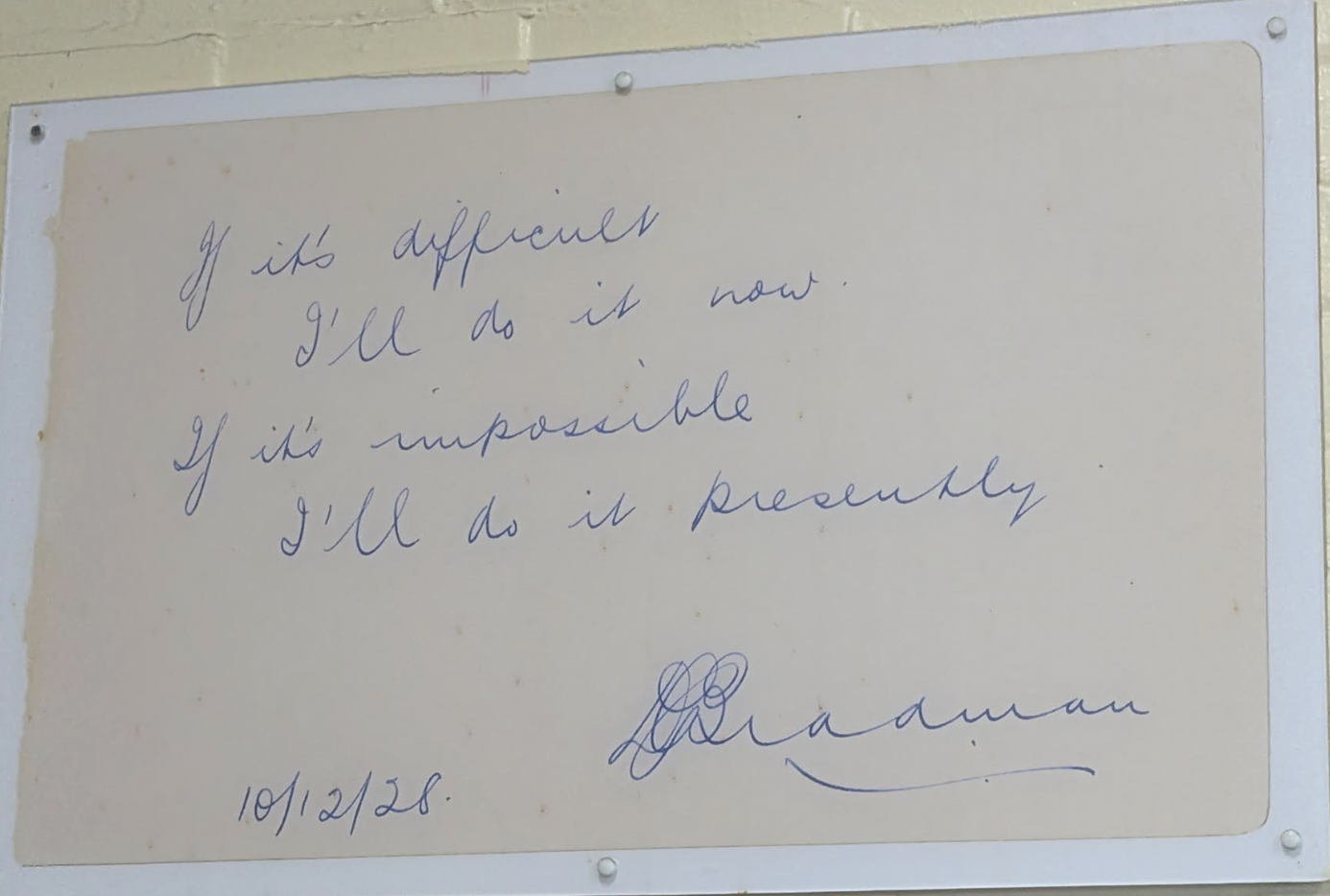
My favorite piece of nostalgia was a piece of yellowed paper, slightly larger than a placemat, displayed proudly and prominently above the doorway to be seen when exiting the home dressing room. It is a note, protected behind glass, handwritten by Sir Donald Bradman, the Babe Ruth of Australian cricket players. In easily legible cursive, in blue ink, with his underlined one-word signature “DGBradman” and date “10/12/28” at the bottom, it reads:

If it’s difficult / I’ll do it now

If it’s impossible / I’ll do it presently

The movie “Dead Poets Society” instantly came to my mind, and heart, specifically the scene when English teacher John Keating, played by Robin Williams, addresses his male teenage students in front of a venerable trophy case. The youthful faces in the century-old photographs within were once just like them, he says, full of passion and hopes and dreams and feelings of invincibility, but are now “fertilizing daffodils.”

“We are all food for worms, lads,” Mr. Keating continues, then memorably concludes by telling the boys the Latin term carpe diem – seize the day.

I imagined Sir Bradman, and the other star lads whose names adorn the wood-paneled lists of batting and bowling feats hanging in the two timeless dressing rooms, back when they were young and in their prime hitting “sixes” and throwing “jaffas” before becoming worm food.

Carpe diem. Do it now. Do it presently. The daffodils may bloom tomorrow.

* * *

Essay copyrights Woody Woodburn

Woody’s new novel “The Butterfly Tree” is now available in paperback and eBook at Amazon (click here), other online bookstores, and is orderable at all bookshops.

*

Woody writes a weekly column for The Ventura County Star and can be contacted at WoodyWriter@gmail.com. Follow him on Twitter and Instagram at @woodywoodburn.
Singing Praises of an Old Gem

The late Henry Lawson, known as “The People’s Poet” of Australia, could not have adequately described the lovely grandeur of the Sydney Opera House in a poem, even an epic one numbering a hundred pages.

Patrick White, the only Aussie to win the Nobel Prize in Literature, similarly in a full novel would have failed to do justice to this waterfront architectural marvel comprised of fourteen gracefully billowing “sails” – or “shells,” depending on the viewer’s imagination – shimmering with more than one million tiles on the outside.

Like the rarest of beautiful people, this World Heritage Site No. 166, which opened in 1973, is somehow even more breathtaking on the inside.

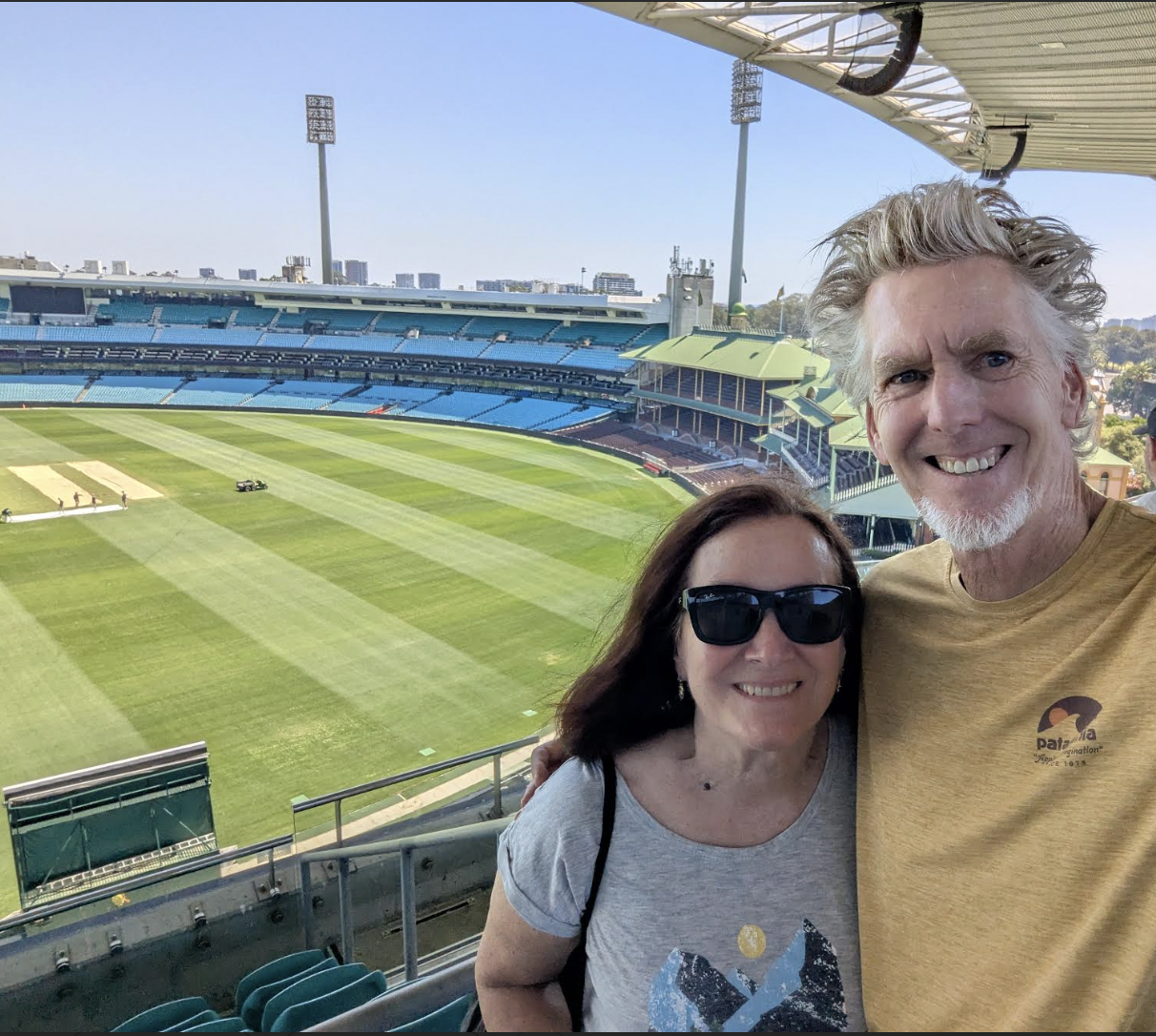
The day after My Much Better Half, herself outwardly beautiful and even more so inwardly, and I toured the Opera House we visited the Sydney Cricket Ground and had our breath taken away anew, and by surprise, by the gorgeous red-brick masonry and overall grandness that greeted us outside and the beautiful history waiting inside.

At Sydney Cricket Ground with MMBH.

The Sydney Cricket House – my nickname for it, trademark pending – is a mere three miles from the Opera House but nearly a century removed, having been founded in 1878.

To put that in some perspective, Wimbledon’s historic Centre Court dates back to 1922 and Fenway Park, the oldest Major League Stadium, was built in 1912. With its preserved old-school architecture and dark-green palette, Sydney Cricket House looks like the shared grandfather of Fenway and Wimbledon.

A dear friend of mine, a travel writer of great merit, always reminds me before I depart on a trip to explore hidden alleyways and gateways and doorways because those are often portals to enchanted experiences.

The Sydney Cricket House is not exactly hidden down an off-the-beaten-path alleyway, but MMBH and I did seek it out almost by serendipity. With a couple hours to fill before heading to the airport on our final day in Australia, the stadium tour simply fit the time opening.

Jimmy Cricket were we surprised and enchanted!

The stadium has been expanded, time and again, and is now a double-decked circular structure, complete with towering lights for night matches, that holds 40,000 spectators. But in the northwest corner, shining like matching diamonds on a necklace, the original twin grandstands remain.

The Members’ Pavilion and Ladies’ Pavilion, as these grand old stands are named, look like something time forgot. Imagine old Yankee Stadium, with its wooden bleachers and support poles for the roof and ornate balustrades on the upper-deck seating, and add a clock tower – analog, of course! – top and center.

The grass “pitch” in the Sydney Cricket House is huge and oval, measuring 155 meters by 140 meters, and is as well manicured as Wimbledon’s Centre Court lawn.

The Members’ Pavilion, originally christened Men’s Pavilion, houses the Home and Away dressing rooms. Exiting these sanctums, players walk down an aisle amidst the spectators to get to the playing field where they make their entrance through “The Sir Donald Bradman Gate” – the Babe Ruth of Australian cricket – bearing a bronze plaque with bas-relief likenesses of his visage and in full swinging a bat, as well as a short biography.

On this day that saw the mercury rise up to 93 degrees – 34 Down Under in Celsius – it was all very cool to see.

Coolest of all, despite not being air conditioned, was seeing the original 19th-century dressing rooms that are still in use by today’s cricket superstars. Entering these doorways was to step through a magical portal to yesteryear and took my breath away.

I will escort you inside both next week.

* * *

Essay copyrights Woody Woodburn

Woody’s new novel “The Butterfly Tree” is now available in paperback and eBook at Amazon (click here), other online bookstores, and is orderable at all bookshops.

*

Woody writes a weekly column for The Ventura County Star and can be contacted at WoodyWriter@gmail.com. Follow him on Twitter and Instagram at @woodywoodburn.
Tasmanian Devil Was No Cartoon

After three days on end at sea traveling from New Zealand to Australia, my headspace was a little loony.

More accurately, I had “Looney Tunes” on my mind.

Specifically, recalling Saturday morning cartoons from my childhood.

Most specifically, episodes with the Tasmanian devil “Taz.”

This was partly because the cruise ship passed through the Tasman Sea en route to Hobart, and furthermore because our itinerary while in port included an excursion 30 miles north to Tasmania and the Bonorong Wildlife Sanctuary that promised to have rescued kangaroos, wombats, and Tasmanian devils.

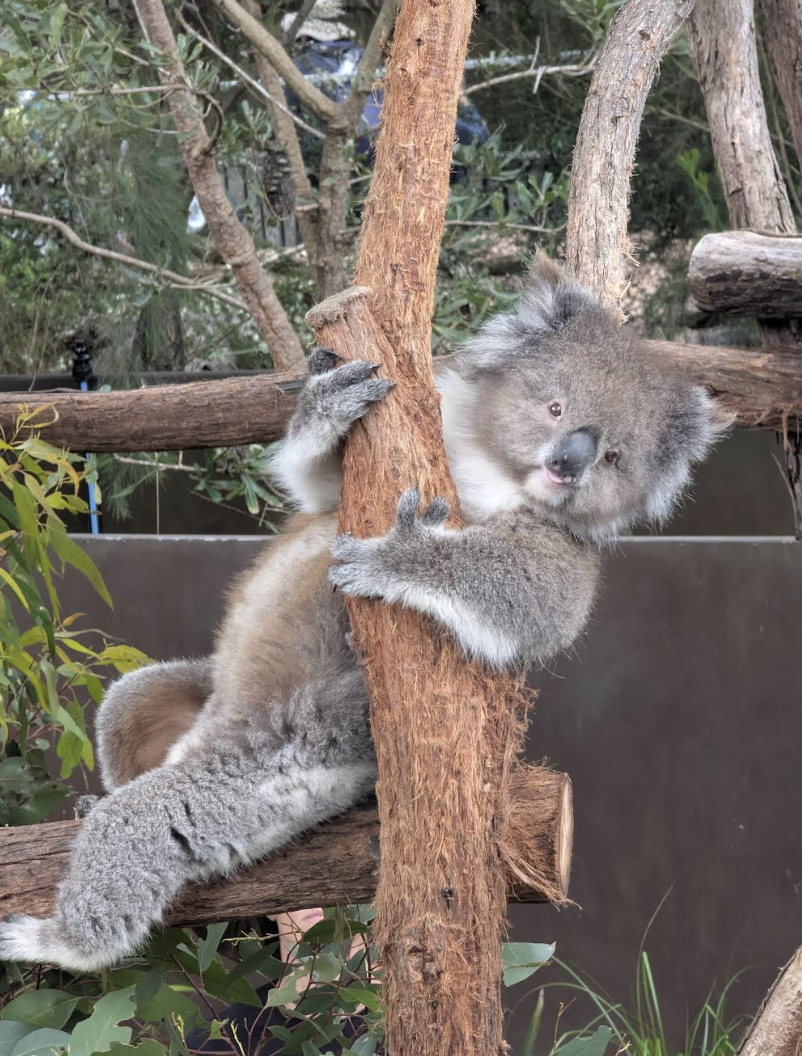
A koala just chillin’!

As for the latter, I found it hard to believe any relative of Taz would ever need rescuing – other than from Bugs Bunny, of course.

Injured “patients” in the animal hospital during our visit included a forest raven (injured in a dog attack), blue-tongued lizard (also bitten by a dog), collared sparrowhawk (hit by a car), and a tawny frogmouth that refused to tell the veterinary staff how it injured its wing.

Outside, in spacious ground habitats and soaring aviaries, we saw an array of other birds; a bare-nosed wombat, which looked like a giant guinea pig on steroids; and a large “mob” of forester kangaroos as tame and friendly as Labradoodles. The Labra’roos even ate kibble out of My Much Better Half’s palm and purred louder than contented house cats when I rubbed and scratched their down-soft chest fur.

A sign at the Tasmanian devil’s enclosure asked: “What does it look like? A dog, skunk, badger, wolverine, rat?” The lone T-devil in current residence refused to offer an answer by hiding in its den.

I did learn that Tasmanian devils are marsupials, but other than having a pouch share little in common with kangaroos. One unstated difference between them is that T-devils do not readily let humans pet their chests.

Also, while ’roos are herbivores, T-devils are scavengers – which is how many of them wind up at Bonorong, being hit by cars while dining on roadkill.

My Much Better Half had been especially keen on meeting a Tasmanian devil, so to drown her sorrows we ended the day at the Hobart Brewing Co. in a big ol’ red barn of a building on the historic railyard waterfront. No much to look at from outside, the craft brewery’s taproom and offerings inspired me to write in my travel journal: “Maybe my all-time favorite microbrewery! So charming – beers so good! Especially the Red Shed Red Ale!”

While we had sadly not seen a twirling, twisting, Taz-like Tasmanian devil, the generous flight of local beers made my head happily spin a little.

Two days later my head spun a new, now with irritation, when MMBH and I missed the boat – literally, due to bad luck – for a harbor tour of Melbourne. As sometimes wonderfully happens when traveling, Misfortune was soon revealed to be Serendipity in disguise.

Healsville Sanctuary, our substitute field trip, proved to be the Hobart Brewing Co. of wildlife reserves. We saw, up close, an armful of cuddly-looking koalas; a dingo, red as fox and handsome as any Best in Show champion at Westminster; a few emus, all tall as men; a duck-billed platypus…

…and a Tasmanian devil!

Resembling a bulldog, black with a flash of white on its muscular chest, albeit with a sharp snout, it scampered hither and dither as if excited to be off leash in a park. All the same, it fell short of my childlike expectations, for this “Taz” did not spin in a dervish blur like a figure skater, or grumble and drool and throw a funny tantrum.

* * *

Essay copyrights Woody Woodburn

Woody’s new novel “The Butterfly Tree” is now available in paperback and eBook at Amazon (click here), other online bookstores, and is orderable at all bookshops.

*

Woody writes a weekly column for The Ventura County Star and can be contacted at WoodyWriter@gmail.com. Follow him on Twitter and Instagram at @woodywoodburn.

Staying Upright Down Under

Woody’s award-winning novel “The Butterfly Tree” is available (signed copies) here on my home page and also (unsigned) at Amazon (click here), other online retailers, and is orderable at all bookshops.

*

On a morning so raw and rough the dolphins and whales sighted a day earlier off starboard of this cruise ship now decided to curl up in warm blankets and stay underwater safe from the bone-chilling wind, I went for a run.

To be honest, if I did not have a consecutive-day running streak dating back to July 7, 2003, I would have remained inside wrapped in a heavy wool blanket myself.

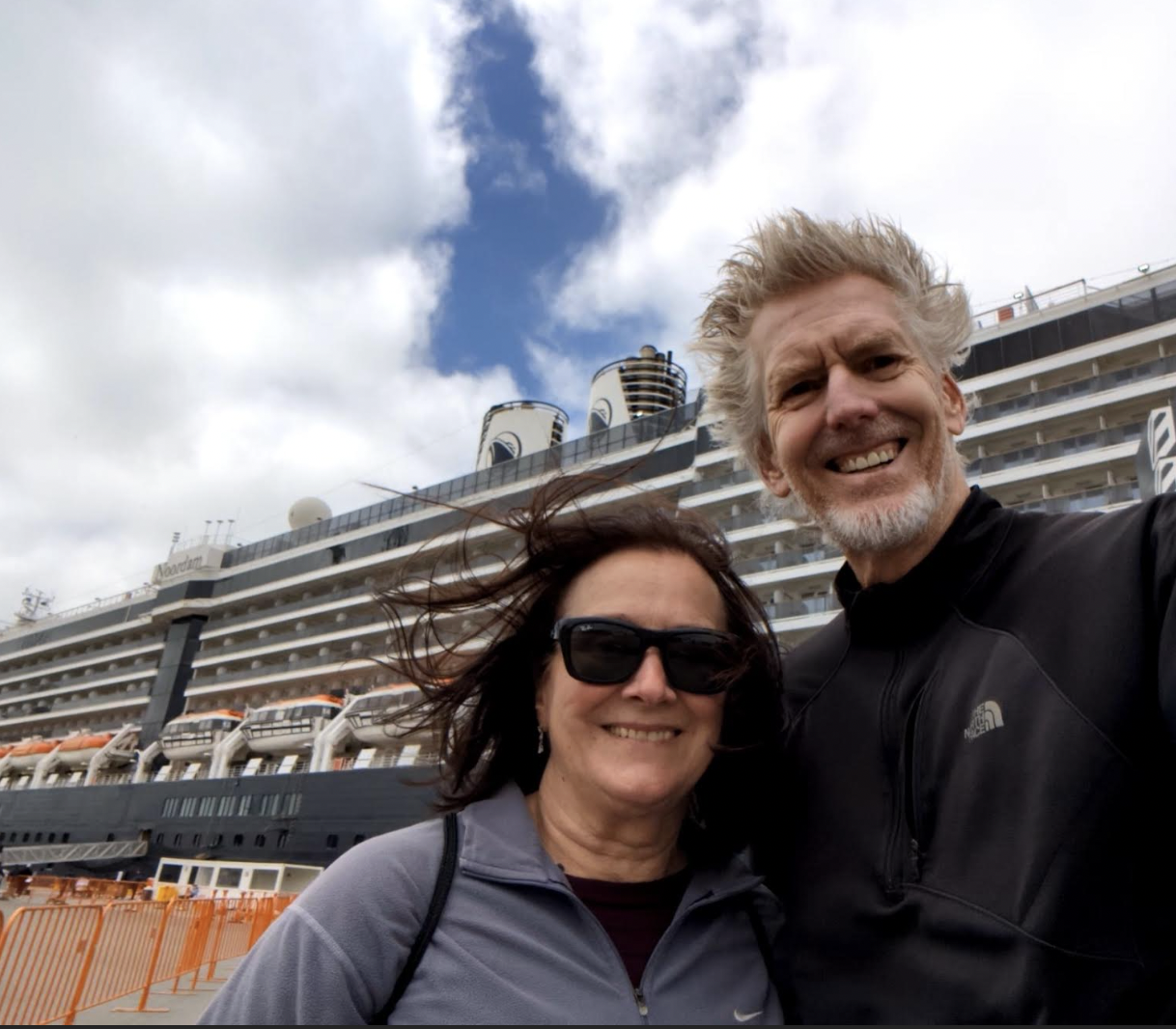
Instead, I was outside on the exercise deck of the “Noordam” traveling deep waters between Port Chalmers, New Zealand, and Perth, Australia. Winter still in America, it was late spring Down Under but the weather did not agree with the calendar.

While My Much Better Half showed she is also My Much Wiser Half by enjoying a massage with warmed lotions, I decided to brave the elements for thirteen miles as an antidote to the ship’s abundantly delicious food that can, just by looking at it, add five pounds.

The “Noordam” in port on a slightly nicer day…

The first few miles were not overly miserable but then, as if in time-lapse photography, the unfriendly weather become downright irascible — nasty and cold, windy and wet, with light raindrops that flew sideways and stung one’s face like acupuncture needles.

Meanwhile, the swells grew, Grew, GREW to between five and seven meters — fifteen to twenty feet!—according to the captain. The exercise deck remained open, surprisingly, as it began rising and dipping like a rollercoaster. These gargantuan undulations were accentuated at the bow and stern, making me feel either almost weightless or else experiencing extra G-forces on my legs.

I maintained my “sea legs” for the most part, but the highest crests and deepest troughs caused an occasional stagger as if I had had four Foster’s for breakfast.

While the frequent one-sixth-Earth’s-gravity-moonwalk-like-strides made the maritime run memorable, the best part was sharing the experience — and sharing hellos and a few high-fives; one woman reading in a deckchair shared a book recommendation, The Book of Goose — with a few other sunny-minded souls.

One fellow exerciser, despite standing slightly stooped, stood tallest in my estimation. In his eighties, I guessed, he was an inspiration for certain. Lap after lap (one time around the deck measured a full third of a mile, larger than a running track!) in weather fit only for a goose, he persisted for a full hour…

…using a walker!

His steps were minced greatly and his legs were bowed slightly, yet he somehow exuded the aura of an athlete. When I slowed down on one go-round to say “Hello, you’re awesome!” he took hold of my arm, lightly, introduced himself as Ichiro, loudly, and said he had once upon a time been a runner — “a sprinter, not a distance guy.”

Ichiro wore dark shabby sweatpants and a fisherman’s cable sweater of cream color, slide sandals with soggy socks, and a straw sunhat that I have no idea how he kept from blowing off. In my mind’s eye, I saw Hemingway’s Santiago in “The Old Man and the Sea.”

Charmed by Ichiro’s friendliness, I walked beside him for one length of the ship and This Old Man on the Sea wisely told me to appreciate being able to run even — no, especially — on days like this one because some day I will no longer be able to.

With that, and with a slight formal bow, he waved me away with the request to do an extra mile for him.

Thus my foul-weather run happily, and gratefully, became a fourteen-miler.

* * *

Essay copyrights Woody Woodburn

Woody’s new novel “The Butterfly Tree” is now available in paperback and eBook at Amazon (click here), other online bookstores, and is orderable at all bookshops.

*

Woody writes a weekly column for The Ventura County Star and can be contacted at WoodyWriter@gmail.com. Follow him on Twitter and Instagram at @woodywoodburn.