
Part 3: Tourist Site Less Traveled To

On a high summer’s day, I visited the Robert Frost Stone House Museum in Shaftsbury, Vermont.

This historic homestead is where Frost lived — and wrote — from 1920 to 1929. His poems penned here include “Nothing Gold Can Stay” and “Fire and Ice” and, in 1923, his first of four Pulitzer Prize-winning volumes, “New Hampshire.”

Serendipity smiled at me, and widely, when I mentioned to the docent, a friendly college-aged woman, that I had long ago been inspired to become a writer in no small measure by a university class focused fully on Mr. Frost. After I finished perusing the modest home-turned-museum, the docent presented me a surprise: a small treasure trove of artifacts, not kept on public display, she had retrieved from locked safekeeping.

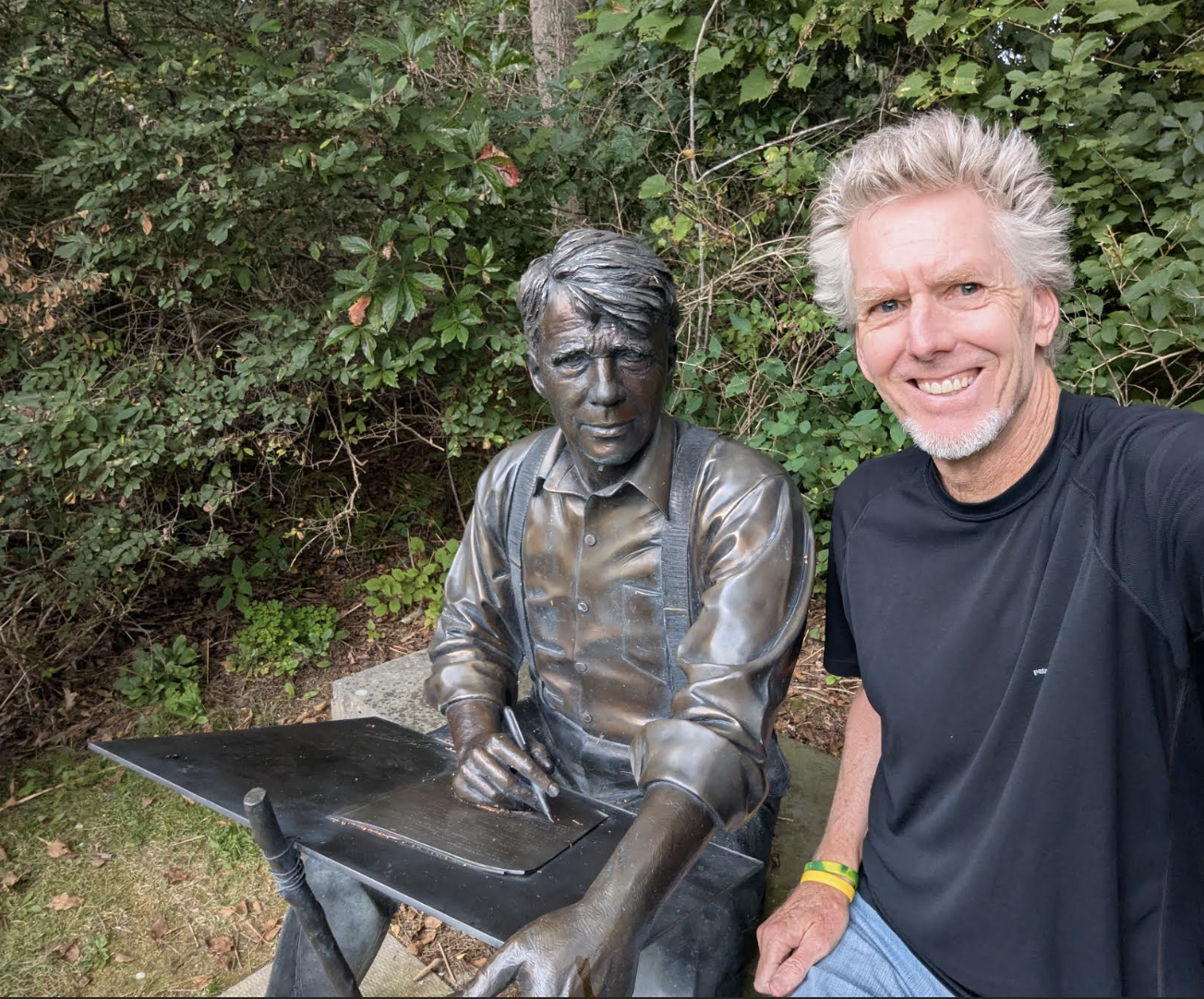
With Robert Frost’s likeness outside his Stone House in Shaftsbury, Vermont.

With her blessing I had the uncommon privilege of handling, carefully and with breath-held awe, a rare volume of “The Cow’s In The Corn: A One-Act Irish Play In Rhyme.” Thin as a thick pamphlet, with pages weathered at the edges, its age-worn hardcover features a geometric print of orange, yellow, and black squares and circles, sans any printed text of title or author.

As commonly advised, do not judge a book its cover. Inside, it is hand-numbered “66” out of only “ninety-one copies” and bears the poet’s signature, crisp and legible and flowing in dark pencil that remains unfaded.

Frost possessed a typewriter, naturally, but rarely used it other than to teach his children to type. He preferred to write by hand, in pencil, and so a one-page manuscript draft at the Stone House was magical to behold — in my mind’s eye I could see him writing and revising, crossing out and inserting, thinking anew and polishing.

Enchanting as this was, equally so was simply gazing out the dining room window and imagining my poet hero composing one of his best-known works, “Stopping by Woods on a Snowy Evening.” Surprisingly, Frost wrote this gem not on a vapor-breath snowy evening, but rather here on his dining table in the gleaming morning, chronicled as being a warm day in June 1922 — quite similar, very likely, to the sunny pre-noon hour of my wife Lisa’s and my August visit.

Something gold that will also stay in my memories happened as we were leaving. A quarter mile down the driveway, past a barn dating back to Frost’s time, near the homestead’s connection to Vermont Route 7A, a rural two-lane road, I spotted a simple black-and-white sign bolted to a weathered wooden post: Welcome To The Robert Frost Trail.

The signage was easy to miss; indeed, we had not seen it when driving in; and its location echoed Frost’s most famous poem, “A Road Not Taken.” Instead of two roads diverging, the gravel driveway and a freshly mowed trail — “Because it was grassy and wanted wear” one stanza states — parted.

Despite having gone for a long run at daybreak, I decided to give this grassy path some wear and went for a short impromptu jiggy-jog before we got back on the road driving.

The Robert Frost Trail passes through remnants of his old apple orchards and stands of red pines. As I traveled it, another line from “The Road Not Taken” resonated poignantly with me and still does today: “I doubted if I should ever come back.”

Though I doubt I will ever make it back to the Robert Frost Stone House, I remain grateful to have visited — and run where its namesake enjoyed taking long walks.

* * *

Essay copyrights Woody Woodburn

Woody’s new novel “The Butterfly Tree” is now available in paperback and eBook at Amazon (click here), other online bookstores, and is orderable at all bookshops.

*

Woody writes a weekly column for The Ventura County Star and can be contacted at WoodyWriter@gmail.com. Follow him on Twitter and Instagram at @woodywoodburn.

Part 2: Summer Day Filled With Frost

My visit of Emily Dickinson’s Homestead in Amherst, Massachusetts, was followed by a roadtrip to bookend homes of poetry — the Robert Frost Stone House Museum in Shaftsbury, Vermont in late morning, and then due east 140 miles to the Robert Frost Farm in Derry, New Hampshire that afternoon.

I shall begin at the endpoint, at the farmhouse, where Frost lived from 1900 to 1911. The drive there from the Stone House, with My Much Better Half in the passenger seat and Google Maps in her palm offering navigation, took a full three hours — and took us through big farmlands and small towns, over skeletal steel bridges and past a wooden covered bridge, a lovely antique in the modern world and a visual time machine back to Frosts’s period.

We traveled roads less taken than highways, narrow and winding and undulating, like a gentle pastoral rollercoaster almost. It was the best kind of drive, one where we were in no rush at all, in no traffic to speak of, just a Sunday ride enjoying the bucolic scenery. We would get there when we got there.

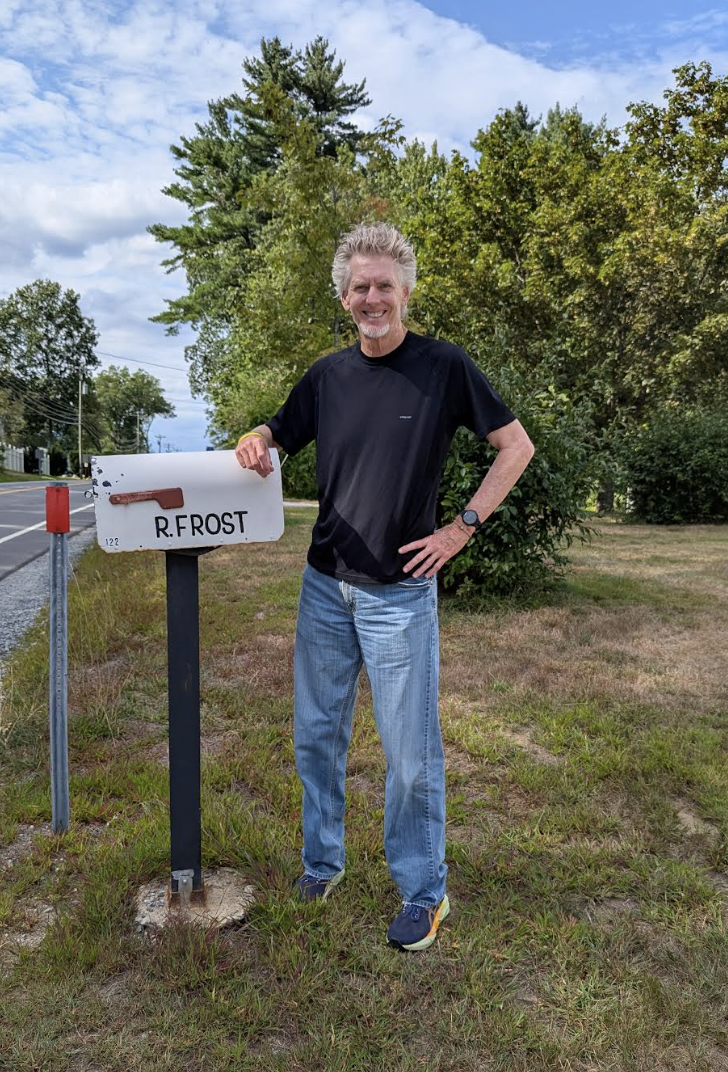
At the Robert Frost Farm in Derry, New Hampshire.

And so we looked out the rental car’s windows at sizable ponds and slow streams, at farmers working their fields and children at play in schoolyards, at cows and horses and signs warning of moose crossing the road.

Eventually, we came to an old tunnel-style steel mail box, painted white and mounted atop a wooden post set in cement two paces off the side of the tree-dotted rural route. On the side of the mailbox, just above the red flag noting outgoing mail that was not raised, were black letters, all caps, with no space between the initial and the last name: R.FROST

Beneath a faded-jeans sky patched with clouds, and bright with sunshine, we had arrived at the farmhouse of a man who was greatly unsuccessful at farming but did not fail at poetry, winning four(!) Pulitzer Prizes in 1924, 1931, 1937 and 1943.

Interestingly, Frost’s failure to sell some farm goods in town in Derry in order to buy Christmas presents for his children in 1905 on the winter solstice — “the darkest evening of the year” he later recalled in verse — caused him to halt his horse besides the woods, weeping, and was the real-life inspiration for “Stopping by Woods on a Snowy Evening.”

Remarkably, Frost did not write this masterwork poem until nearly two decades later, in Shaftsbury.

More remarkably, he did so on a July morning, looking out his Stone House dining room window at a snowless summertime landscape.

Most remarkably, he claimed to have composed it in one sitting.

Earlier on our summer day here, in the morning, I stood beside the dining room table where he composed that iambic tetrameter magic, my imagination wandering as I gazed out the same window.

Back to our afternoon in New Hampshire. In the farmhouse gift shop, a converted old barn that still smells authentic, I bought a thick volume of Frost’s poems. It is a nice book, although certainly no match for the slim, at just 20 pages, 1936 first edition of “From Snow To Snow” I already owned. While the latter’s cloth hardcover looks like it was once left outside through a snowy winter, the pristine title page bears a pencil signature, dark and clear, albeit a little shaky, in the author’s hand.

This prized volume, however, pales to the rare book I saw — and held — earlier in the day at Robert Frost’s Stone House, which I will share here next week.

* * *

Essay copyrights Woody Woodburn

Woody’s new novel “The Butterfly Tree” is now available in paperback and eBook at Amazon (click here), other online bookstores, and is orderable at all bookshops.

*

Woody writes a weekly column for The Ventura County Star and can be contacted at WoodyWriter@gmail.com. Follow him on Twitter and Instagram at @woodywoodburn.
Part 1: Poetic Addition to a Collection 

My family tree bears a Dickinson lineage, three generations before me, but tracing these roots deeper has, to my great disappointment, unearthed no direct kinship to the famous poet Emily.

No matter, it was still a thrill not long ago to visit my non-relative’s relatively regal residence in Amherst, Massachusetts.

To see where Emily Dickinson penned such celebrated poems as “Hope Is the Thing with Feathers” was indeed a feather in my cap because in the fashion some people accumulate national park roadtrips, or collect rare comic books or vintage wines or special antiques, I collect pilgrimages to the homes of rare, vintage, special writers.

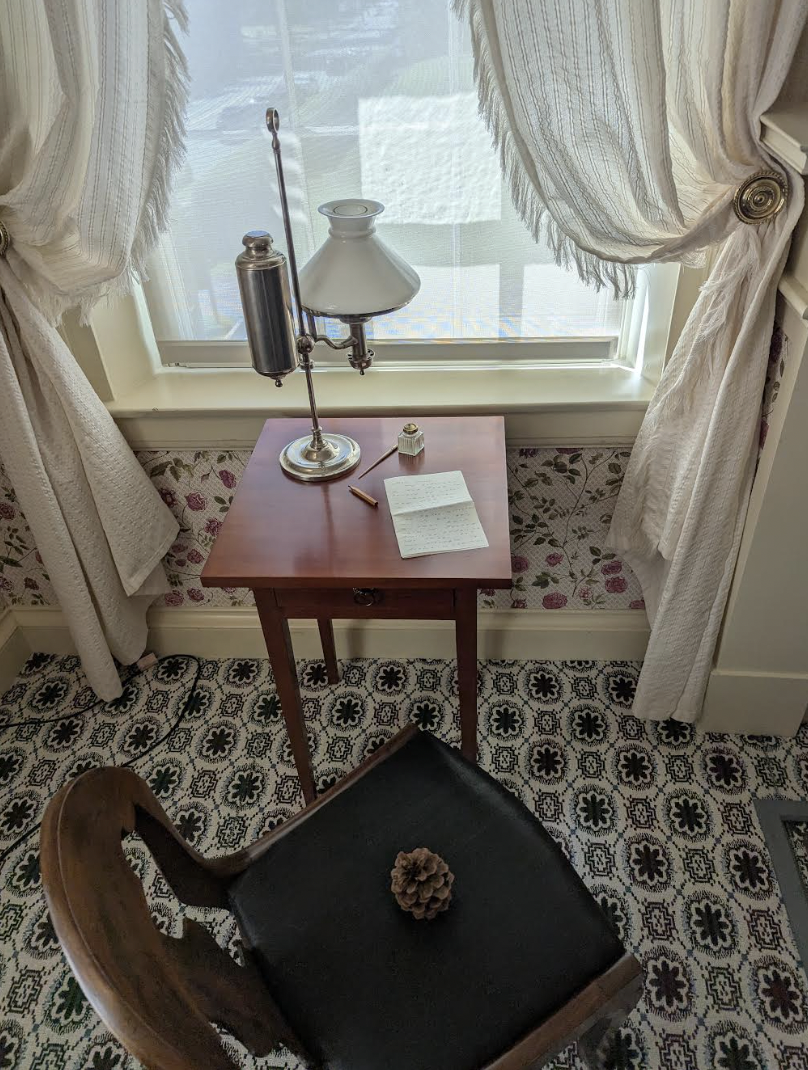
The tiny desk where big poetry magic happened.

My literary wine cellar, so to speak, includes modest to mansion quarters of: Mark Twain, Ernest Hemingway, John Steinbeck (New York and California), John Muir (California and Scotland), Robert Frost (Vermont and New Hampshire), Robert Louis Stevenson, Harriet Beecher Stowe, Henry Wadsworth Longfellow, Charles Dickens, Tennessee Williams, William Faulkner, Edgar Allen Poe, Eugene O’Neill, Thornton W. Burgess, Ralph Waldo Emerson, and Henry David Thoreau.

My novel pursuit brought me most recently to “The Homestead” at 280 Main Street; to a three-story brick house, buttery yellow in color with forest-green shutters on every window, and there are many, with a grand porch and elegant portico at the front entrance; to where Emily Elizabeth Dickinson was born in the winter of 1830, where she grew up and remained and wrote most of her 1,789 lifetime poems, and where she died 140 springs ago.

The three-acre estate, once totaling 14 acres and now a recognized historical landmark, is breathtakingly bucolic. A towering white oak, planted by Emily’s grandfather and today lovely as a poem, holds sentinel near the main residence.

The postcard scene is further decorated with maples and pines, elms and chestnuts, as well as fruit trees of apple, cherry, plum, and pear. Too, importantly, there is a garden in the side yard that still grows vegetables and, pleasingly, pink roses that match the wallpaper in Emily’s bedroom.

It was in this garden that many of Dickinson’s poem sprouted as notes, initially scribbled in pencil on scraps of paper, both of which she always kept in her dress pockets so as to never be without when inspiration blossomed.

Later, in her bedroom, she would would cull lines and thoughts from these jottings and compose polished poems, in ink, on legal stationery purloined from her father’s downstairs study.

This second-floor sanctuary, in the southwest corner at the back of the house, was the highlight of the tour. Specifically, just beyond the foot of the sleigh bed, to the left of a small fireplace, directly below a white-curtained window overlooking the backyard: a tiny table, only eighteen inches square, and side chair.

This is where the writing magic happened, often by candlelight or illumination from an oil lamp, long after the rest of the household was asleep.

To see Emily’s nib pen and glass inkwell resting on the cherrywood tabletop was to see, as I have, Steinbeck’s favored pencils or Hemingway’s Royal typewriter, and set my imagination flying free as if with feathered wings from her poem about Hope.

Outside on a gorgeous summer day, our guide Brenda, who had already recited a dozen Dickinson poems in full, bid me goodbye with one more: “There Is Another Sky” with 14 lines that include these two: “Here is a brighter garden, / Where not a frost has been.”

Next on my itinerary, coincidentally, was a homestead where Frost — Robert — long ago had been, and which I will share next week.

* * *

Essay copyrights Woody Woodburn

Woody’s new novel “The Butterfly Tree” is now available in paperback and eBook at Amazon (click here), other online bookstores, and is orderable at all bookshops.

*

Woody writes a weekly column for The Ventura County Star and can be contacted at WoodyWriter@gmail.com. Follow him on Twitter and Instagram at @woodywoodburn.
Cleaning Up Wayne’s World Daily

In a spirited game of Monopoly or gin rummy or lawn croquet, my lifelong friend Wayne Bryan can be a playful trash talker.

He is also a serious trash walker.

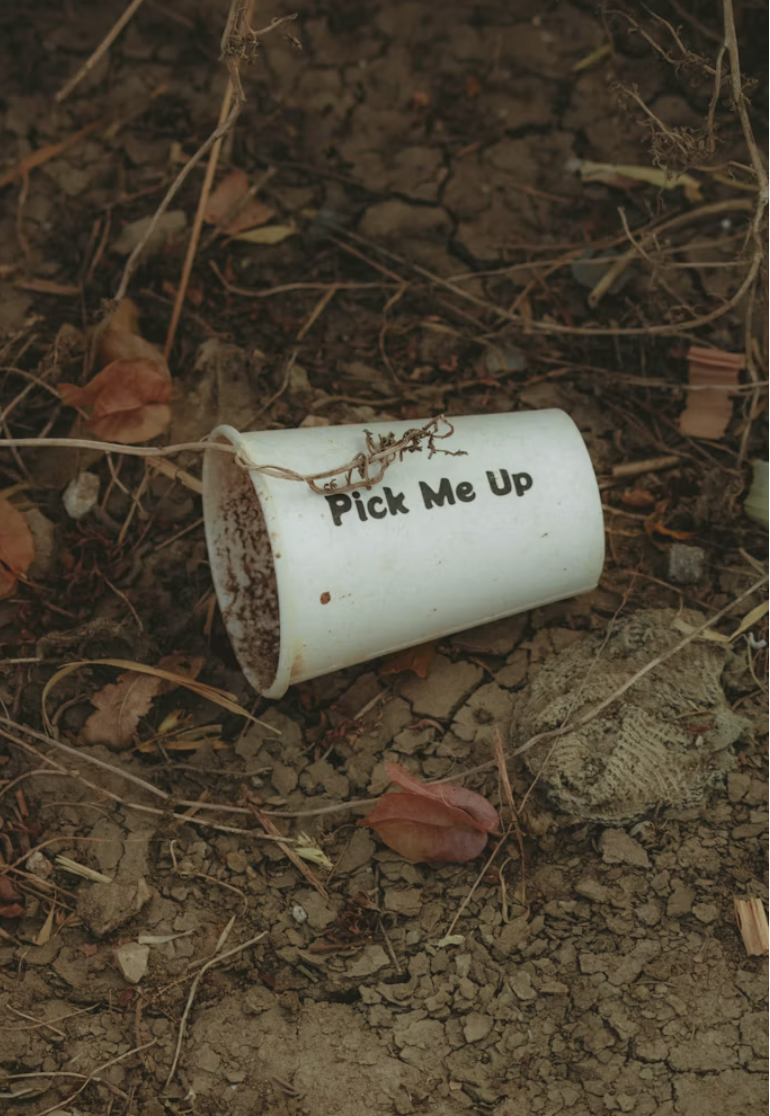
That is to say, during his brisk daily morning strolls for exercise through his Camarillo neighborhood he picks up litter. He also pulls weeds and sometimes prunes bushes, and when larger items of junk and discarded furniture sadly, but routinely, materialize on his route he loads them into a truck and hauls them off to the dump on his own dime.

It is a Sisyphean task, but the end result is Wayne’s World is as pristine as Disneyland’s Main Street USA.

“I take pride in keeping a three-mile stretch clean and litter-free,” Wayne says. “I hate to see trash or graffiti or weeds or even trees that need pruning. It actually makes me jump out of bed each morning at six o’clock to get out there and make things look better.”

Armed with a “grabber” — pinchers on the end of a stick — and high-octane vigor, Wayne estimates over the past year alone he has filled more than 100 lawn-sized plastic bags with trash as well as green waste.

A week ago, he ventured beyond his usual adopted roadway and supercharged his efforts by tackling a two-mile stretch of a busy city street, including the median between lanes, that had become a blight that saddened him whenever he drove by.

Five days in a row he jumped out of bed at sunrise and spent the next three hours in a dual role of volunteer garbage collector and gardener. By week’s end 15 hours of solo labors had filled 13 large bags with trash and litter, weeds and brush — and an eyesore, thanks to Wayne’s sore back, is now a sight to make eyes happy.

Hercules cleaning the Augean stables was no more impressive, especially when you consider the Greek hero was in his twenties when he undertook his famous 12 Labors while Wayne turned 79 earlier this summer.

“Picking up orange peels,” as John Wooden referred to his similar habit of cleaning up litter on his morning walks, has long been a labor of love for Wayne. His twin sons Mike and Bob even mentioned this during their induction ceremony into the International Tennis Hall of Fame last summer, sharing with the audience: “Each day when we made that seven-minute drive to the Cabrillo Racquet Club, if our dad ever saw a piece of trash on the side of the road he’d pull the car over and we’d jump out and pick it up. He’d often say to us, ‘Always leave the campsite cleaner than you found it.’ ”

Going even further back than Mike and Bob’s childhood, I take you to my own. In the 1970s, we young tennis players enthusiastically raced around the Cabrillo Racquet Club grounds after Saturday morning clinics frantically picking up discarded paper cups, cans, and wrappers as if we were hunting Easter eggs because Coach Wayne made it a fun competition.

Wayne would like to revive that spirit today in grand fashion.

“I dream of every school class in America having an annual kids’ trash pick-up day with a three-hour effort in their community,” he says. “Pick up trash. Or pull weeds. Or plant trees. Or paint over graffiti. Or all four! Get all their parents helping, too!”

Wayne added a plea to me: “Help me get the idea out there!”

And so I shall: Local schools, are you up to the challenge?

* * *

Essay copyrights Woody Woodburn

Woody’s new novel “The Butterfly Tree” is now available in paperback and eBook at Amazon (click here), other online bookstores, and is orderable at all bookshops.

*

Woody writes a weekly column for The Ventura County Star and can be contacted at WoodyWriter@gmail.com. Follow him on Twitter and Instagram at @woodywoodburn.
On 25th Anniversary of 9/11, Some Reflecting

In remembrance of today’s 25th anniversary of 9/11, here is my column that originally ran in 2015 following a road trip up and down the Eastern Seaboard…

*

The Smiling Pool from a series of children’s books by Thornton Burgess is aptly named because its curved shape, when viewed from atop an overlooking hill – as Burgess did often during his boyhood in East Sandwich, Massachusetts – resembles a smile.

Indeed, it remains a happy place to sojourn as I learned during my recent tour of his home-turned-museum.

My emotions were completely polar at the next pool of water I visited. Actually, pools plural: the twin reflecting pools at the National September 11 Memorial in lower Manhattan. The Crying Pools seems apropos.

Each reflecting pool is nearly an acre square and situated on the footprints where the Twin Towers once majestically stood. Water pours over all four edges of each pool at a rate of 3,000 gallons per minute, forming waterfall curtains, before disappearing down a small square abyss at the bottom.

The symbolism of the flow rate is heartrending because nearly 3,000 lives disappeared in the terrorist attacks of Sept. 11, 2001 and Feb. 26, 1993. The victims’ names are inscribed on bronze panels on the parapets surrounding the pools. Visitors’ eyes, in turn, often become miniature reflecting pools overflowing with tears.

This was my first return to the site since Tuesday, June 11, 2002 (I still have my “WTC:00 Viewing Platform – 2:00-2:30 pm” ticket), nine months to the day after the World Trade Center became Ground Zero.

I remember very little from those 2002 NBA Finals I covered, other than the Los Angeles Lakers played the New Jersey Nets. But the sight of the steep-sided square hole in the ground remains unforgettable. It looked like a gargantuan grave.

Inside the completed 9/11 Memorial Museum the somberness is even more overwhelming than at the twin reflecting pools. Boxes of tissues are placed liberally throughout and empty quickly. My wife teared up within the first two minutes of entering the exhibition; I did so even sooner.

To tour the museum once is a must, I believe; I believe also I could not bear to do so again.

To describe the experience would require a dozen columns. Instead, I will share a single image that most profoundly punched me in the soul. It is the transcript of a phone call from Brian Sweeney, a 38-year-old passenger aboard United Airlines Flight 175, to his wife. Julie was not home, so he left his last words on their answering machine:

“Jules, this is Brian. Listen, I’m on an airplane that’s been hijacked. If things don’t go well, and it’s not looking good, I just want you to know I absolutely love you. I want you to do good. Go have a good time. Same to my parents and everybody. And I just totally love you and I’ll see you when you get there. Bye, babe. I’ll try to call you.”

At 9:03 a.m. the plane crashed into the South Tower.

My trip of the Eastern Seaboard had earlier taken on an “author” theme with Ralph Waldo Emerson, Henry David Thoreau, Louisa May Alcott, Nathaniel Hawthorne, and Thornton W. Burgess playing roles.

However, I believe Brian Sweeney’s words – composed with no time for writer’s block, no chance to revise and edit and polish – are as potent and poignant as any left behind by the above literary masters.

After telling my son, whom I was visiting, to “do good” and have “a good time” and that I “absolutely love” him, I hugged him goodbye while blinking repeatedly to keep my twin reflecting pools from overflowing, and boarded a jetliner so similar –and so polar – to the one Brian Sweeney took.

* * *

Essay copyrights Woody Woodburn

Woody’s new novel “The Butterfly Tree” is now available in paperback and eBook at Amazon (click here), other online bookstores, and is orderable at all bookshops.

*

Woody writes a weekly column for The Ventura County Star and can be contacted at WoodyWriter@gmail.com. Follow him on Twitter and Instagram at @woodywoodburn.

Rivers Run Through Him

“What really knocks me out,” Holden Caulfield, the narrator in “The Catcher in the Rye,” says, “is a book that, when you’re all done reading it, you wish the author that wrote it was a terrific friend of yours and you could call him up on the phone whenever you felt like it.”

That perfectly sums up how I felt when Roger W. Thompson’s debut book “My Best Friend’s Funeral,” a coming-of-age memoir, came out a dozen years ago.

As luck would have it, the author lives in Ventura and so instead of making a phone call, for I had never met him, I attended one of his book signings and asked if he wanted to get a beer sometime.

To my great luck, he did.

To my greater luck, we hit it off like trout and mountain streams and ever since have enjoyed “Beer Thirty” (to use Roger’s term) happy hours because (to use my late mom’s reasoning about why weddings should commence on the half-hour) time slows down when the minute hand is sweeping uphill.

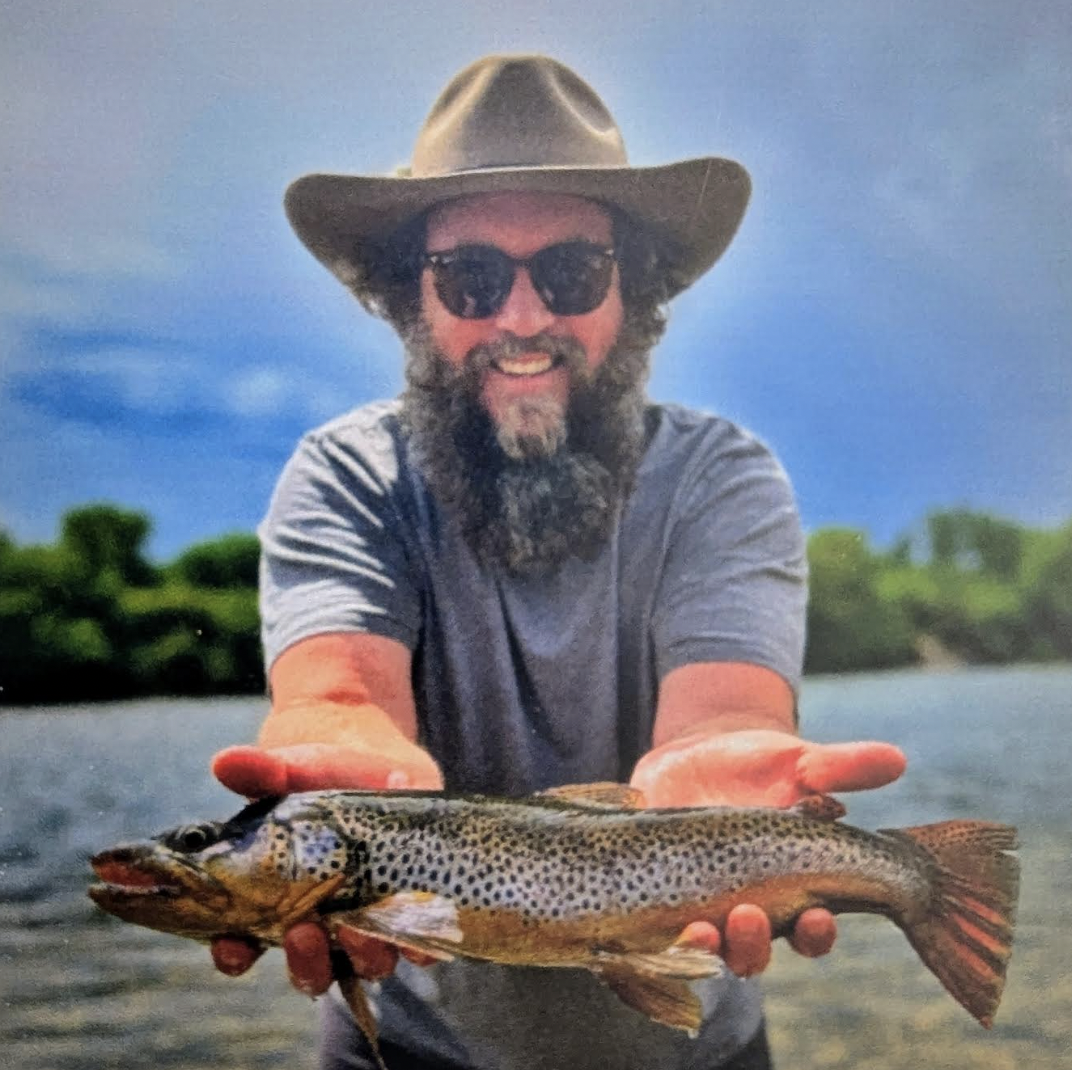
Author Roger Thompson at play…

Roger’s second book, a travel memoir titled “We Stood Upon Stars,” made me fall further in love with his elegant prose that makes time seem to slow down as you savor the rhythm and cadence of his sentences that flow like burbling brooks, with eddies here and gentle riffles there, bends and pools elsewhere and hidden beauty and depth beneath the surface.

The above description of Roger’s writing came to me while reading his brand-new book, “The Wisdom of Rivers: Family, Friendship, and the Fly-Fishing Life,” that once again knocked me out.

I am therefore thrilled to be moderating a public conversation and Q & A with Roger at his book launch signing this Tuesday, September 8, from 6 to 8 p.m., at Iron & Resin at 324 E. Main Street in Downtown Ventura.

Norman Maclean’s masterwork “A River Runs Through It” has long been my favorite fishing-themed book, but it now shares top-shelf billing with “The Wisdom of the River.” With both the former novella and the latter memoir, one need not be a fly fisherman-or-woman to be hooked and enthralled.

More than about fishing, “The Wisdom of the River” is about Friendships, Fatherhood, Love, and Faith — these being the four tributaries this hardback gem forks into. Each section features a handful of themed essays, all of which carry faint echoes of Henry David Thoreau and John Muir, and prove the truth of this line by the Muir-bearded Thompson: “In every good fisherman, there is a better storyteller.”

A tall accomplishment considering Roger, a zealous angler since boyhood, has trout streams coursing through his veins.

“Our lives are filled with more important things than fishing,” Roger writes. “Sometimes, it take fishing to figure out what they are.”

“The Wisdom of the River” is filled with important things.

“What began as mine is now ours,” Roger further shares, speaking about teaching his wife, Melissa, and sons, Austin and Hayden, to fly fish. But this Angling Apostle is also talking to all of us who read his poetic prose and vicariously join him on a fishing (and life) journey by turning these pages — “Book Thirty” pages, because they are best read starting on the half-hour so they pass by more slowly.

Yes, what began as Rog’s writing is now ours to relish.

Me, I am doubly blessed because I get to have 16-ounce conversations whenever I feel like it with my terrific friend who wrote this knockout book.

* * *

Essay copyrights Woody Woodburn

Woody’s new novel “The Butterfly Tree” is now available in paperback and eBook at Amazon (click here), other online bookstores, and is orderable at all bookshops.

*

Woody writes a weekly column for The Ventura County Star and can be contacted at WoodyWriter@gmail.com. Follow him on Twitter and Instagram at @woodywoodburn.

Polar Outcomes For Two Friends

Bookend stories about two friends of mine, former colleagues both, one ends in heartbreak and the other with a mended heart.

Let me begin with tears, but in doing so lead with a laugh.

Sitting in a press box alongside Stu Mathews, a gifted sportswriter for The Star for seven years in the 1990s, was like being in a comedy club on Open Mic Nite. His quirky humor routinely put me in stitches.

Of a million quips, this one stands out in my mind. It was in the newsroom and a know-it-all editor started pontificating about polar bears, describing their VW bus-like size and Bowie-knife claws and ten-mile sense of smell. He concluded his impromptu lecture by saying polar bears can charge “faster than a racehorse at 50 mph!” or some such made-up speed. (In truth, thoroughbreds top out at around 40 mph; polar bears at about 25 mph — I just looked it up.)

Stu, from across the room, asked deadpan: “Is that running on ice? Or tundra?”

That was more than a quarter of a century ago, and for the past 20 years rarely did I have an exchange with Stu — in person, phone, text — when one of us, or both, did not find a way to slip “ice or tundra?” into the conversation.

Now I have no one to share the inside joke with: Stuart Glenn Matthews died on June 22, far too young having just turned 62, after a five-year war with cancer.

When he was first diagnosed, Stu told me with the same sure confidence he displayed at the keyboard: “I’m going to beat it.”

It wasn’t a fair fight: Oral cancer, a stage IV tumor in his jaw, required a 12-hour operation to remove. The surgeons thought they got all of it, but the margins were “razor-thin” so six weeks of torturous radiation therapy followed.

The cancer eventually came back, as the heinous beast is wont to do, this time in his throat.

“I want to fight it bravely,” Stu texted me, sounding like Hemingway, whom he loved, and brave he was to the very end.

Six days before Stu passed away, our shared friend Ed Zintel very nearly died — and would have had a TV episode of “Baywatch” not played out in real life.

On June 16, on a sunny day on Strand Beach in Dana Point, Ed — a splendid sportswriter for The Star for five years through 2000 — suffered sudden cardiac arrest, at age 71, and collapsed unconscious in the parking lot.

Some might say a guardian angel was watching over him, but Ed thinks otherwise: he says five were. First, a woman who drives a shuttle golf cart transporting people to and from the beach, spotted Ed and administered CPR.

In a second godwink, two Orange County Park Rangers happened to be working nearby and rushed over with an Automated External Defibrillator — two separate shocks to Ed’s chest failed, but the third try restored a heartbeat.

Next, two firefighters arrived at the scene minutes after receiving a 911 call. They assisted the Park Rangers in stabilizing Ed and cared for him on the drive to the hospital.

Amazingly, remarkably, blessedly, Ed, now with a defibrillator/pacemaker, was discharged from the hospital after 10 days.

Against all odds, he has already attended a Dodgers home game and will soon make a road trip to see them play the Giants in San Francisco.

“It’s a wonderful life,” Ed says, adding knowingly, “especially when you get a second chance at it.”

* * *

Essay copyrights Woody Woodburn

Woody’s new novel “The Butterfly Tree” is now available in paperback and eBook at Amazon (click here), other online bookstores, and is orderable at all bookshops.

*

Woody writes a weekly column for The Ventura County Star and can be contacted at WoodyWriter@gmail.com. Follow him on Twitter and Instagram at @woodywoodburn.
Private Sector Use For GLOVEs

In “What could go wrong?” news, it has been reported that Immigration and Customs Enforcement plans to spend up to $20 million to equip ICE officers with electrified patrol gloves that are cleverly, or sadistically, named Generated Low Output Voltage Emitters — GLOVE, get it?

Those who do get it, literally, will receive a painful shock designed to force submission without leaving physical marks, nor bodily evidence of misuse. Indeed, What can can wrong?

An outcry has risen to ban GLOVEs, but I favor limited use in the private sector. For example, equip school librarians with GLOVEs so they can gently place a hand on the shoulders of parents who raise a ruckus to ban books: “Shhhhhh, now. I’m sorry for your discomfort, but books never hurt anyone.”

As for teachers, these are not “kid gloves” as the manufacturer expressly warns that the GLOVE should not be used on children — however, parents who become threatening would seem fair game.

Anyone who must shake hands with That Guy (and we have all met one, unfortunately, often a businessman who is louder than his neck tie; or an annoying uncle; or a former frat boy with an ego larger than his true golf handicap which he has officially made smaller by cheating) Who Turns A Handshake Into A Feat Of Trying To Prove His Alpha Masculinity By Squeezing Your Hand Hard(!) While Grinding Your Knuckles Until You Wince, can turn the tables with a GLOVE and make him cry uncle first.

In a twist from the 1920s, fashionably dressed (or even casually attired) women in 2026 should henceforth start routinely wearing GLOVEs — if her date gets a little handsy, she can elegantly place a hand on his cheek with an electrified caress that surpasses a slap by delivering the kick of a mule.

The sports world definitely can use new GLOVEs. For example, when an obnoxious fan gets truly unruly, or outbattles a kid for a foul ball, how better to handle the situation than with an electrified high-five!

In soccer, the epidemic of flopping and diving when a foul never happened can be eliminated overnight by giving referees a GLOVE and marching orders to lend a helping hand up off the ground to every cleated Shakespearean performer.

A special baseball GLOVE — MITT: Mighty Irritating Timing Tool (trademark pending) — will put an end to extended replay challenges. With electrified MITTs, a baserunner’s twitching body will make it obvious the precise instant he is tagged. Or, no twitch: “Safe!”

The GLOVE will be ideal for restaurant waitstaff when a drunk (or sober) patron gets out of hand or overly flirtatious with a touching hand. Recommended voltage: 15 to 20 percent. As for annoying customers who order a steak cooked rare and then complain because it is pink inside, servers can simply dial up the GLOVE’s intensity, place three fingers on the beef and zap it to “well done” right at the table.

Constituents at town hall meetings will be allowed to “take the gloves off” by putting GLOVEs on to shake hands with any elected official who dodges their questions or flat-out lies.

Walkers and runners will certainly love the GLOVE. When an off-leash dog rushes at them, an electrified hand can safely defuse the situation — not by “petting” the unleashed dog into submission, for the animal is not to blame; rather, by zapping the irresponsible dog owner for not controlling their pet.

Ditto, except with the voltage set to “medium well,” for any dog owner who fails to pick up after Fido does his business.

* * *

Essay copyrights Woody Woodburn

Woody’s new novel “The Butterfly Tree” is now available in paperback and eBook at Amazon (click here), other online bookstores, and is orderable at all bookshops.

*

Woody writes a weekly column for The Ventura County Star and can be contacted at WoodyWriter@gmail.com. Follow him on Twitter and Instagram at @woodywoodburn.

Small Voices, Big Performance

The first concert I ever attended, in my teens half a century ago to see Fleetwood Mac at the height of their superstardom in an outdoor stadium in Southern California, remains perhaps my most memorable — but not because it was a fantastic show.

Rather, it was unforgettable because they did not put on a show at all thanks to a windy landslide-powerful storm that blew in shortly before the band was to take the stage, forcing a literal rain-check cancelation.

Another concert, a few years later, also remains unforgettable — also for an unfortunate reason. Held inside Inglewood’s Fabulous Forum, safe from an unfabulous rainout, my buddies and I arrived very early and decided to stay in our car in the parking lot and listen to the album “Tommy” instead of going in to see the who-are-they band that was opening for The Who.

We timed things perfectly and found our seats during The Who’s opening song.

Or so we thought.

After the electrifying concert ended, including a handful of encores, Keven, George and I grumbled our surprise and disappointment that they hadn’t played “Baba O’Riley — to which a fan next to us told we three tardy idiots, “They opened with it and it was amazing!”

Vowing “Won’t Get Fooled Again,” I have been fortunate to see some other memorable concerts, all without missing the opening song, including Paul McCartney, James Taylor a few times, Tom Petty, and, yes, Fleetwood Mac under a roof, to name a fab four of my favorites.

Big names are wonderful, but to my concert honor roll I added a new performance last weekend by the small attendees of the annual Crescendo Summer Music Camp. Their hour-long songfest, held in the Camarillo United Methodist Church, was nothing short of magical.

Magical does not mean flawless, for herding two dozen kindergarteners and first-graders onstage and into proper alignment is bound to have a lost sheep or two, so to speak, that needs a shepherd to guide it home.

Expectedly, not every note was sung in key, nor every dance step executed in sync — or even executed at all. Too, the sixth- and seventh-grade handbells symphony, under the expert direction of camp co-director Kristi VanKeersbilck, occasionally rang notes a fraction early, or late — but every note was struck with visible joy on the bellringers’ faces.

And that was the real magic of the concert — the joy on the faces of the 98 young performers and their eight music teachers’ countenances as well. Joy being highly contagious, the packed pews were also filled with the sunbeam smiles of siblings, parents, and grandparents, including my wife and me to watch our 7-year-old granddaughter Maya sing “I Am a Pizza” with laughter in her eyes and “You Are My Sunshine” with welling moisture in ours.

Another highlight was “Do Re Mi” sung by second- and third-graders, their rendition rivaling the Trapp children’s in my opinion.

Similarly, “The Lion Sleeps Tonight” was a roaring success and Prince’s “1999” was royally good; Michael Jackson, Justin Bieber, and Earth Wind and Fire songs were also well worthy of applause.

But my favorite performance, most assuredly, was the finale. Under the guidance of co-camp director Connie Halpern (belovedly know as “Mrs. Fig,” who used to own The Bookworm bookstore in Camarillo), the Crescendo Campers took the stage en masse, spilling into the wings on either side, and sang — and signed with their hands — “Heal the World.”

Unlike “Baba O’Riley,” I would not have missed it for the world.

* * *

Essay copyrights Woody Woodburn

Woody’s new novel “The Butterfly Tree” is now available in paperback and eBook at Amazon (click here), other online bookstores, and is orderable at all bookshops.

*

Woody writes a weekly column for The Ventura County Star and can be contacted at WoodyWriter@gmail.com. Follow him on Twitter and Instagram at @woodywoodburn.

Mourning Beloved Irish Musical Poet

Irish poet-singer-songwriter Glen Hansard died last week, tragically and far too young at age 56, leaving behind a wife and three-year-old son. As evidenced by the viral outpouring of grief on social media, he also left behind more fans worldwide than he could have possibly known he had — including me.

My son first introduced me to Hansard’s indie-folk music 20 years ago, and my daughter and I had a truly masterpiece evening together at one of his concerts last October, as shared in this column from my archives…

*

Sometimes, rare wonderful times, when everything seems to be going wrong it somehow all turns out wonderfully. Such was the case the other evening when a young child cried and technology pouted and traffic threw a tantrum – and serendipity just kept smiling over and again, and once more.

Ever since she was a toddler my daughter and I have gone on “Daddy Dates,” as she called them then, and still does, because to my great fortune she has not outgrown these special outings, just the two of us, even though she is now well into her thirties.

In one of my favorite photographs, Dallas, maybe 5 years old, wears a sunflower dress and holds a bouquet to match, and I am in a “tuxedo” which is what she called the sport coat she requested I wear. I, in turn, requested that when she was older if a boy did not open car doors and pull out her chair, she not give him another date.

Naturally, when she and I went to a concert in San Francisco’s Masonic Auditorium recently I opened doors and helped her into her seat because I do not want to be unworthy of future Daddy Dates.

This date almost ended before it even began because a tearful two-year-old did not want her mommy to leave. A delay that would surely make us late should have been frustrating, but instead it was actually a joy to watch my daughter soothe her own daughter with love and patience.

Heavy traffic, followed by a serpentine security line, then a brief snafu with our online tickets all conspired to make us miss the opening song. And yet, somehow, we made it to our seats literally five seconds before the house lights went down and the music rose up. It was as if serendipity winked and asked The Swell Season to wait specifically for us.

As for our seats, a birthday gift from my son, they were terrific: floor level, slightly left of the stage, and so close we could see Markéta Irglová’s fingers dancing – gently sometimes, other times frenetically and mesmerizingly, always seemingly perfectly – on the piano keys.

Similarly, the skill and passion of Glen Hansard strumming his acoustic guitar with speed and fury was a thrill to behold and explains the comet-shaped gash worn through its face just below the sound hole.

The Swell Season sang familiar old hits from the movie “Once” and new gems from their 2025 album “Forward,” but the highlight was the final encore, an acoustic rendition, sans microphones, with the ginger-and-grey-bearded Hansard magnetically leading 4,000 patrons in a goose-bumps beautiful sing-along of the classic American folk song “Passing Through” popularized long ago by Pete Seeger.

Joining in I was 11 again, transported back to elementary school when my beloved fifth-grade teacher Mr. Hawkins played guitar for sing-alongs.

Walking the city aimlessly after the concert, Dallas and I happened upon 608 Bush Street and serendipity smiled once more with a California Historical Society commemorative plaque noting that Robert Louis Stevenson, the great Scottish writer who penned “Treasure Island” and “Strange Case of Dr. Jekyll and Mr. Hyde,” briefly lived and wrote here in 1879 and 1880.

Our Jekyll-and-Hyde evening continued on the drive home with freeway traffic wheezing along as congested as lungs with pneumonia. Yet this, too, proved to be a silver lining because it wonderfully extended our time together.

Naturally, I walked my date to her front door – but there was no need to apologize to her father for missing curfew.

* * *

Essay copyrights Woody Woodburn

Woody’s new novel “The Butterfly Tree” is now available in paperback and eBook at Amazon (click here), other online bookstores, and is orderable at all bookshops.

*

Woody writes a weekly column for The Ventura County Star and can be contacted at WoodyWriter@gmail.com. Follow him on Twitter and Instagram at @woodywoodburn.