‘Psychedelic Snowfall’ Of Butterflies

Woody’s award-winning novel “The Butterfly Tree” is available at Amazon (click here), other online retailers, and orderable at all bookshops.

* * *
In honor of the “Books, Butterflies & Botanical Gardens” fundraiser benefiting the Ventura County Library Foundation on Sunday, October 19, this column from my archives seems apropos to share anew…

*

In “A Moveable Feast,” a memoir of his halcyon days – and nights – in Paris in the 1920s, Ernest Hemingway wrote of F. Scott Fitzgerald: “His talent was as natural as the pattern that was made by the dust of a butterfly’s wings.”

A key reason for my traveling to Key West on vacation was to visit The Hemingway Home & Museum in Old Town. Five minutes away by foot, on the same block as the popular Southernmost Point in the Continental United States, is The Key West Butterfly & Nature Conservatory. Being so near, I decided to see some butterfly wings.
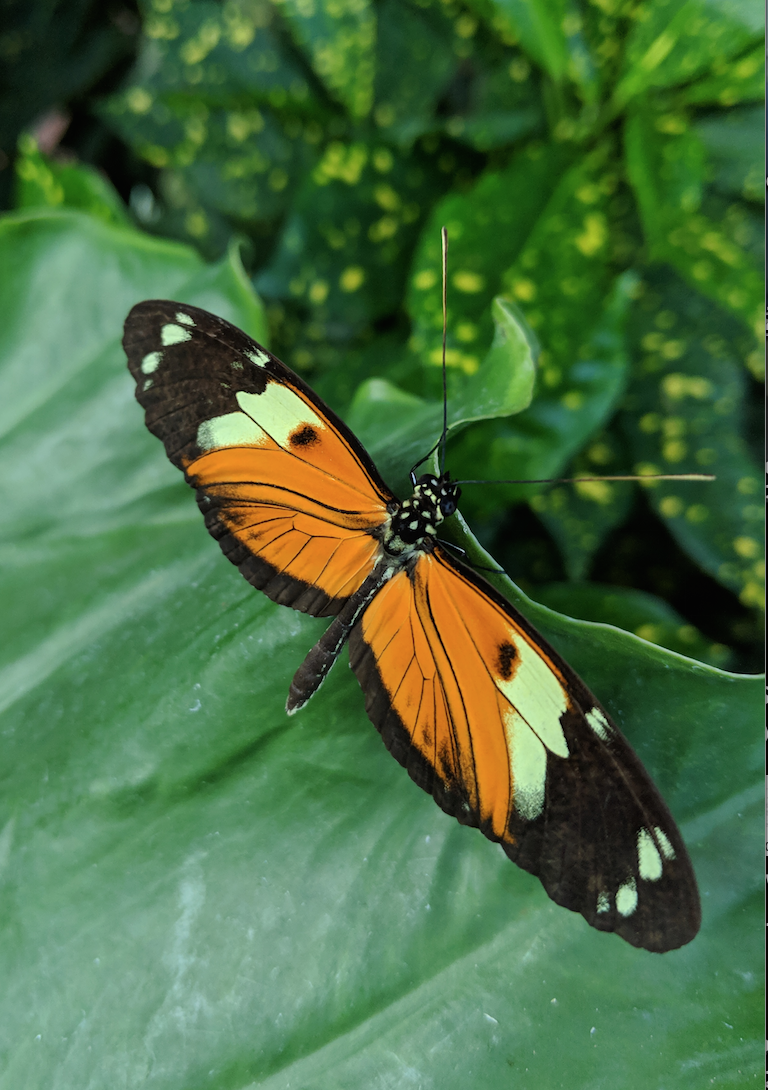
Entering the humid sanctuary with a soaring glass ceiling that seems to touch the clouds was to step into a time machine. Within seconds, I became a bubbly kindergartener on a school field trip.

“Look!” I reflexively exclaimed to my wife, pointing at a butterfly fluttering a few feet ahead.

“Look! … Look!” I quickly repeated, almost singing, as two more painted marvels danced through the air in slow motion.

Seeing a single butterfly in one’s backyard lightens the heart; here, inside the artificial outdoors, there are more than 3,000 representing 65 species. I had anticipated spotting butterflies would be like an aerial Easter egg hunt requiring eagle eyes and good luck. Instead, it was like being in the midst of an NBA championship celebration with confetti – oversized and alive! – floating all about.

My reaction to this psychedelic snowfall was as if watching Fourth of July fireworks: “Oooh! … Ahhh! … Wow! … Look at that one!” So unbridled was my childlike delight that I may have half-skipped along the winding pathway.
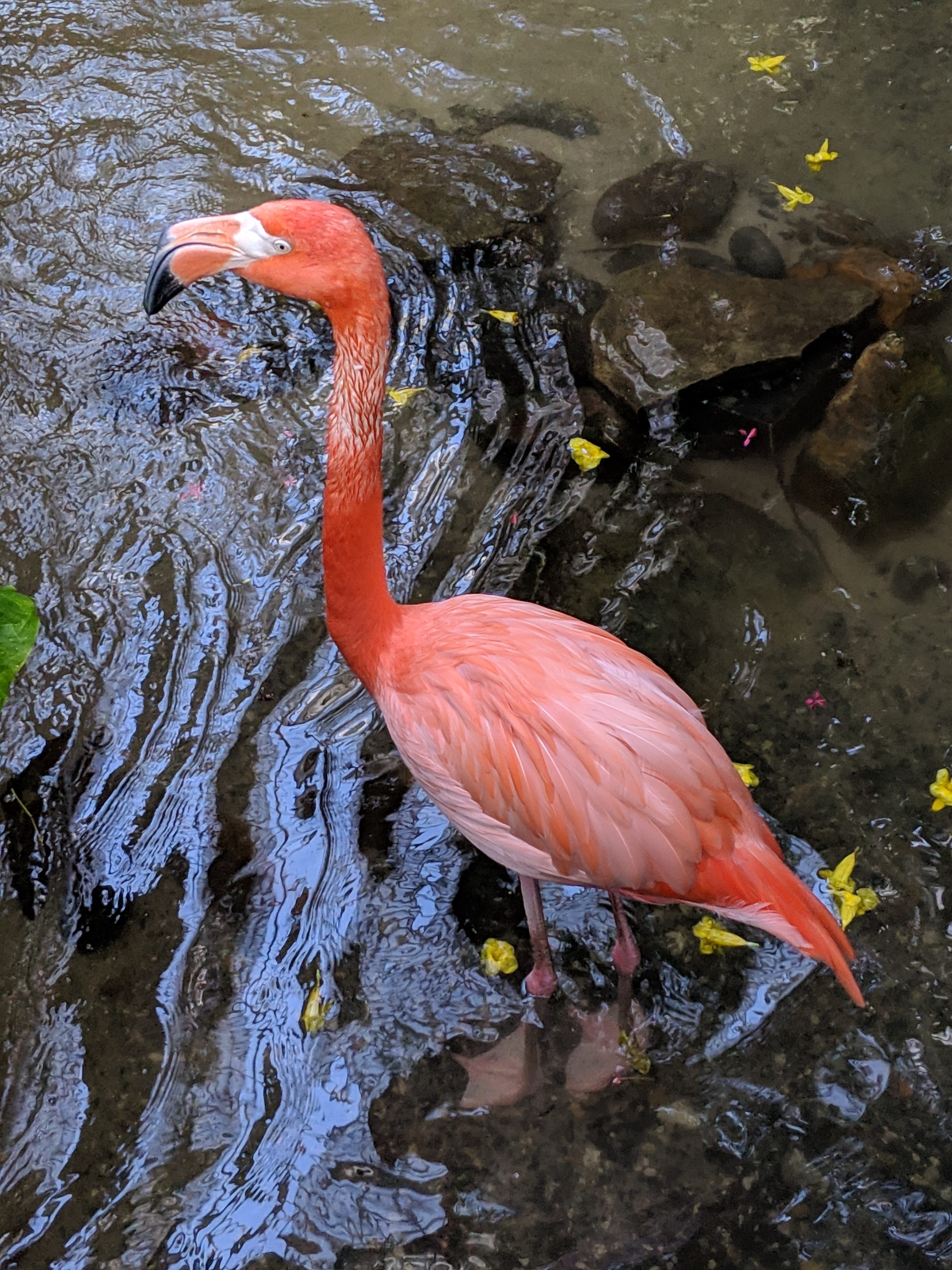
Scarlett, or perhaps Rhett, struts her stuff.

The climate-controlled paradise boasts beyond butterflies. The botanical garden features a rain forest of plants and trees, a meandering stream with resident turtles, and two gorgeous flamingos as florescent pink as a Key West sunset.

Long-long-long-legged Scarlet and Rhett were not always so radiant. After two years of bureaucratic pink tape to secure them, they arrived sickly and gray. Loving care, and importantly a diet rich in brine shrimp containing a natural dye called canthaxanthin, returned the “Gone with the Wind” pair to “flame-colored” per the Portuguese derivation “flamenco.”

Rhett and Scarlet, each 7 years old with life expectancies up to 75, enjoy the feathered company of 20 other species of exotic birds that seem to have had their feathers colored by imaginative children using the 64-count box of Crayola crayons.

Indeed, the fabulous fowls – “Look! … Oooh! … Another one over there!” – come in purples and pinks, reds and oranges, greens and golds, vibrant hues all. I wish you could see them.

Yet it is the butterflies that steal the show. One of the guides called them “flowers of the sky” which I think is perfect. I bet Hemingway would have loved that description too.

Two especially memorable moments occurred on my breathtaking stroll through this Land of Ahhs. First, a bird of a royal blue variety lighted on my left shoulder and remained perched for what seemed like a minute, although surely it was 10 seconds at most, before flying off.

Shortly thereafter, a “flower of the sky” as luminously turquoise as the local shallow ocean waters, lighted upon my right forearm. With its wings opening and closing ever so slowly for thermal regulation, it rested there for a true minute before bidding me farewell.

On a sheet of paper in a typewriter at Hemingway’s nearby home, a copy of a letter he wrote to a friend begins: “Having a wonderful time!!!”

That aptly describes my visit with the butterflies!!!

* * *

Essay copyrights Woody Woodburn
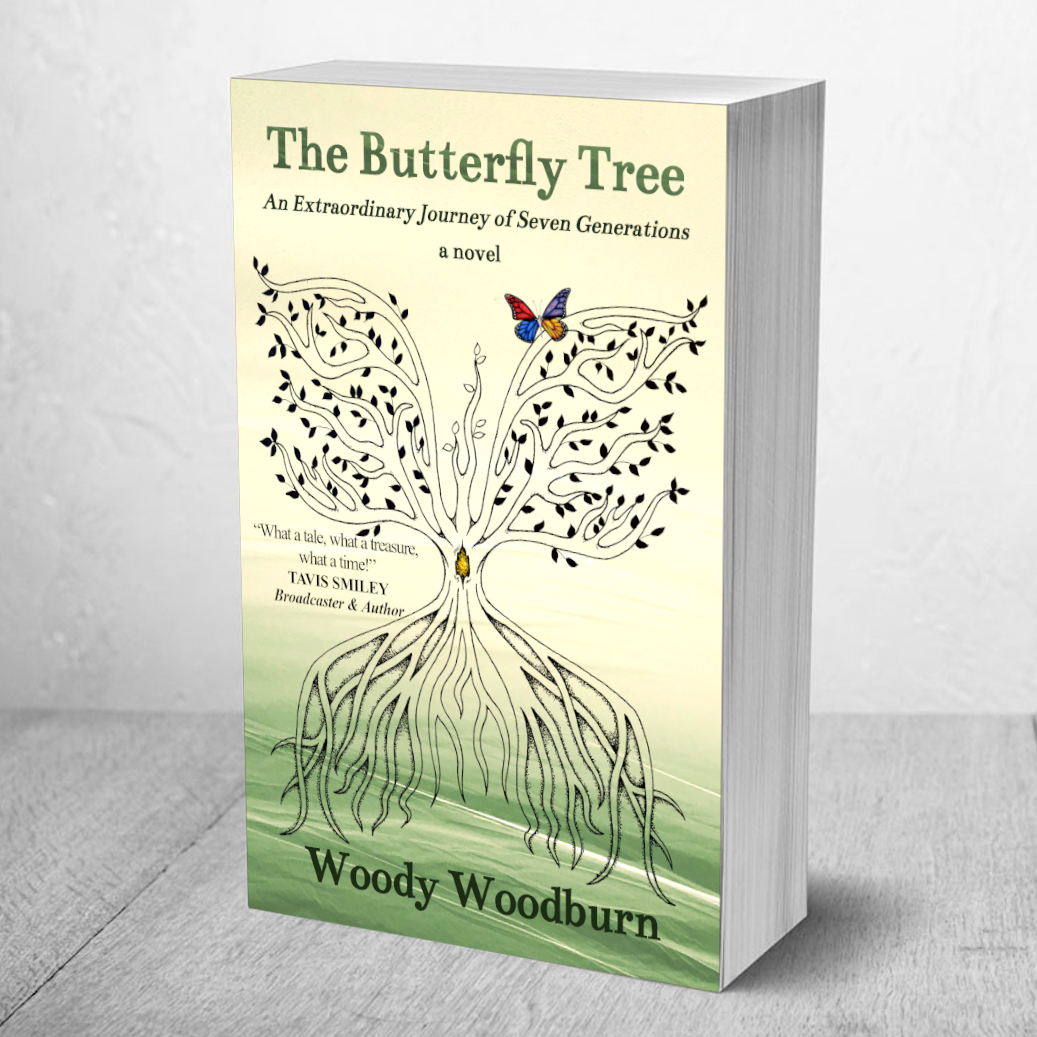
Woody’s new novel “The Butterfly Tree” is now available in paperback and eBook at Amazon (click here), other online bookstores, and is orderable at all bookshops.

*

Woody writes a weekly column for The Ventura County Star and can be contacted at WoodyWriter@gmail.com. Follow him on Twitter and Instagram at @woodywoodburn.
Part II: My Top Top-Shelf Book

Woody’s debut novel “The Butterfly Tree” is available at Amazon (click here), other online retailers, and orderable at all bookshops.

*

Picking up where I left off last week in answering the question, “What is my favorite book that I own?”

While my previously mentioned 1885 first edition, seconding printing, of “Adventures of Huckleberry Finn” is monetarily the most-valuable volume in my Favorite Books Bookcase, a short stack gifted by friends and family are more priceless to me largely because they were thoughtful presents.

While my very favorite of favorites will surely come as a surprise, it is no surprise that “Wooden: A Lifetime of Observations and Reflections On and Off the Court” by John Wooden is on the elite shelf. This little blue book is big-time special because of the story behind it: when I politely told Coach I would instead buy my own copy because he had already given me too many gifts on previous visits, he grinned wryly and said he could not very well give it to someone else because he had already inscribed it to me…

…but, after a moment’s reflection, Coach encouraged me to go ahead and buy a second copy and give it to a friend for no reason.

Writers who, like Coach Wooden, have made friendship a fine art with their own gift books now residing on my special shelf include Ken McAlpine, Roger Thompson, Mimi Herman, Geoffrey Simpson, Jacinda Townsend, Tom Hoffarth, Tavis Smiley, and Chuck Thomas.

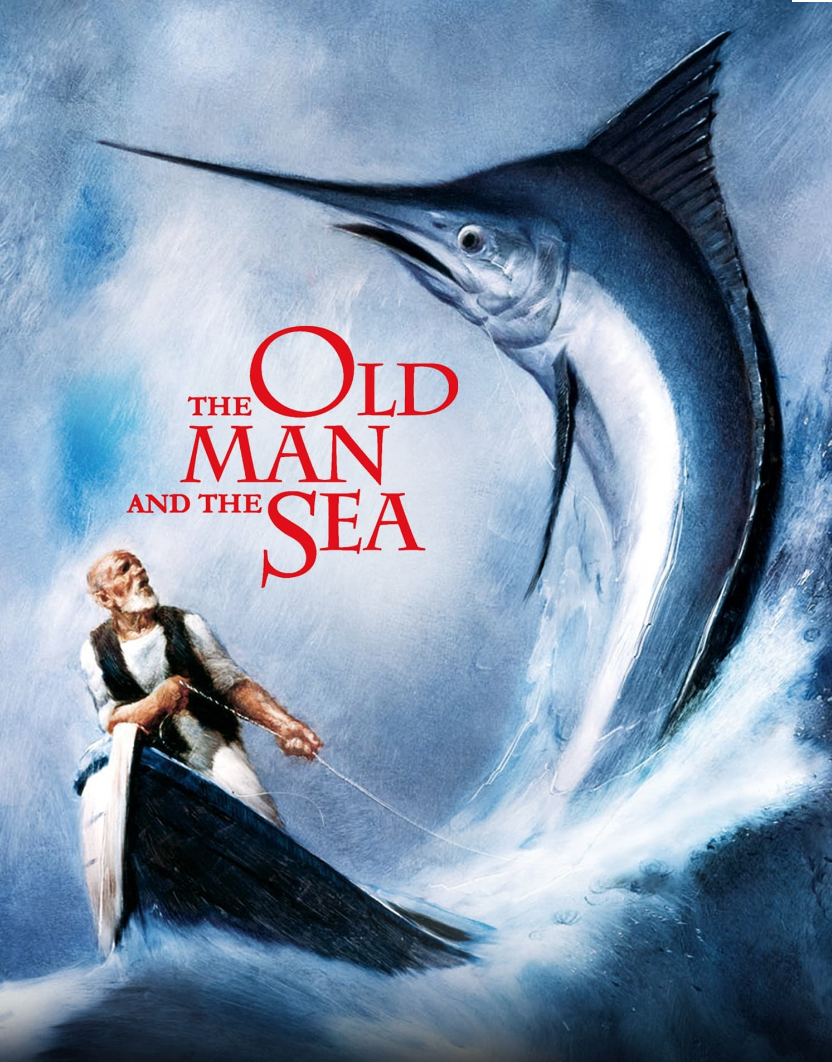
Dog-eared paperbacks of “The Old Man and the Sea” and “Travels With Charley” have brought me great reading joy, but “good” condition hardcover first editions as gifts from my daughter make her Old Man’s heart Travel to the moon.

So dearly do I love “The Snow Goose,” which I have read a dozen times at least, that I gifted myself a volume signed by its author, Paul Gallico. Still, my favorite copy of this little-known 58-page novella is a 1941 first edition, its pricey value multiplied many times over because my friend Nick Sarris searched it out as a gift.

While first editions and signed title pages are indeed special, emotional provenance is no less so. Hence, three muddy-moss-colored cloth-covered obviously often-read hardbacks by John Steinbeck are exceptional beauties to my eyes because they were long-ago treasured by the father of my college dorm pal Mikey Weinberg-Lynn, who wanted me to have the family heirlooms because of my great admiration for the author.

Similarly, an age-worn collection of “The Bedtime Story Books” series by Thorton W. Burgess that belonged to my dad as a boy reside in my Favorite Books Bookcase.

But my all-time top top-shelf book is not a storybook, although it does indeed have myriad marvelous color illustrations; nor is it a novella or novel.

Rather, it is a textbook, placemat-sized and thick as “Ulysses” at more than 500 pages, and heavy as a cinder block because of the glossy paper throughout. The black hardcover, especially its spine, shows the wear from countless late-night study sessions, three successive generations in fact, for the book originally belonged to my grandfather Ansel, whose name is on the first inside page, then my father, and in turn my eldest brother – doctors all.

Why in the world would “An Atlas of Anatomy” by J. C. Boileau Grant, a 1947 second edition, be my most cherished book? Because two days before my big brother passed away – exactly a year ago this week – during my very last bedside visit with him, Jimmy gave it to me along with these whispered final words:

“You’ve been a great little brother.”

And so it is that I learned, on page 440, about orifice of naso-lacrimal duct – the tear duct.

* * *

Essay copyrights Woody Woodburn

Woody’s new novel “The Butterfly Tree” is now available in paperback and eBook at Amazon (click here), other online bookstores, and is orderable at all bookshops.

*

Woody writes a weekly column for The Ventura County Star and can be contacted at WoodyWriter@gmail.com. Follow him on Twitter and Instagram at @woodywoodburn.
This Favorite Book Will Surprise You

Woody’s debut novel “The Butterfly Tree” is available at Amazon (click here), other online retailers, and orderable at all bookshops.

*

“What’s your favorite book?” I was asked the other day, a simple question that is calculus-difficult to answer.

Hemming a moment, I finally replied I would need to think about it. Now I have, long and happily, retreating a lifetime into memory back to my first favorite book that I checked out of the library myself, at age 5, “Where The Wild Things Are,” and then browsing forward through a hundred books that each merit a color in my rainbow of all-time favorites.

Scarlet or violet or gold or…?

“The Old Man and the Sea” or “The Grapes of Wrath” or…?

I decided to reframe the conundrum to: What is my favorite book I own? My answer, without question, will surprise you.

Let me begin by sharing a handful of contenders that share a shelf of honor in my Favorite Books Bookcase. This includes the full collection – three novels, four short story collections, one children’s book – by my all-time favorite writer, with no apologies to John Steinbeck: my daughter, Dallas.

Proving truth in the aphorism to not judge a book by its cover, monetarily the most valuable book I own has a hardback front and back that only a mother – or perhaps great-great-grandmother – could love, for it looks like gaudy red-pink-gold-green-and-white patterned wallpaper from the 19th Century. The spine, however, of rich brown leather with gilt lettering tells a different tale: “Adventures of Huckleberry Finn.” It is a first edition, second issue (with a few corrections) published in 1885.

Ol’ Huck is not the oldest book on my special shelf. That honor, by a mere year, goes to a poetry collection titled “Red Letter Poems.” It is a handsome illustrated edition with a white leather cover protecting 647 gilt-edged pages, but its true value is in having been passed down on my mother’s side of the family.

And yet the favorite book of poetry I own is small and slim, at just 20 pages, with a cover that looks like it was once left outside through a full winter. No matter, “From Snow To Snow” by Robert Frost is dear to me because a college class studying the four-time Pulitzer Prize winner’s works partially inspired me to become a writer. Further making this 1936 first edition, first printing, all the more dear is the pencil signature inside, dark and clear, albeit a little shaky, in the author’s hand.

Nonetheless, my most-prized Pulitzer honoree’s signature is on the title page of “The Sporting World of Jim Murray” – “Keep swinging! Jim Murray” he penned – that I found in a used bookstore in Twentynine Palms for all of $6.50 according to the penciled price inside the cover. That was in 1982, my rookie year in journalism, and a few years before I would meet my sportswriting hero in person in a press box.

Even more precious, even though it is unsigned, is a 1936 edition of “Roget’s Thesaurus of English Language In Dictionary Form.” The dirty-red, well-worn cloth cover is nothing to look at – until you take a closer look. In the lower right corner, imprinted in small gilt letters, it reads JIM MURRAY and was gifted to him by Roget’s.

Making this Thesaurus more cherished – also: loved, beloved, precious, special – is that Jim’s widow gifted it to me in honor of his and my friendship.

Indeed, being gifts is a theme that makes a handful more books in my Favorite Books Bookcase truly priceless to me – none more so than my surprising answer as my No. 1 fave, which I will reveal in this space next week.

Endings Prequel: Opening Sentences

Last week’s column featuring some memorable ending sentences I have “collected” while browsing bookstores brought numerous requests for a bookend prequel of opening lines that really knock me out, to paraphrase Holden Caulfield.

Speaking of Holden, J.D. Salinger’s “The Catcher in the Rye” has this all-time great introductory line: “If you really want to hear about it, the first thing you’ll probably want to know is where I was born, and what my lousy childhood was like, and how my parents were occupied and all before they had me, and all that David Copperfield kind of crap, but I don’t feel like going into it, if you want to know the truth.”

Speaking of “David Copperfield” by Charles Dickens: “Whether I shall turn out to be the hero of my own life, or whether that station will be held by anybody else, these pages must show.” Also, from his “A Christmas Carol”: “Marley was dead, to begin with.”

“The Satanic Verses” by Salman Rushdie: “ ‘To be born again,’ sang Gibreel Farishta tumbling from the heavens, ‘first you have to die.’ ”

Add death, from “One Hundred Years of Solitude” by Gabriel Garcia Marquez: “Many years later, as he faced the firing squad, Colonel Aureliano Buendía was to remember that distant afternoon when his father took him to discover ice.”

From “Charlotte’s Web” by E.B. White: “ ‘Where’s Papa going with that axe?’ said Fern to her mother as they were setting the table for breakfast.”

Short but not so sweet. “The Color Purple” by Alice Walker: “You better not never tell nobody but God.” In “Beloved” by Toni Morrison: “124 was spiteful.” And “Fahrenheit 451” by Ray Bradbury: “It was a pleasure to burn.”

Bookend numbers of note. “The Lord of the Rings” by J.R.R. Tolkien: “When Mr. Bilbo Baggins of Bag End announced that he would shortly be celebrating his eleventy-first birthday with a party of special magnificence, there was much talk and excitement in Hobbiton.” And in “1984” by George Orwell: “It was a bright cold day in April, and the clocks were striking thirteen.”

Succinct trio. “I am an invisible man,” from “Invisible Man” by Ralph Ellison. “Slaughterhouse-Five” by Kurt Vonnegut: “All this happened, more or less.” And “Catch-22” by Joseph Heller: “It was love at first sight.”

Poetically from “The Red Badge of Courage” by Stephen Crane: “The cold passed reluctantly from the earth, and the retiring fogs revealed an army stretched out on the hills, resting.”

Speaking of fog, I love this darkly vivid opener from “Fog” by Venturan author Ken McAlpine: “They ran across the sloping deck like marionettes, arms and legs akimbo, and when the waves caught the sailors their arms jerked out, snatching at the night, before they disappeared without a sound.”

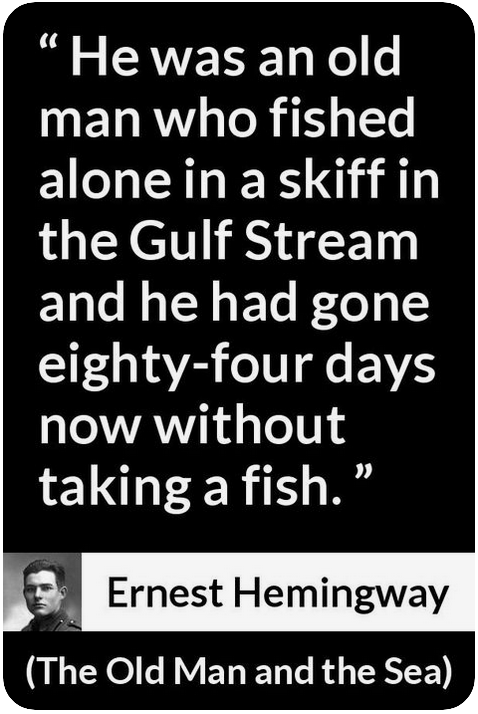
Also from the ocean. “Their Eyes Were Watching God” by Zora Neale Hurston: “Ships at a distance have every man’s wish on board.” And from “The Old Man and the Sea” by Ernest Hemingway: “He was an old man who fished alone in a skiff in the Gulf Stream and he had gone eighty-four days now without taking a fish.”

“Peter Pan” by J. M. Barrie: “All children, except one, grow up.”

Lastly, the first line of the first book I remember checking out long before I grew up, “Where The Wild Things Are” by Maurice Sendak: “The night Max wore his wolf suit and made mischief of one kind and another his mother called him ‘WILD THING!’ and Max said ‘I’LL EAT YOU UP!’ so he was sent to bed without eating anything.”

*   *   *

Woody’s debut novel “The Butterfly Tree: An Extraordinary Saga of Seven Generations” will be published in late March.

Essay copyrights Woody Woodburn

Woody writes a weekly column for The Ventura County Star and can be contacted at WoodyWriter@gmail.com. Follow him on Twitter and Instagram at @woodywoodburn. His SIGNED books are available at www.WoodyWoodburn.com.
Sharing a Collection of Last Lines

A while back, while browsing a second-hand bookshop, specifically our local treasure Bank of Books – by the way, is any perfume more lovely than the musty-woodsy-vanilla-fresh-rain scent that wafts up from the open pages of an old book?—I came upon a copy of “Anna Karenina.”

I have long meant to tackle this classic tome by Mr. Tolstoy, long being the operative word for it is pushing 600 pages, and on this encounter I simply read the opening sentence—“Happy families are all alike; every unhappy family is unhappy in its own way”—and then flipped to the ending: “My life now, my whole life, regardless of all that may happen to me, every minute of it, is not only not meaningless, as it was before, but has the unquestionable meaning of the good which it is in my power to put into it!”

And so began my habit of wandering through bookstores and partaking of the first and last lines, or paragraphs, of novels—ones I have already read and also those I wish to one day do so in full.

Just for fun, and to give myself the day off from writing my own last line for this column, here are some endings I have jotted down in my collection…

From “Where the Wild Things Are,” the first book I remember checking out of the library as a kid, the last page reads: “and it was still hot.”

“Harry Potter and the Deathly Hallows”: “The scar had not pained Harry for 19 years. All was well.”

“The Catcher in the Rye”: “It’s funny. Don’t ever tell anybody anything. If you do, you start missing everybody.”

“A Prayer for Owen Meany”: “Oh God—please give him back! I shall keep asking You.”

“Beloved” concludes powerfully and unforgettably with simply the novel’s title: “Beloved.”

Two more succinct endings are “I’ll pray, and then I’ll sleep” from “Gilead” and “Are there any questions?” from “The Handmaid’s Tale.”

“To Kill a Mockingbird” closes: “He turned out the light and went into Jem’s room. He would be there all night, and he would be there when Jem waked up in the morning.”

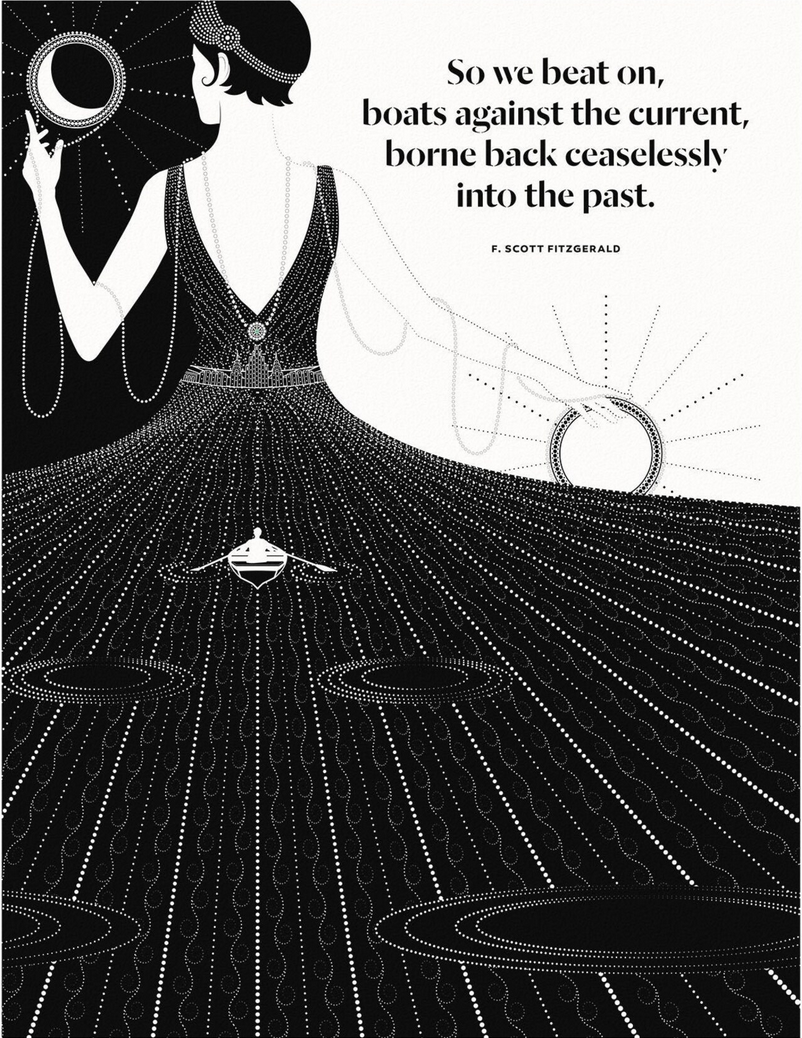
“The Great Gatsby” famously ends: “So we beat on, boats against the current, borne back ceaselessly into the past.”

No title is needed to identify this couplet finale: “For never was a story of more woe / Than this of Juliet and her Romeo.”

From “The Road” comes this poetic prose: “In the deep glens where they lived all things were older than man and they hummed of mystery.”

“The Green Mile” ends: “We each owe a death, there are no exceptions, I know that, but sometimes, oh God, the Green Mile is so long.”

Death, the narrator of “The Book Thief,” concludes: “A LAST NOTE FROM YOUR NARRATOR. I am haunted by humans.”

“Adventures of Huckleberry Finn”: “I got to light out for the territory ahead of the rest, because Aunt Sally she’s going to adopt me and sivilize me, and I can’t stand it. I been there before.”

“The Sun Also Rises”: “ ‘Yes,’ I said. ‘Isn’t it pretty to think so?’ ”

“The Grapes of Wrath” closes with this indelible image: “She looked up across the barn, and her lips came together and smiled mysteriously.”

“Travels with Charley”: “And that’s how the traveler came home again.”

And in “brown girl dreaming” Jacqueline Woodson ends with this verse: “gather into one world / called You / where You decide / what each world / each story / and each ending / will finally be.”

*   *   *

Essay copyrights Woody Woodburn

Woody writes a weekly column for The Ventura County Star and can be contacted at WoodyWriter@gmail.com. Follow him on Twitter and Instagram at @woodywoodburn. His SIGNED books are available at www.WoodyWoodburn.com.
Some Very, Very Short Stories

“Simplify, simplify,” advised Henry David Thoreau, to which Ralph Waldo Emerson wryly, and wisely, replied: “One ‘simplify’ would have sufficed.”

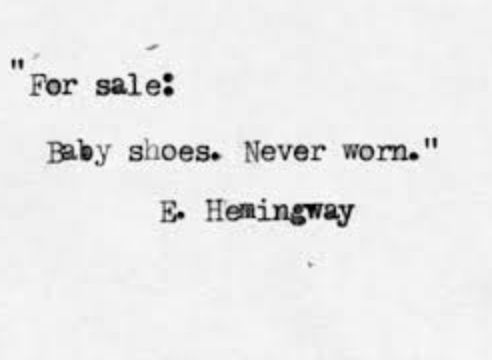
On a similar theme, Ernest Hemingway is said to have once accepted a bet that he couldn’t write a complete story in a mere six words. Papa triumphed with this mini-masterpiece: “For sale: baby shoes, never worn.”

For fun, I challenged some friends to write their own six-word stories of fiction or memoir. Here are some of their tiny tales…

“She had me with her smile.” By Mitch Gold.

By Steve Grimm: “I asked her, she said yes!”

Conversely, and darkly, by Debby Holt Larkin, author of “A Lovely Girl” and the daughter of the late, great Bob Holt who chronicled this column space long ago: “Wife ran off … need your shovel.”

Even more darkly, a six-word historical novel by Chris Barney: “Rats had fleas. Millions died painfully.”

More happily, by Ethan Lubin: “Former students visited. Made my day.”

“Ignored warning signs, at great peril.” By Joe Garces.

“Caesar had the best,” noted John Yewell: “ ‘I came, I saw, I conquered.’ Of course in Latin it’s only three words.”

“The light is darkness. Oh, Oppenheimer.” By Karen Lindell.

 “Today, tomorrow and whatever comes next,” wrote John Collet and Susie Merry offered: “Small things can bring big happiness.”

Less happily, by Patrick Burke: “Last man down the trail, alive.”

“ ‘You run everyday?’ They are confused.” A mini-memoir by Lauren Siegel, a “streaker” who has run 8,737 consecutive days.

 “I patted her pillow. It’s empty,” wrote James Barney, while Mary Eilleen Distin offered: “He left, and now I’m happy.”

“I moved to NYC at 71.” By Kris Young.

Jeff McElroy flipped the script on Hemingway’s heartbreaking micro-novella, turning it into a much happier one – and in only five words: “Free: Baby shoes, well-worn.”

Seeking even further simplicity, I posed a second challenge of brevity: Write a happy story in only four words…

“I love you, too,” wrote Chulwon Karma Park.

Kathy McAlpine and Betsy Chess both identically authored a classical super small storybook: “Lived happily ever after!” while Allyson McAuley added a slight twist: “They lived, happily, peacefully.”

“Peace love rock roll,” wrote Dick Birney while Carrie Wolfe offered: “Life is unexpected love.”

“The grandkids came over!” wrote Toni Tuttle-Santana and E.Wayne Kempton echoed: “Good to be Grampy!”

By Alison Smith Carlson: “Julie’s cancer was cured.”

In a sequel to his earlier six-word story, or perhaps a prequel, James Barney wrote: “She woke beside me.”

“The cruise is booked!” wrote Karen Biedebach-Berry and Julie Chrisman offered another tale of the sea: “Today I went Paddleboarding!”

Susie Merry wrote a sweet story, “I ate some chocolate,” and John Brooks served up a similar theme for readers’ consumption: “I ate some cannoli!”

“I got over it,” wrote Shaka Senghor and I, for one, want 1,000 more words.

Cindy Hansen wrote, “Hike trees bees breathe,” while Tom Koenig similarly offered: “Warm water beach sand.”

In an inspiring mini-memoir, Todd Kane wrote: “Been sober since 1976.”

“Because she was brave.” By Hannah McFadden.

“We are all together,” wrote Mike Weinberg-Lynn while Robin Harwin Satnick offered: “We happily adventured together.”

“9 o’clock starting time,” wrote Rodney Johnsen, Sr. in a story that may turn less happy by the third tee.

“Fireplace book cooking wine,” wrote Kathleen Koenig while Vicki Means offered: “Feeling safe and sound.”

“Autumn air smells earthy!” By Lisa Barreto.

Julie Hein wrote, “Gave birth; heart grew,” while Edie Marshall also offered a love story: “Found Chuck. Got married.”

Lastly, by yours truly: “Column written for me.”

*   *   *

Essay copyrights Woody Woodburn

Woody writes a weekly column for The Ventura County Star and can be contacted at WoodyWriter@gmail.com. Follow him on Twitter and Instagram at @woodywoodburn. His SIGNED books are available at www.WoodyWoodburn.com.
Part 2: Hemingway’s “Last Red Cent”

FOLLOW ME ON INSTAGRAM: @woodywoodburn

*

Part 2: Hemingway’s

“Last Red Cent”

The stairway to heaven has 19 steps.

Before climbing the outdoor flight leading to Ernest Hemingway’s second-floor writing studio in the backyard, spitting distance away I toured the main house at 907 Whitehead Street in Key West’s Old Town. It is a mansion masterpiece.

The Spanish antiques and African artwork throughout, much collected by Hemingway himself, are stunning. However, I was more captivated by the wordsmith’s seven typewriters – three Underwood models; one Remington portable; two Corona machines, one black and the other forest green; and one Royal – displayed in various rooms.

Hanging out with Hemingway in his Key West home.

The black Royal portable, Hemingway’s favorite, naturally resides in his next-door upstairs studio. The spacious room has robin-egg blue walls and red terra cotta tile floor. Sun pours through ample windows, one of which affords a view of the Atlantic Ocean.

In addition to bookcases fully filled, the décor features taxidermic hunting trophies plus a mounted fish – albeit greatly smaller than Santiago’s great marlin in “The Old Man and the Sea.”

The showpiece of the room, however, is a modest round table the master used as a desk paired with a lone wooden chair. Upon the well-worn tabletop sits Hemingway’s prized typewriter as well as a notebook with a pen resting on its open pages.

When I came through, an orange six-toed cat was also resting on the table-turned-desk. One could imagine the tabby was waiting for its master to return because a sheet of typing paper was in the Royal, as if Papa had just stepped out for a moment.

“There is nothing to writing,” Hemingway famously said. “All you do is sit down at a typewriter and bleed.”

Hemingway bled profusely in this den from 1931 to 1939, writing nine books. The prolific period began with “Death in the Afternoon”, included “The Green Hills of Africa” and “For Whom the Bells Toll”, and ended with “Under Kilimanjaro.” His process was to rise at dawn and hunch over his Royal until early afternoon, always quitting while still in the flow so it would be easier start anew the following morning.

The magic one feels standing before the Mona Lisa or the marble David, I experienced here. Oh, how I would have loved to give the Pulitzer Prize winner’s antique Royal a whirl for a sentence or three!

Too, I would have liked to dive into the magnificent swimming pool some two dozen strides from the writing studio and directly below the master bedroom in the main house. Dug into solid coral ground, it took two years to complete and was the only swimming pool within 100 miles.

Measuring 60 feet by 24 feet and 10 feet deep at the south end, half that at the opposite point on the compass, the rectangular pool cost a staggering $20,000 in 1938. Understand, less than a decade earlier the entire home and acre of land was purchased for $8,000.

Hemingway was exasperated at the pool’s final cost and at his second wife who oversaw its construction while he was away as a correspondent for the Spanish Civil War. Upon his return, he is said to have flung down a penny and complained: “Pauline, you’ve spent all but my last red cent, so you might as well have that!”

Offered as evidence that the story is true and not apocryphal, Pauline had a penny embedded heads-up in the cement on the shallow-end deck. Superstitiously, I left a shiny penny behind on top of that famous red cent.

Soon thereafter, I left a few dollars behind in the gift shop for a leather bookmark with the image of a lucky six-toed cat.

 *   *   *

Woody Woodburn writes a weekly column for The Ventura County Star and can be contacted at WoodyWriter@gmail.com. Follow him on Twitter and Instagram at @woodywoodburn. His books are available at www.WoodyWoodburn.com.
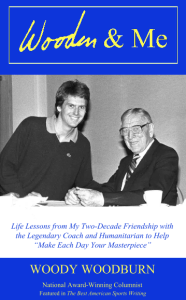
Check out my memoir WOODEN & ME: Life Lessons from My Two-Decade Friendship with the Legendary Coach and Humanitarian to Help “Make Each Day Your Masterpiece” and my essay collection “Strawberries in Wintertime: Essays on Life, Love, and Laughter” …


Hemingway’s Home Is Cats’ Meow

FOLLOW ME ON INSTAGRAM: @woodywoodburn

*

Hemingway’s Home

Is The Cats’ Meow

            A seven-block walk from the celebrated red-black-and-yellow concrete buoy marking The Southernmost Point in the Continental United States brought me to the North Star: The Ernest Hemingway Home & Museum.

Inside the brick wall and front gate awaits the home.

Nestled in the heart of Key West’s Old Town, the white-black-and-gold manor at 907 Whitehead Street is where the master wordsmith lived for a prolific writing span from 1931 to 1939. In 1968, seven years after Hemingway’s death, the estate became a registered National Historic Landmark.

Architecturally, the home seems transplanted from the French Quarter in New Orleans with a black wrought-iron balcony wrapping around the second story. Floor-to-ceiling arched windows framed by gold shutters add to the southern charm.

Majestic trees, including skyscraper palms, surround the home. The one-acre lush grounds are in turn framed by a brick wall, tall as a man. Not surprisingly, there is a tale behind the wall.

It seems that when the town’s red-brick streets were being torn up in 1938, Hemingway and some pals, including renowned Sloppy Joe’s Bar owner Joe Russell, surreptitiously followed behind the work wagons helping themselves to Baltimore pavers. After the pilfering was discovered – for the bricks had in fact not been headed to the scrap heap – Hemingway settled up by paying a penny apiece.

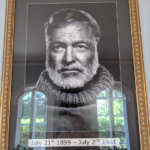
A Hemingway portrait greets visitors inside.

The wall had become necessary because of an earlier visit to Key West by President Franklin D. Roosevelt. To capitalize on the event, a map was printed for tourists and among the sites highlighted was Hemingway’s home complete with address. Suddenly, strangers were knocking on the front door and roaming the property uninvited.

Emphasizing the dangers of the period, Hemingway expert Chris Parsons told me in a private visit following a public tour: “Key West was like the Wild West when he lived here. You needed a knife or gun if you went out on street after dusk. Hemingway, of course, didn’t need a weapon because he was larger than life – ”

Nodding towards the brick wall’s entranceway, Parsons added, “ – with a gait wider than that gate.”

Strolling through that gate an hour earlier, I was immediately greeted by a sense of overwhelming reverence. In my mind’s eye, I could see Papa Hemingway; in my heart’s imagination, I felt his presence.

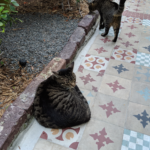
Too, I was greeted on the front porch by a grey tabby rubbing up against my leg. Inside, more cats awaited. In some rooms, the felines seemed as numerous as the butterflies at the nearby nature conservatory.

The famous six-toed Hemingway cats roam everywhere, outside and inside.

It turns out about 60 cats live out their pampered nine lives at Hemingway’s home. To give you an idea, they are even allowed to sleep on the priceless antique furniture that is roped off from the public visitors.

The resident cats are of all shades and colors: gray, black and white, red. Most are likely distant descendents of a Snow White, a rare six-toed cat given as a gift to Hemingway from a local boat captain. Six-toed cats, even black ones, were considered good luck at the time.

Cats normally have five toes on each front paw our tour guide informed us, but the majority of the Hemingway housecats are “polydactyl” meaning they have six front toes. The polydactyls are easy to spot because their paws are so large it looks like they are wearing mittens.

“One cat leads to another,” Hemingway liked to say of his caboodle, although he had fewer back then than the current five dozen.

He also liked to name his cats after famous people, a practice that continues today with Lucille Ball, Winston Churchill and Cary Grant among those all in current residence.

To be continued next week.

 *   *   *

Woody Woodburn writes a weekly column for The Ventura County Star and can be contacted at WoodyWriter@gmail.com. Follow him on Twitter and Instagram at @woodywoodburn. His books are available at www.WoodyWoodburn.com.

Check out my memoir WOODEN & ME: Life Lessons from My Two-Decade Friendship with the Legendary Coach and Humanitarian to Help “Make Each Day Your Masterpiece” and my essay collection “Strawberries in Wintertime: Essays on Life, Love, and Laughter” …

National Book Month In One Day

FOLLOW ME ON INSTAGRAM: @woodywoodburn

*

National Book Month

List In One Day

Well, this isn’t the first time I’ve been late to a party. October is National Book Month and a friend invited me to join a 31-day challenge. Below, in one day, is my full month of answers.

Had I replied to the prompts yesterday, there’s a good chance half my answers might be different; tomorrow, perhaps the other half would change. I hope you are inspired you to come up with your own list.

Day 1 – The Best Book You’ve Read This Year: Tie between “The Nickel Boys” by Colson Whitehead and “This Tender Land” by William Kent Krueger.

Day 2 – A Book That You’ve Read More than Three Times: “The Old Man and the Sea” by Ernest Hemingway.

Day 3 – Your Favorite Series: “The Famous Bedtime Story Books” by Thornton Burgess.

Day 4 – Favorite Book of Your Favorite Series: “The Adventures of Buster Bear.”

Day 5 – A Book That Makes You Happy: Most any Dr. Seuss book.

Day 6 – A Book That Makes You Sad: “Old Yeller” by Fred Gipson.

Day 7 – Most Underrated Book: “Sweet Tuesdays” by John Steinbeck.

Day 8 – Most Overrated Book: I don’t think a book can be overrated, but Ann Patchett’s new offering, “The Dutch House”, didn’t lived up to the hype for me.

Day 9 – A Book You Thought You Wouldn’t Like But Ended Up Loving: “Lincoln in the Bardo” by George Saunders.

Day 10 – Favorite Classic Book: “The Adventures of Huckleberry Finn” by some fella named Mark Twain.

Day 11 – A Book You Hated: Knowing the effort every writer puts into a book, my lips are sealed.

Day 12 – A Book You Used to Love But Don’t Anymore: My crushes all remain intact.

Day 13 – Your Favorite Writer: John Steinbeck is a close second behind my daughter Dallas Woodburn.

Day 14 – Book From Your Favorite Writer: “The Grapes of Wrath” by Steinbeck and “Woman, Running Late, In A Dress” by Woodburn.

Day 15 – Favorite Male Character: Atticus Finch (I have not read “Go Set a Watchman.”)

Day 16 – Favorite Female Character: Charlotte A. Cavatica.

Day 17 – Favorite Quote: “Isn’t it pretty to think so?” Final line of “The Son Also Rises” by Hemingway.

Day 18 – First “Chapter Book” You Can Remember Reading As A Child: “Charlotte’s Web.”

Day 19 – Favorite Book Turned Into A Movie (I’ll add the stipulation “good” movie): The Harry Potter series.

Day 20 – Book That Makes You Laugh Out Loud: “A Walk In The Woods” by Bill Bryson.

Day 21 – Favorite Book From Your Childhood: “Where the Wild Things Are” by Maurice Sendak.

Day 22 – Book You’re Currently Reading: “Mr. Penumbra’s 24-Hour Bookstore” by Robin Sloan and halfway through, I’m loving it.

Day 23 – Your Guilty Pleasure: Anything by Robert Fulghum.

Day 24 – A Book You Wish More People Would Read: “Fog” by Ken McAlpine; “We Stood Upon Stars” by Roger W. Thompson; and “Wooden & Me” by me!

Day 25 – Favorite Book You Read In School: “To Kill a Mockingbird” by Harper Lee.

Day 26 – Favorite Autobiography: “They Call Me Coach” by John Wooden.

Day 27 – The Most Surprising Plot Twist or Ending: “Life of Pi” by Yann Martel.

Day 28 – Favorite Title: “Cloudy with a Chance of Meatballs” by Judi Barrett.

Day 29 – A Book Few Have Heard Of That You Loved: “The Snow Goose” by Paul Gallico.

Day 30 – Book on the top of your To Read Next Pile: “The Goldfinch” by Donna Tartt.

Day 31 – Favorite Book: Impossible! But if I must try, a tie between Hemingway’s “The Old Man and the Sea” and “Travels with Charley” by Steinbeck.

*

Woody Woodburn writes a weekly column for The Ventura County Star and can be contacted at WoodyWriter@gmail.com. Follow him on Twitter and Instagram at @woodywoodburn. His books are available at www.WoodyWoodburn.com.

Check out my memoir WOODEN & ME: Life Lessons from My Two-Decade Friendship with the Legendary Coach and Humanitarian to Help “Make Each Day Your Masterpiece” and my essay collection “Strawberries in Wintertime: Essays on Life, Love, and Laughter” …

Steinbeck’s (Like) Typewriter

*

#TBT stands also for

Throwback Typing

            Throwback Thursday, more often designated simply with the hashtag #TBT, is popular on Instagram, Facebook and Twitter when social media users post nostalgic photos once a week.

In that same spirit, this is a #TBT column. Instead of a photograph from yesteryear, the nostalgia involved is that I wrote the first draft of this column on a typewriter instead of my laptop computer. #TBT is for Throwback Typing.

This old-school exercise came about because I recently received a truly glorious gift for my birthday – a 1949 Hermes Baby portable typewriter in mint condition.

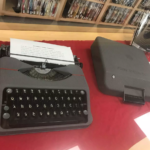
John Steinbeck’s Hermes Baby at San Jose State University.

Gray, black and silver with a single fire-engine red racing stripe, it is the same model John Steinbeck took on his famous road trip around America while writing “Travels with Charley.” His Baby, etched with “The Beast Within” on the back, is on display in the Center for Steinbeck Studies at San Jose State University. Ever since seeing it a handful of years ago, I have been smitten.

“Suisse”-made, the Hermes Baby made its debut in 1924 and was anything but beastly. In fact, it was the first true mini-typewriter with a four-row keyboard. Indeed, the Baby is a marvel in sleek compactness, almost exactly the rectangular size of my Apple Notebook, albeit nearly three inches in height instead of less than an inch thick.

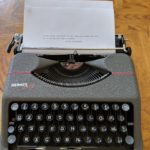
My Hermes Baby on display … at home in Ventura.

Compared to the 1912 Underwood No. 5 that I inherited from my grandfather, which is about as heavy as an anvil, the Baby is featherlight. Too, its keystrokes require only a light touch rather than finger pounding.

All the same, the keyboard forces me to slow down. This is not because the type bars stick together if they simultaneously cross paths, but rather because my specific Baby has an odd Italian layout with the customary QWERTY keyboard arranged instead QZERTY. Hence, one must turn off the autopilot when typing W’s and Z’s that have traded places.

As a result, it is easy to misspell zords – rather, words – containing Z’s and W’s. In notes to friends, I simply let these transposed misstrikes go as is because I think they add charm. With this column draft, however, I edited misstrikes and mistakes the old-fashioned way, in pencil using copyediting symbols. Doing so was enjoyably nostalgic.

The funky W and Z keys added to my nostalgia. You see, at my first newspaper job nearly four decades past, the ancient battleship-sized Remington typewriter I was assigned had a broken “K” key. Actually, half-broken – it would type a capital but not lowercase. Thus, one had to painstakingly hit “Shift” and “K” to write “broKen” or “quarterbacK” and then correct it afterward with a copyediting slash.

Being forced to slow the fingers down perhaps has its advantages by also making one think in less of a rush. Indeed, this first draft seemed more polished than when I compose on a speedy laptop where rewriting is clean and easy. It’s the difference between walking a high wire without a safety net below versus with one.

Despite the added step of retyping my words into a laptop document file, perhaps I will write more columns on my Baby – or my 1953 Underwood portable or 1962 Hermes 3000 Curvy, a beautiful sea-foam green semi-portable that rounds out my small collection to date.

An old song goes, “Don’t throw the past away / You might need it some rainy day . . . When everything old is new again.”

That’s how I, and a growing number of QWERTY – and QZERTY – aficionados, feel about Throwback Typewriters. My Hermes Baby is a seven-decades-old fossil, but it also seems good as new again.

*

FOLLOW ME ON INSTAGRAM: @woodywoodburn
Woody Woodburn writes a weekly column for The Ventura County Star and can be contacted at WoodyWriter@gmail.com. Follow him on Twitter and Instagram at woodywoodburn. His books are available at www.WoodyWoodburn.com.

Check out my memoir WOODEN & ME: Life Lessons from My Two-Decade Friendship with the Legendary Coach and Humanitarian to Help “Make Each Day Your Masterpiece” and my essay collection “Strawberries in Wintertime: Essays on Life, Love, and Laughter” …