Sauntering and Buddy Benches, too

I have another bench I adore.

As shared here once before, I “collect” benches, storing them in my mind and heart, dating back to a salty-sea-air-weathered wooden bench, high on a bluff with a postcard-worthy panoramic view of the Pacific Ocean, that I made frequent contemplative use of as a student at the University of California, Santa Barbara.

The sitting assemblage includes a steel bench in San Francisco with a look at The Golden Gate Bridge and another of wood tucked away in a secret cove in Kona, Hawaii, where I watched surfers at play; a green-painted cement bench with a plaque reading “The Drake Seat” at Vista Point on Saint Thomas Island, U.S. Virgin Islands, where Sir Francis Drake is said to have looked down for enemy ships of the Spanish fleet far below; a memorial bench on the Ventura Pier with a nameplate honoring Larry “Coach” Baratte; and a hundred more gems, near and far, where I have sat alone enjoying a quiet moment.
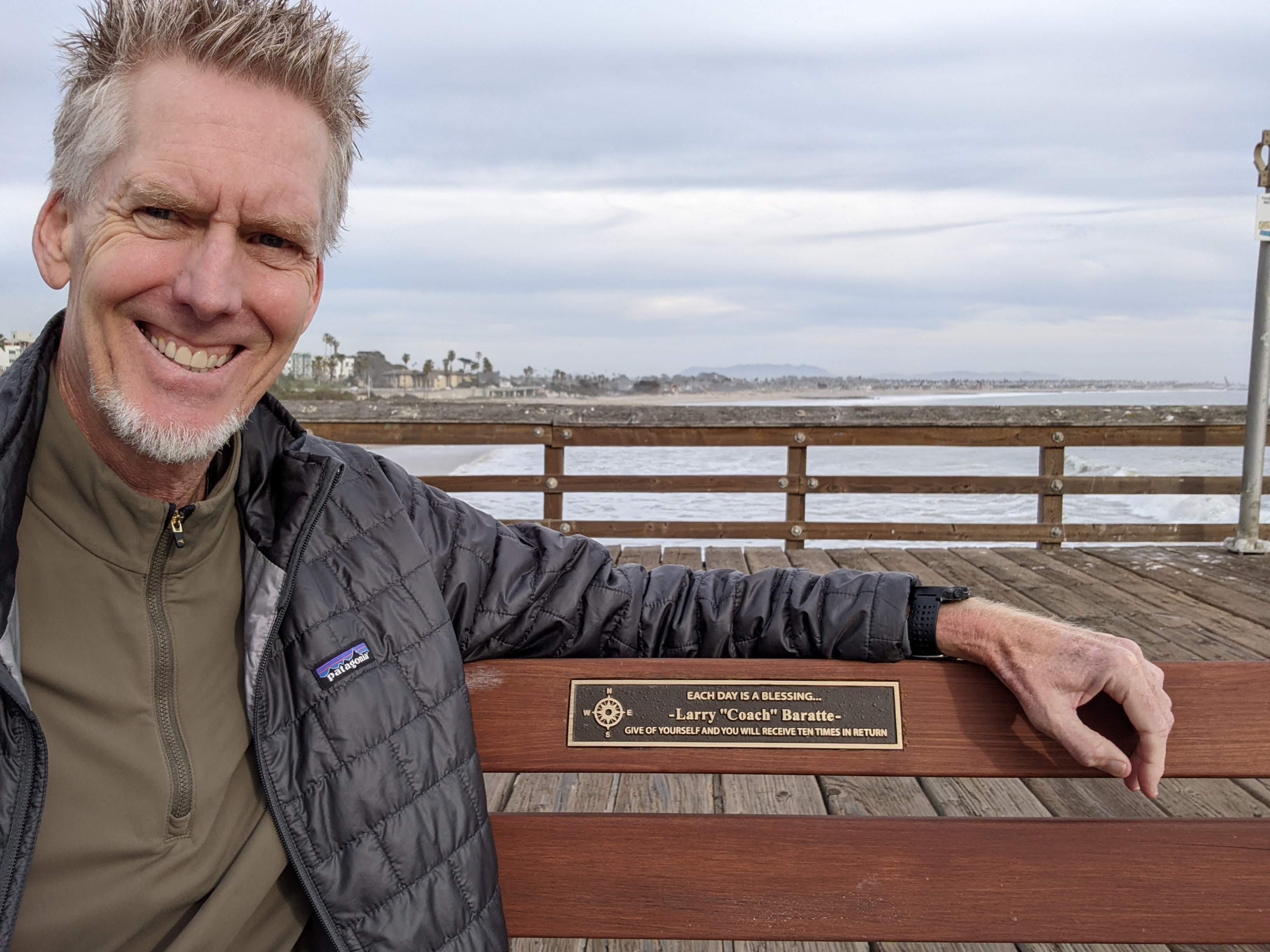
My friend “Larry’s” memorial bench on the Ventura Pier.

The new bench I have fallen in love with is one I have not experienced in person, but rather saw in a news story. Painted rainbow colors, it graces an elementary playground and has been christened the “Buddy Bench” and here is why: if a child is lonely at recess, he or she sits on it and waits and the other schoolchildren know to come offer an invitation to join them in play.

This simple idea fosters kindness and friendship so well that Buddy Benches are spreading far and wide at pre- and elementary schools, and public playgrounds as well.

Perhaps Buddy Benches for teens and adults would be a good idea, too.

*

Speaking of upbeat stories, or “good little news” as reader of this space Judee Hauer calls them, she shared this with me in an email: “Every day we see, hear, sense bad news, but also the little blessings, chirps, colors of how good life is.

Example of one of my new favorite benches.

“So we need to celebrate the elderly person seen burying a fallen sparrow, digging the small hole with a found branch, covering and talking to the dead creature, marking the spot with a broken piece of asphalt; the house at the corner where somebody has set up two pink plastic chairs at a small table overflowing with 75 mini-animals, inviting a childlike response; smiling eyes under a mask at the doctor’s office; a you-have-the-right-of-way wave…

“There is good right here, right now, all over the place.”

*

Coming full circle to column’s beginning, the gorgeous hiking trails in Ventura’s Harmon Canyon Preserve are dotted with a good many lovely benches, and by coincidence – or serendipity – on Earth Day last weekend I came across this quote from John Muir:

“Hiking. I don’t like either the word or the thing. People ought to saunter in the mountains – not hike! Do you know the origin of that word ‘saunter’? It’s a beautiful word. Away back in the Middle Ages people used to go on pilgrimages to the Holy Land, and when people in the villages through which they passed asked where they were going, they would reply, ‘A la sainte terre,’ ‘To the Holy Land.’ And so they became known as sainte-terre-ers or saunterers. Now these mountains are our Holy Land, and we ought to saunter through them reverently, not ‘hike’ through them.”

In this hectic, busy, go-go-go world, maybe we all need to remind ourselves to slow down and saunter through our daily lives a little more often – and ask someone sitting on a Buddy Bench if they want to join us.

*   *   *

Essay copyrights Woody Woodburn

Woody writes a weekly column for The Ventura County Star and can be contacted at WoodyWriter@gmail.com. Follow him on Twitter and Instagram at @woodywoodburn. His SIGNED books are available at www.WoodyWoodburn.com.

Part 3: Tears in the Storyteller – and Listener

Now the final chapter of the story…

“I was a high school senior with plans to enter nursing school in August,” Suzie shared, reaching back 69 winters and across the country from her Camarillo home.

But an unwanted teen pregnancy upset her apple cart beyond repair, she feared, and upset her parents beyond so much as a kind word. Terrified and feeling all alone in the world, Suzie slinked into the office of a doctor she had never met.

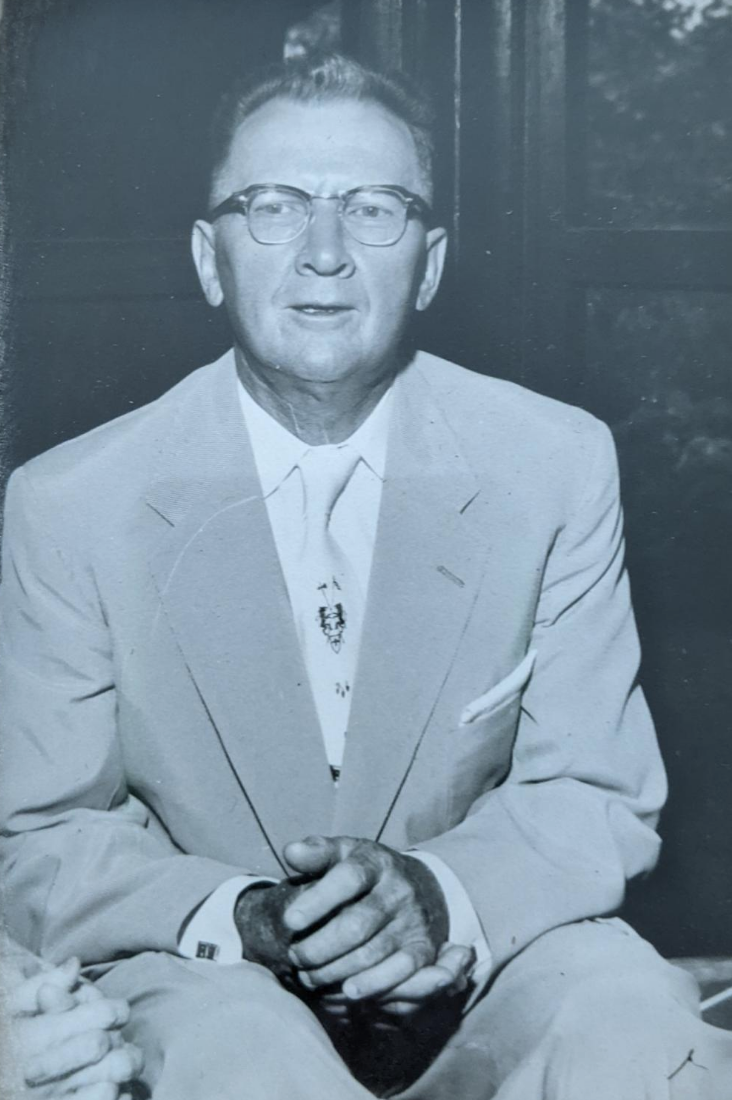
That doctor was my grandpa, before he became my grandpa, back in 1954, back in the small town of Urbana, Ohio.

My hero and my grandpa, Ansel

“How could I ever forget those three visits with Dr. Ansel Woodburn,” Suzie continues, her words a grateful statement not a question. “As a teenager, it was scary to discuss my private life in detail, but he was very kind – grandfatherly, even – and gentle in his questioning and examination.”

With a soothing bedside manner that would have made Hippocrates proud, Ansel determined that Suzie, who timorously claimed she had only missed one menstrual period, was actually three months along dating back to Thanksgiving break when her college boyfriend returned home.

“Your grandfather reassured me there was nothing to be ashamed of,” Suzie remembers. “He said there was no shame in my situation, that there was no shame in having sex. What a wonderful gift he gave me – to feel normal, okay, valued and not judged as a loose woman.”

At her next appointment, Ansel instructed Suzie to phone him immediately if she started spotting. His worries proved well-founded: Soon thereafter, Suzie, “painfully alone in the bathroom,” suffered a passed miscarriage at home.

Painfully alone still, she returned to Ansel’s office at 107 Church Street where she says she received the kindness of a minister and the compassion of a saint.

“ ‘Oh, Suzie,’ he said,” Suzie recalls with timeless clarity. “Dear Dr. Ansel Woodburn gathered this trembling young woman in his arms and held me as I cried and cried and cried about the mess I created. Several times he told me I was okay and I would be okay. I remember how good it felt to be wrapped in his strong arms – my father did not do that for me, ever.

“No one asked me how I was feeling, how I was doing, but your grandfather did. He said my life depended upon what I did in the future, and that I was strong and young and would be successful. I’ll never forget that – I’ve never forgotten him.”

The great poet Robert Frost said, “No tears in writer, no tears in the reader,” and at this moment it is true also with speaker and listener.

“For as long as I needed, and I think it was an hour at least, your grandfather held me and comforted me,” Suzie goes on. “He knew I wasn’t getting any comforting at home. As I rested my head on his shoulder, I heard his soft whistle-hum. He didn’t let me leave until I stopped crying.”

The tearful memory elicits a smile from Suzie: “He had a funny comment that made me laugh, and then he let me leave with another wonderful hug like a big bear. Thanks to your grandfather, I knew I was strong and would be able to go on in life.”

In extending her invitation for my visit, Suzie said, “Your grandfather’s spirit shall be present at our meeting, I’m sure of that.”

Bidding our goodbyes, Grandpa Ansel’s long-ago patient gave me a hug that sent the vibrations of a soothing whistle-hum through my being.

*   *   *

Essay copyrights Woody Woodburn

Woody writes a weekly column for The Ventura County Star and can be contacted at WoodyWriter@gmail.com. Follow him on Twitter and Instagram at @woodywoodburn. His SIGNED books are available at www.WoodyWoodburn.com.
Part 2: From Cold War to Warm Heart

Picking up where I left off last week…

“Your assignment,” Miss Bauer, my first-grade teacher, told the class while passing out oversized pieces of Manila art paper, “is to draw the most important person in the world.”

When it was time to share, my classmates showed off crayon pictures of baseball stars and football heroes, presidents and movie stars and other famous people, and I held up a portrait of a bespectacled man wearing a plaid fishing shirt, with a black doctor’s bag in one hand and a fly rod in the other.

“This is my grandpa,” I said happily, proudly.

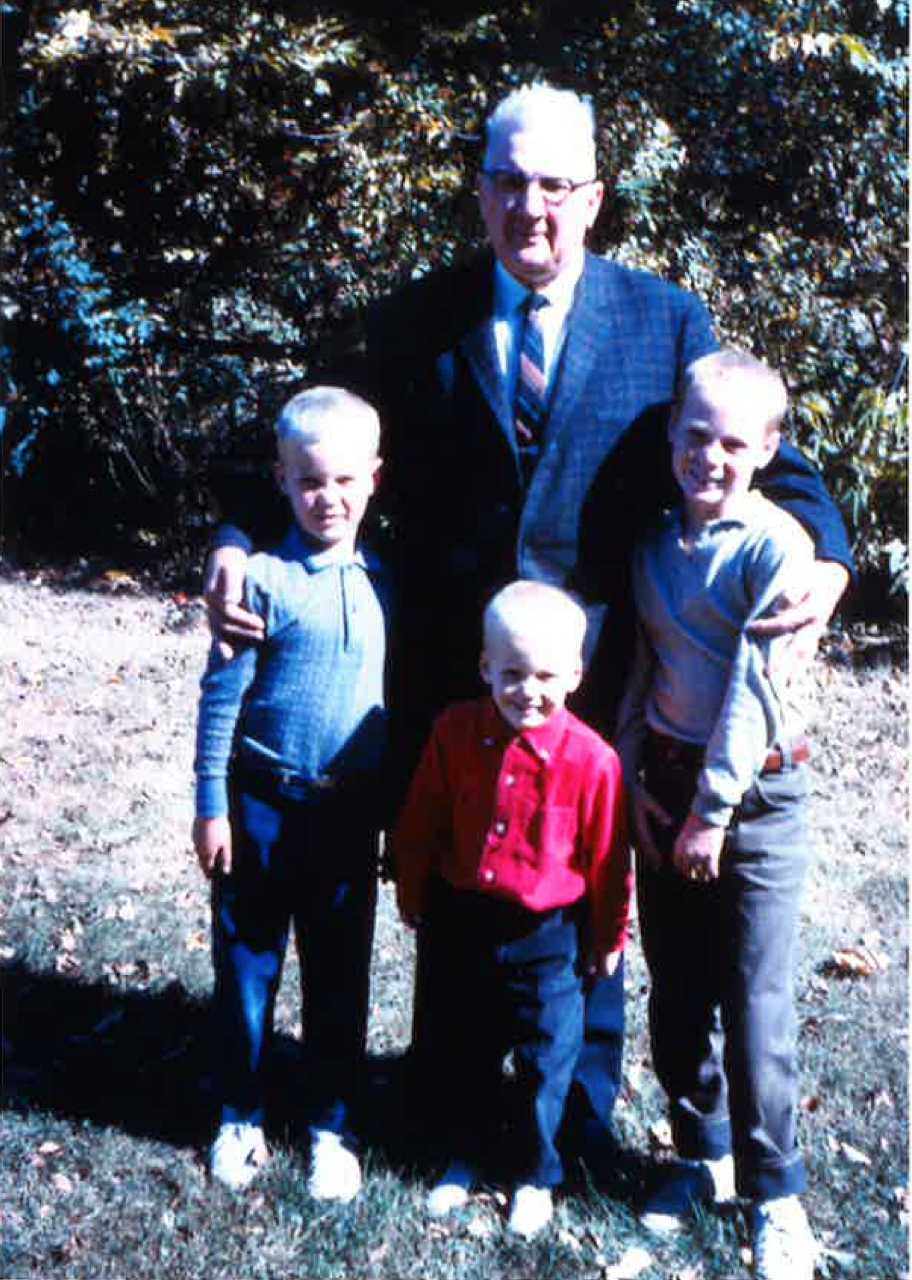
My esteem for Grandpa Ansel, my paternal grandfather, has not diminished in the passing decades. As evidence, my son’s middle name is in his honor.

Grandpa Ansel, my two older brothers and me.

While my memories of Grandpa are about as thin as one of his fly rods, I do vividly recall the way he softly whistle-hummed when he was concentrating,such as when tying fishing flies; and also when he hugged me, the quiet lip music as soothing as a cat’s purr.

Here is something I else I have never forgotten. I was maybe 7 years old, which would mean it was the final year of Grandpa’s life for he died in 1968 at age 76, and I was playing with little green plastic army men. This being during the Cold War, my American mini-G.I. Joes were naturally shooting up evil Russian soldiers.

Grandpa interrupted my war games, getting down on hands and knees on the carpet, and told me, gently but earnestly, that Russian boys were no different than me – they liked to fish with their grandpas, ride bicycles with their friends and play sports with their brothers, and probably loved orange soda almost as much as I did. Of a hundred family stories I have heard about Grandpa, to me this one has always encapsulated the humanity and wisdom that was woven into the fabric of his being.

All these years later, I was recently told a new story from seven decades past that doubled the height of the lofty pedestal on which I view Grandpa. The gift remembrance came from a former patient of his, for Ansel was a longtime country physician in the small rural town of Urbana, Ohio.

In 1954, Suzie was a high school senior with a college boyfriend. Her mother snoopily intercepted a love letter, had reason to think her daughter might be pregnant, and took her to see Dr. Ansel Woodburn. That choice was made for two important reasons: four years earlier, Ansel had delivered Suzie’s youngest sister; perhaps more chiefly, Suzie’s family had since moved from their farm just outside of Urbana to Springfield, some 20 miles away, and her mother thought an out-of-town doctor might prevent gossip.

“Needless to say, my parents were very angry,” Suzie says, adding: “My dad was not kind to me at all and my mother was no nicer.”

While there was only icy acrimony at home, Suzie was embraced with great warmth in Ansel’s medical office.

“I have never told anyone, not even my four children, about this episode,” Suzie confided to me. “It happened so long ago and life has moved on with a great force to live each day looking forward.”

Here and now, with me sitting in her Camarillo living room, Suzie looked backward. What she saw, and shared, began with heartbreak but in the end put birdsong – no, a soothing whistle-hum as she also remembered my grandpa doing – in her heart as well as mine.

To be continued, and concluded, next week.

*   *   *

Essay copyrights Woody Woodburn

Woody writes a weekly column for The Ventura County Star and can be contacted at WoodyWriter@gmail.com. Follow him on Twitter and Instagram at @woodywoodburn. His SIGNED books are available at www.WoodyWoodburn.com.
Shared Memory is Music to My Heart

Approaching the front door of an attractive home, two stories and gated, I was greeted with a gentle breeze that carried upon it a jazzy piano melody.

So lovely was the music, which I soon learned came from a gorgeous Steinway – a century-old family heirloom, in fact, played by a gifted pianist – that before gently knocking, rap-rap-rap, I stood outside the threshold for a very long moment and listened.

And yet an even more beautiful song awaited me inside, the song of a story shared about my paternal grandfather, life-changing memories from 69 years ago and 2,300 miles away.

Dr. Ansel Woodburn, aka my Grandpa

Before moving forward with this song, I must first briefly go backwards. Three years ago in this space, I wrote about my Grandpa Ansel who was a country physician in Urbana, Ohio. In part, I quoted from a yellowing newspaper clipping from The Urbana Daily Citizen with the headline “Fond Memories of Doc Prevail” below whichMarilyn Johnson recalled being treated by my grandfather many, many years ago.

“When I was small,” she wrote, “I was always breaking a bone. Dr. Ansel Woodburn would first of all use his trusty (and hated) thumb to locate the fracture. He would then set the bone and cast it.”

She specifically recalled one fracture and treatment: “After he casted my arm, he asked how my favorite doll was doing. Before I could say ‘Jack Robinson,’ he had fashioned a doll cradle with Plaster of Paris and wires on which to rock.”

In response to my column, I received an email from another patient my grandpa had cared for a long, long time ago. Suzie told me she was given an even greater kindness than a toy doll cradle.

Wondering how in the small world Suzie had come across my column nearly across the nation in Ohio, and also wishing to hear more of her recollections about Grandpa Ansel, I wrote her back and asked. Surprise of surprises, it turns out she now lives in Camarillo and subscribes to The Ventura County Star.

Moreover, Suzie very kindly invited me to come for a visit so she could share her memories in person. Alas, the busyness of life, as it has a way of doing, along with the pandemic, as it had a way of doing, got in the way. Recently, at long last, our get-together happened.

By convenience, and by a 1-in-365 coincidence, we unintentionally met up on the very day marking the 55th anniversary of Ansel’s death. Adding to the serendipity, perhaps raising it to fate or a Godwink, is this: In 1954, when Suzie was an 18-year-old high school senior walking into Ansel’s physician’s office, he was 62 years old. When Suzie, now an octogenarian, welcomes me into her home with a piano’s song, I too am 62.

Music and poetry go hand in hand, so I am reminded of an original poem Grandpa penned on the title page of his copy of “Modern Surgery,” an heirloom holy as scripture. It is dated October 1, 1919, four days before his 28th birthday:

“The worker dies, but the work lives on / Whether a picture, a book, or a clock

“Ticking the minutes of life away / For another worker in metal or rock

“My work is with children and women and men – Not iron, not brass, not wood

“And I hope when I lay my stethoscope down / That my Chief will call it good”

A narrative Suzie shared with me, and which I will share here next week, confirms that Ansel’s “Chief” called his life’s work “good.”

*   *   *

Essay copyrights Woody Woodburn

Woody writes a weekly column for The Ventura County Star and can be contacted at WoodyWriter@gmail.com. Follow him on Twitter and Instagram at @woodywoodburn. His SIGNED books are available at www.WoodyWoodburn.com.