
Fast-Break Iambic Rhythms

STRAW_CoverWoody’s highly anticipated new book “STRAWBERRIES IN WINTERTIME: Essays on Life, Love, and Laughter” is NOW available! Order your signed copy HERE! 

*   *   *

Iambic Rhythms at Fast-Break Pace

What do Alexander Hamilton and John Wooden have in common? An obvious answer is the number 10: Hamilton is on the 10-dollar bill and Wooden won a record 10 NCAA national championships as a basketball coach.

Meanwhile, about the last denominator the legendary secretary of the treasury and legendary Wizard of Westwood would seem to share is hip-hop music.1raphamilton

Well, the critically acclaimed Broadway musical “Hamilton” is performed in rap lyrics. Lin-Manuel Miranda, the creative genius who wrote the music, lyrics and playbook, is making rap more mainstream than March Madness office pools. Indeed, “Hamilton” is harder to get tickets to than the Final Four and here’s an iambic fast-break highlight why:

“How does a bastard, orphan, son of a whore and a Scotsman, dropped in the middle of a forgotten / spot in the Caribbean by Providence impoverished in squalor grow up to be a hero and a scholar?

“The Ten dollar, founding father without a father / got a lot farther by working a lot harder / by being a lot smarter by being a self-starter / by fourteen, they placed him in charge of a trading charter.”

Take a breath, because that is only the first 10 seconds of the four-minute opening song. Act I has 24 songs in all and Act II has 23.

Which brings us to three other rap songs, the video links to which a friend emailed me, asking: “What do you think Coach Wooden would think?”

In his offering “Wooden Heart,” artist Fearce Vill mixes imagery Coach would admire along with some Wooden-isms:

“I go the hard route / I don’t play it safe / because the scuff on my shoe represents / what I’ve been through / so I’m gonna keep runnin’, runnin’

“The scuff on my shoe represents / what I’ve been through / so I’m gonna take one day at a time / one day at a time

“Things turn out best for the people / who make the best of the way things turn out / Everybody want a free throw / but nobody want to work for it”

The artist known as “Freestyle” offers these slam-dunk lines:

“John Wooden taught me / you get back what you put in it / The things he said are music to my ears

“He taught us that a poor man’s wealth is his ability / Winning takes talent / to repeat takes character / That’s what he taught the people across America

“Success is never final / failure is never fatal / What counts is the courage you bring to the table.”

And in “The Keys,” Megan Ran uses the rhythmic verbal beat of a quickly dribbled basketball while incorporating Wooden’s famous Pyramid of Success along with other maxims:

“Most times we won / before we even stepped upon the court / Tools for life much bigger than any sport / Life lessons for leaders, athletes and teachers / even musicians pushing education through the speakers on me

“Yeah, on me / these are the keys, ready / enthusiasm, intentness, loyalty, dedication, physical and mental fitness, self-control, confidence, poise, skill and condition / Better get on your mission / to make it come to fruition

“Little things make big things happen / Make each day your masterpiece / Never forget the team /Always keep the ‘we’ before the ‘me’ / Ask questions / because these here are the best lessons / Follow these keys and success is destined.”

Now back to my friend Bill’s question of what Wooden might think of these rap songs were he alive today. I think, like me, he would love them!

After all, Coach had a passion for poetry – reading, writing, reciting. Indeed, listening to these hip-hop tributes reminds me of how Coach would oftentimes recite a poem, fast-paced, almost rapper-like.

Too, I believe he would be pleased that his teachings are being shared with a new generation and audience.

Coach Wooden, however, might have had one reminder for Fearce Vill, Megan Ran, Freestyle, and the cast of “Hamilton” – “Be quick, but don’t hurry.”

*  *  *

Woody Woodburn writes a weekly column for The Ventura County Star and can be contacted at WoodyWriter@gmail.com.
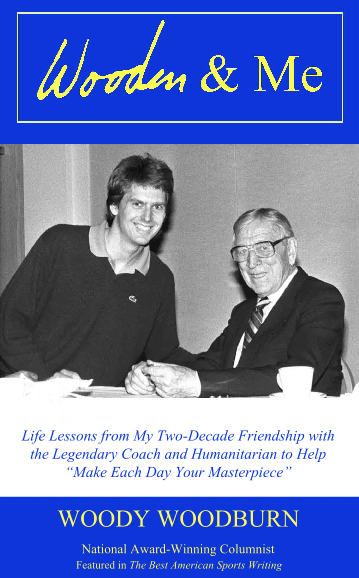
Wooden&Me_cover_PRCheck out my new memoir WOODEN & ME: Life Lessons from My Two-Decade Friendship with the Legendary Coach and Humanitarian to Help “Make Each Day Your Masterpiece”

My Farming Roots Run Deep

STRAW_CoverWoody’s highly anticipated new book “STRAWBERRIES IN WINTERTIME: Essays on Life, Love, and Laughter” is NOW available! Order your signed copy HERE! 

*   *   *

Family Roots: Soil, Seed and Corn

This Tuesday past was National Agriculture Day, a day I observed by enjoying some fresh guacamole made from local-grown avocados and earlier giving thanks to those doing backbreaking work in a strawberry field as I drove past.

As John Greenleaf Whittier wrote: Give fools their gold, and knaves their power; let fortune’s bubbles rise and fall; who sows a field, or trains a flower, or plants a tree, is more than all.

And, the poet should have added, he and she who harvest a field.1cornpic

My farming roots run five generations deep into the rich soil of Ohio.

My paternal great grandfather, J.D., in particular, was renowned in the agricultural community. His 330-acre farm on Route 68, south of the small town of Urbana, was saturated with nutrients from long-ago floodings of the Mad River. On this fertile land, over many years, he developed what respectfully became know far and wide simply as “Woodburn Corn.”

J.D. began with a variety of dark corn called “Ripley” that his grandfather began growing on the family farm 70 years earlier as animal feed. J.D. cross-pollinated Ripley with a light-colored variety called “Loudenbark.” The result was what you would expect: ears of corn with a mix of both light and dark kernels.

For several successive years, J.D. selected the darker of these new ears to use as seed to repeat the process, believing this would result in a more robust and bountiful variety.

A few years into his experimentation, J.D. tested his hypothesis by planting his hybrid seed in a side-by-side test. Specifically, he sowed seven acres with the darker selection he favored and seven acres with the lighter kernels he was trying to eliminate. To his surprise, the lighter corn out-yielded the dark – and greatly so.

Thereon, J.D. switched his focus to developing an improved variety of light-colored corn. Importantly, he also selected the ears with the largest kernels – the result being corn with more animal feed per ear. He ultimately would spend more than four decades improving his corn.

About 10 years into the process, a grain elevator worker noticed that J.D.’s corn was far superior to the other corn coming in. The worker started recommending it to others, and soon J.D. was selling all his extra seed to neighbor farmers – and much further away, too.

And for good reason: J.D.’s “Woodburn Corn” won the gold medal for the Utility Contest at the Ohio State Fair as well as the silver medal for Yield. With a test result of 98-percent germination, J.D.’s entry crop in the ten-acre contest resulted in 112.64 bushels of corn per acre.

“Topping one-hundred bushels per acre was like breaking the four-minute mile,” my dad recalls, adding of his trips as a young boy to the State Fair: “Farmers from all over would come up to ask Grandpa for advice.”

Interestingly, and remarkably, J.D. grew the prize bounty without using any manure or fertilizer. Rather, he simply grew it in a virgin pasture – that is how fertile his farmland was. “One of the choicest farms of his township,” according to The History of Champagne County, Ohio.

However, it took more than choice magical land to grow medal-winning crops.

“Good seed, that’s the one big secret of our crop,” J.D. told a newspaper reporter. “But I don’t know as you would call it a secret. It’s a thing any good farmer knows.”

While my great-grandfather won prizes for his corn, my great uncle – “Unc” – earned his own measure of local fame in Urbana for his green thumb.

Instead of using wooden stakes for his garden beans to climb, Unc got the idea to plant a single sunflower seed inside each circle of planted bean seeds – the beans, he reasoned, would then be able to climb the rising sunflower stock.

Well, as they say, the best laid plans . . .

The beans withered and died because the sunflowers bogarted the extra fertilizer and water intended for the beans. Not all was lost, however, as Unc boasted – and was teased for – “the tallest crop of sunflowers in town.”

*  *  *

Woody Woodburn writes a weekly column for The Ventura County Star and can be contacted at WoodyWriter@gmail.com.

Wooden&Me_cover_PRCheck out my new memoir WOODEN & ME: Life Lessons from My Two-Decade Friendship with the Legendary Coach and Humanitarian to Help “Make Each Day Your Masterpiece”

Part 2: Alvin the Roll Model

STRAW_CoverWoody’s highly anticipated new book “STRAWBERRIES IN WINTERTIME: Essays on Life, Love, and Laughter” is NOW available! Order your signed copy HERE! 

*   *   *

He is a roll model and inspiration

(This is Part 2 of a column that began last Saturday)

*

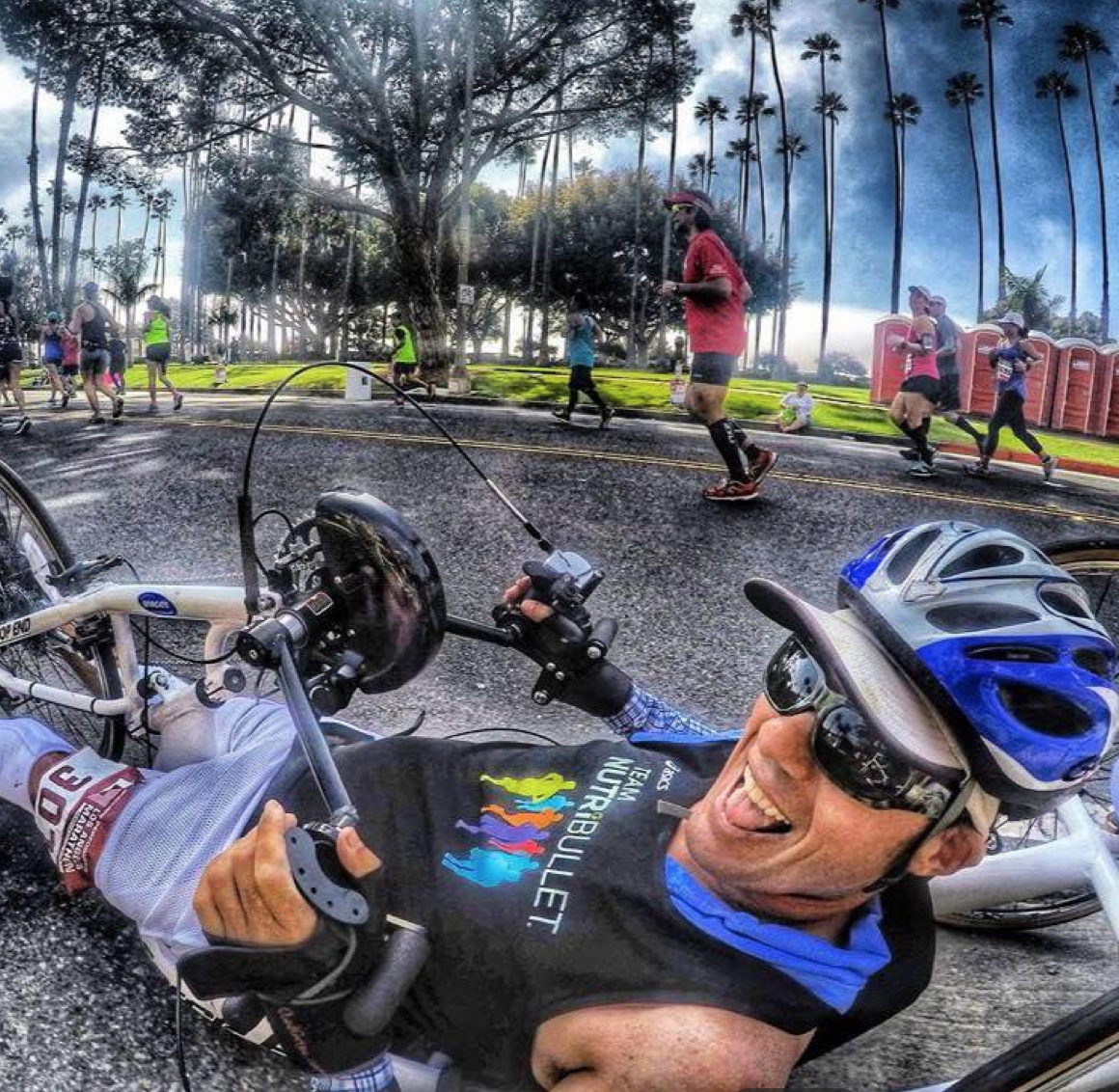
“Can I do this?” Alvin Matthews thought to himself, worry pumping through his veins, at the starting line of the 2016 Los Angeles Marathon.

A veteran of 20 previous marathons, including frigid treks at Antarctica and the North Pole, these were not normal pre-race jitters for the 44-year-old Ventura native.

1AlvinCycle

Alvin Matthews at the 2016 L.A. Marathon

The reason for Alvin’s apprehension was because this was his first post-accident marathon. Two years ago, he fell three stories and suffered a “catastrophic” spinal cord injury that left him in a wheelchair with limited use of his arms and hands.

Reaching the L.A. Marathon starting line on Feb. 14 required a Herculean effort by Alvin. It also required a village of doctors and rehabilitation therapists, family members and friends, and Team NutriBullet members who bought him an $8,000 state-of-the-art three-wheeled recumbent handcycle.

Two more vital benefactors were Mike Pedersen, a 3:30 marathoner and member of the Ventura Running Tribe club, and Orange County tri-athlete Brain Dao. They volunteered to escort Alvin – and provide energy drinks and gels; apply moleskin on hand blisters; and much more – along the marathon course.

On the way to the staging area, Alvin rolled through a human “Tunnel of Love” comprised of nearly 100 well-wishers. “The outpouring of emotions was overwhelming,” Mike recalls. It proved a mere sprinkle compared to the emotional deluge in the 26.2 miles ahead.

At 6:32 a.m., the starting horn blared for the wheelchair and handcycle racers.

At Mile 4, on a steep uphill leading to the Walt Disney Concert Hall, the chain slipped off Alvin’s handcycle. As Mike and Brian fixed it, the able-bodied runners who had started 15 minutes behind now caught up.

For the remainder of the marathon, Alvin would be in heavy traffic – and wonderfully so. Instead of a hindrance, it was a blessing. Instead of glares for having to weave around Alvin, the runners offered cheers.

“Nobody ever got upset,” shares Mike. “People would all say, ‘You got this!’ ‘Good job, brother!’ ‘Way to go, man!’ I’m not talking tens of times, even hundreds of times, but easily a thousand voices of encouragement throughout the morning.”

Indeed, the sometimes-mean city streets became a “Tunnel of Love” comprised of runners and spectators, police officers and firemen, race officials and volunteers.

So appreciative was Alvin that he kept giving high-fives as thanks, even though this cost him momentum and required difficult effort to get his hands slipped back into the chest-high “pedals” each time.

“The support from everyone was amazing,” Alvin says, adding twice more for emphasis: “Amazing, amazing!

“Before race I was worried, ‘Can I do this?’ and didn’t want to let myself down. But as the race went on, I knew I couldn’t let down all these people who were supporting me.”

While the cheers warmed his heart, Alvin’s body temperature was at constant risk of overheating because paralysis has robbed his ability to sweat. Out of necessity, Mike and Brian doused him with water every mile until Mile 23 when a steady downhill to the finish line allowed the competitor in bib No. 307 to pull away from his two-man entourage.

Magically, wonderfully, unexpectedly, Alvin soon gained two new escorts when Chris Pryor and Roge Mueller sneaked onto the course pedaling beach cruisers. Together, the three boyhood friends rolled the final two miles and through the finish chute as the race clock read 5 hours, 34 minutes.

In a photo with the finisher’s medal proudly draped around his neck, a neck once shattered and the reason he is laying supine in a racing handcycle, Alvin’s smile is beatific. It is the joyous smile of a boy in a Matterhorn sled at Disneyland for the first time. A smile of triumph, not tragedy.

“My accident has brought me closer to my mom and my brother,” Alvin shares. “It has given me new friends. There is so much bad stuff in the world, but I’ve found there is also so much good. So many people have come out of the woodwork to help me, even strangers and anonymous angels.

“They have all helped me realize I still have a great life.”

*  *  *

Woody Woodburn writes a weekly column for The Ventura County Star and can be contacted at WoodyWriter@gmail.com.

Wooden&Me_cover_PRCheck out my new memoir WOODEN & ME: Life Lessons from My Two-Decade Friendship with the Legendary Coach and Humanitarian to Help “Make Each Day Your Masterpiece”

Part 1: Miracle Man Alvin

STRAW_CoverWoody’s highly anticipated new book “STRAWBERRIES IN WINTERTIME: Essays on Life, Love, and Laughter” is NOW available! Order your signed copy HERE! 

*   *   *

Remarkable Journey to Starting Line

The race aside, Alvin Matthews’ journey to the starting line of the 2016 Los Angeles Marathon is a remarkable story in itself.

Alvin’s racing resume does not suggest it was a prodigious feat for him to be among more than 20,000 people lining up for the 26.2-mile challenge three weeks past. After all, the 45-year-old Ventura native had previously run 20 marathons with a PR of 3 hours, 13 minutes.

A cold Alvin Matthews at the top of the world!

A cold Alvin Matthews at the top of the world!

More impressively, Alvin has finished marathons around the globe in North America, Europe, Asia, Africa, Australia and Antarctica. He lacks only South America to join the select “Marathon Grand Slam Club” with 73 members to date who have completed marathons on all seven continents, plus the North Pole.

Yes, Alvin completed – “survived” is more accurate – the North Pole Marathon in frostbite conditions that would make a polar bear shiver. In addition to a race-day temperature of minus-27 degrees Fahrenheit, the 6-foot-2, 175-pound competitor had to forge through knee-high powered snow for five-plus hours. It wasn’t a marathon so much as an expedition like Robert Peary made more than a century ago.

By comparison, Alvin completed the Antarctic Ice Marathon in balmy 10-degree weather.

Conversely, in true heat, Alvin has also completed a 56-mile ultra marathon in South Africa. To be sure, the 1989 Buena High graduate has heavy mettle.

Two years ago, all those marathons, combined one after another into one mega race, was a smaller challenge than what Alvin suddenly faced.

In spring 2014, Alvin was living in Lebanon and working as a contractor overseeing civilian construction. Away from the dangers of the work site, tragedy befell him.

On April 15, he found himself locked out of his house. Because it was built into the side of a hill, Alvin had easy access to the flat rooftop that he could walk across to reach an open balcony. He had previously done this several times.

“This time I slipped,” Alvin recalls, “and fell three stories.”

He landed on concrete, on his neck, suffering what his doctors termed a “catastrophic spinal cord injury at the level C5 to C7.”

Translation: quadriplegia.

What Alvin shares next, and unbelievably with a smile, reveals his unbreakable courage and character: “I’m fortunate. If I landed a few inches either way, it could have been worse.”

With a state-of-the-art hospital in Beirut deemed too far away, Alvin was taken to a local facility that did not even have computer technology. Fortunately, an expert team of neurosurgeons was brought in from the capital. One of the doctors called Alvin’s survival “a miracle.”

The Miracle Man remained in the hospital for 25 days before returning to the United States. Two months in UC Davis Medical Center Hospital was followed by six weeks at the highly acclaimed Rehabilitation Institute of Chicago.

When catastrophe strikes, Alvin says there are two possible paths: self-pity or fortitude. He chose the latter, tackling rehab like it was a “Grand Slam” marathon.

Initially barely able to move only his left side, through diligent physical therapy Alvin slowly regained some movement and strength in both shoulders and arms. Use of his once-dominant right hand remains greatly limited, but he has become adept at most things with his left hand even though its coordination is also compromised.

“The support of family and friends, and also strangers rallying around me, has kept me going,” Alvin shares.

One such friend is Jim Freeman, who had helped coach Alvin for the 2010 L.A. Marathon. Now he invited Alvin to join Team NutriBullet as its only wheelchair athlete.

After the first practice, after seeing Alvin struggle with only his left hand able to grip a wheel to propel his chair, team members organized a fundraiser to buy an $8,000 top-of-the-line racing handcycle.

Days before the 2016 L.A. Marathon, Alvin received his sleek, three-wheel, 30-gear dream machine that allows his weak hands to be securely strapped into the “pedals.” With only two short test rides under his belt, Alvin rolled to the starting line.

He recalls worrying: “Can I do this?”

Next week in this space we will learn the answer.

*  *  *

Woody Woodburn writes a weekly column for The Ventura County Star and can be contacted at WoodyWriter@gmail.com.

Wooden&Me_cover_PRCheck out my new memoir WOODEN & ME: Life Lessons from My Two-Decade Friendship with the Legendary Coach and Humanitarian to Help “Make Each Day Your Masterpiece”