
Part II: My Top Top-Shelf Book

Woody’s debut novel “The Butterfly Tree” is available at Amazon (click here), other online retailers, and orderable at all bookshops.

*

Picking up where I left off last week in answering the question, “What is my favorite book that I own?”

While my previously mentioned 1885 first edition, seconding printing, of “Adventures of Huckleberry Finn” is monetarily the most-valuable volume in my Favorite Books Bookcase, a short stack gifted by friends and family are more priceless to me largely because they were thoughtful presents.

While my very favorite of favorites will surely come as a surprise, it is no surprise that “Wooden: A Lifetime of Observations and Reflections On and Off the Court” by John Wooden is on the elite shelf. This little blue book is big-time special because of the story behind it: when I politely told Coach I would instead buy my own copy because he had already given me too many gifts on previous visits, he grinned wryly and said he could not very well give it to someone else because he had already inscribed it to me…
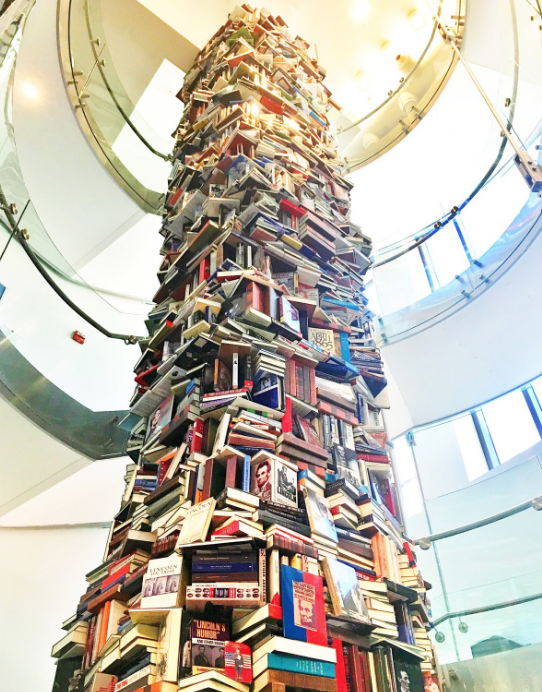
…but, after a moment’s reflection, Coach encouraged me to go ahead and buy a second copy and give it to a friend for no reason.

Writers who, like Coach Wooden, have made friendship a fine art with their own gift books now residing on my special shelf include Ken McAlpine, Roger Thompson, Mimi Herman, Geoffrey Simpson, Jacinda Townsend, Tom Hoffarth, Tavis Smiley, and Chuck Thomas.

Dog-eared paperbacks of “The Old Man and the Sea” and “Travels With Charley” have brought me great reading joy, but “good” condition hardcover first editions as gifts from my daughter make her Old Man’s heart Travel to the moon.

So dearly do I love “The Snow Goose,” which I have read a dozen times at least, that I gifted myself a volume signed by its author, Paul Gallico. Still, my favorite copy of this little-known 58-page novella is a 1941 first edition, its pricey value multiplied many times over because my friend Nick Sarris searched it out as a gift.

While first editions and signed title pages are indeed special, emotional provenance is no less so. Hence, three muddy-moss-colored cloth-covered obviously often-read hardbacks by John Steinbeck are exceptional beauties to my eyes because they were long-ago treasured by the father of my college dorm pal Mikey Weinberg-Lynn, who wanted me to have the family heirlooms because of my great admiration for the author.

Similarly, an age-worn collection of “The Bedtime Story Books” series by Thorton W. Burgess that belonged to my dad as a boy reside in my Favorite Books Bookcase.

But my all-time top top-shelf book is not a storybook, although it does indeed have myriad marvelous color illustrations; nor is it a novella or novel.

Rather, it is a textbook, placemat-sized and thick as “Ulysses” at more than 500 pages, and heavy as a cinder block because of the glossy paper throughout. The black hardcover, especially its spine, shows the wear from countless late-night study sessions, three successive generations in fact, for the book originally belonged to my grandfather Ansel, whose name is on the first inside page, then my father, and in turn my eldest brother – doctors all.

Why in the world would “An Atlas of Anatomy” by J. C. Boileau Grant, a 1947 second edition, be my most cherished book? Because two days before my big brother passed away – exactly a year ago this week – during my very last bedside visit with him, Jimmy gave it to me along with these whispered final words:

“You’ve been a great little brother.”

And so it is that I learned, on page 440, about orifice of naso-lacrimal duct – the tear duct.

* * *

Essay copyrights Woody Woodburn
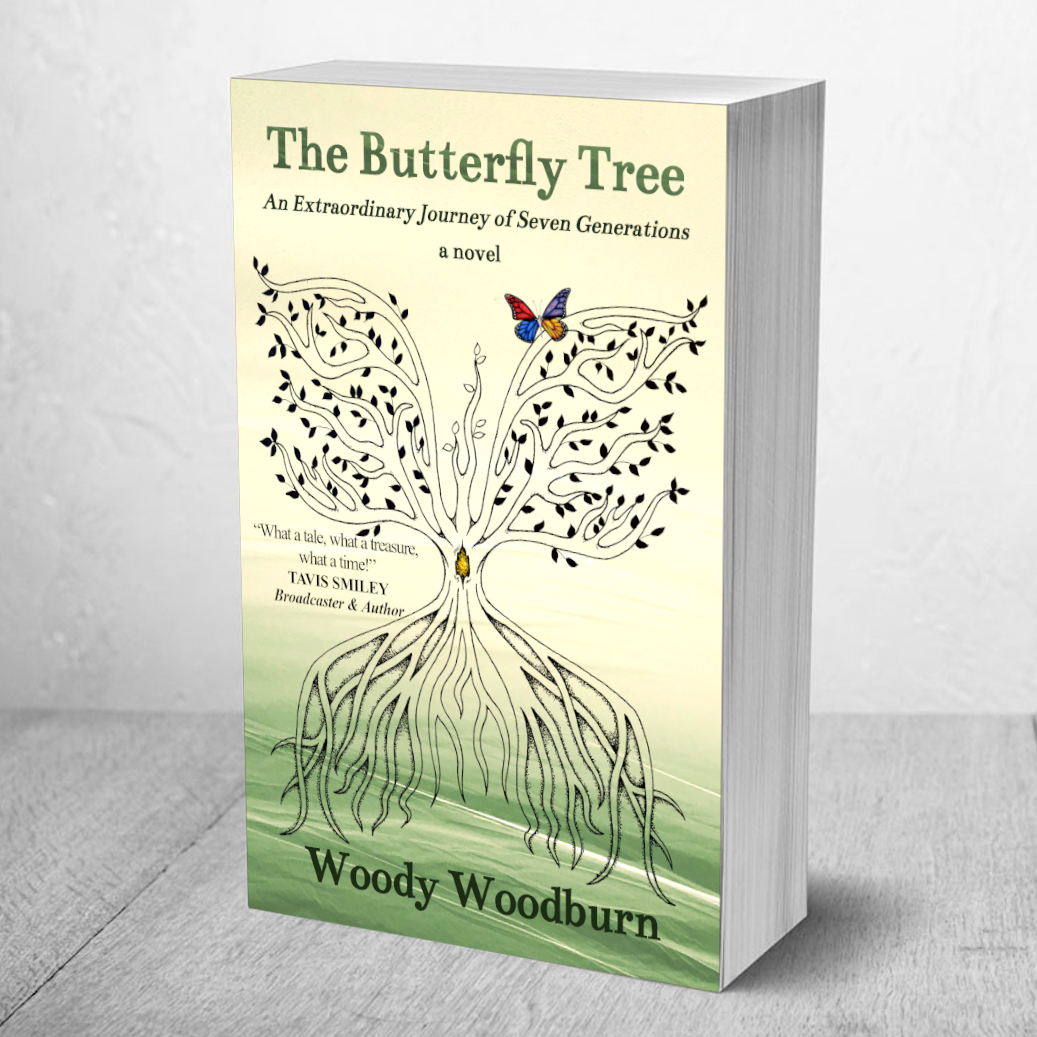
Woody’s new novel “The Butterfly Tree” is now available in paperback and eBook at Amazon (click here), other online bookstores, and is orderable at all bookshops.

*

Woody writes a weekly column for The Ventura County Star and can be contacted at WoodyWriter@gmail.com. Follow him on Twitter and Instagram at @woodywoodburn.
Part 2: The Man Who Loves ‘Ulysses’

My new novel “The Butterfly Tree” is available at Amazon (click here), other online retailers, and orderable at all bookshops.

*

There was no tinkling bell above the door. Instead, my entrance was greeted by a singsong voice as warm as a Writers’ Tears toddy: Helloooo, and where are you from?”

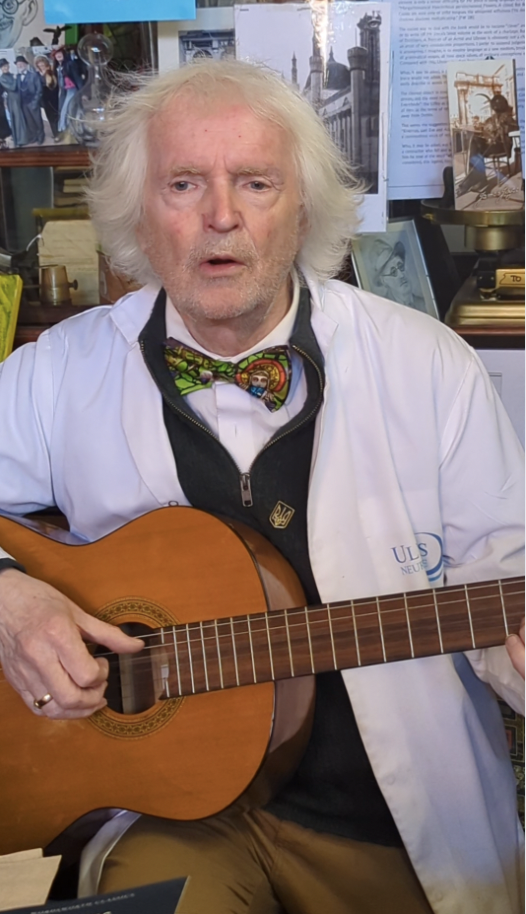
It was not the last music the proprietor of Sweny’s small bookshop in Dublin, Ireland, would treat me to. Shortly thereafter, he retrieved a handsome guitar and sang—in Gaelic, so I have no idea what the words meant, much like reading James Joyce can sometimes feel; yet nonetheless, again like Joyce’s prose, was lovely to the ear.

Patrick Joseph Murphy, introduced in this space two weeks past, is as Irish as his name suggests; so Irish his family founded iconic Murphy’s Stout Brewery in County Cork, some 150 miles southwest from Dublin, in 1856, its dark nectar becoming the first beer transported around the world on refrigerated ships; so Irish his accent makes you think of leprechauns.

Patrick James Murphy, proprietor of Sweny’s bookshop, in song…

In appearance, however, “P.J.”—as he prefers to go by—brings to mind America and Hollywood and “Back to the Future” movies, specifically the charismatic mad scientist, Dr. Emmett Brown, with longish wild electrified white hair and the enthusiastic verbal energy of a lightning bolt.

Also like Doc Brown, and in a nod to his fourth-great-grandfather Frederick William Sweny, who originated the store as a pharmacy in 1853, P.J. always wears a white lab coat at work. Too, on this day, P.J. wore an easy smile and a bowtie as colorful as a stained-glass window.

His family continued to own and run “F.W. Sweny & Co. Ltd. Dispensing Chemists” through 1926, at which time it remained a pharmacy in other hands until 15 years ago when it was sold to become—“Great Scott!” as Doc Brown would say in exasperation—a dispenser of upscale coffee. Unable to bear that thought, P.J., then in his late 60s, reacquired the store and turned it into a bookshop devoted solely to famed Irish writer James Joyce, who frequented the original Sweny’s and included a lengthy encounter within in his epic novel “Ulysses.”

At well over 700 pages, treading fully through the tome is the literary equivalent of climbing Mount Everest; many who begin the journey do not reach the summit—or final page. P.J. admits he quit in the early going the first time, at age 18, he set out to conquer the voluminous volume. Many years later, he tried again and succeeded, and has kept climbing as untiringly as Sisyphus ever since.

At last count, P.J. has scaled Mount “Ulysses” a staggering 73—yes, seventy-three—times! Adding to this Herculean erudite feat, he has done so in all seven languages (English, Portuguese, French, Italian, Spanish, German, Russian) he speaks, often reading aloud to groups he hosts at Sweny’s nearly every evening. Not surprisingly, he readily quotes passages from the novel at length from memory.

“I’ve earned an unofficial PhD when it comes to Mr. Joyce, I should think,” Professor P.J. noted. “I’ve read everything he wrote, though of course ‘Ulysses’ is my favorite.”

Later, during our hour-long visit, he cajoled: “After being in Dublin, you must read ‘Ulysses.’ It’s all about Dublin. After you finish it you can come back from California and we can talk about it more.”

With a wink, P.J. added a nudge: “ ‘Ulysses’ is best enjoyed with the book in one hand and a whiskey in the other.”

“That’s a lot of Jameson,” I laughingly replied, then asked for a shorter Joyce recommendation. Thus I purchased a copy of “Dubliners” that, at only 202 pages, was no threat to push my suitcase overweight as would “Ulysses.”

* * *

Essay copyrights Woody Woodburn

Woody’s new novel “The Butterfly Tree” is now available in paperback and eBook at Amazon (click here), other online bookstores, and is orderable at all bookshops.

*

Woody writes a weekly column for The Ventura County Star and can be contacted at WoodyWriter@gmail.com. Follow him on Twitter and Instagram at @woodywoodburn.

Part 1: A Most Unique Irish Bookshop

Woody’s new novel “The Butterfly Tree” is available at Amazon (click here), other online retailers, and orderable at all bookshops.

*

Don’t judge a bookstore by its front façade is a lesson I learned in Ireland, in Dublin, in the late afternoon after stepping inside a dog-eared shop, taller than wide, with a recessed front entryway bookended by two display windows above which are three rising arched panes, each one topped by rectangular signage of capitalized gold letters on black, reading left to right:

DRUGIST / SWENY / CHEMIST

To be sure, nothing on the outside suggested a bookshop. My first impression—and second, third, sixth, for I walked past it the daily from across the street for nearly a week—was that it was a pawnshop. And so, while I adore bookshops as dearly as I do ocean sunsets, I kept passing by without stopping to look more closely.

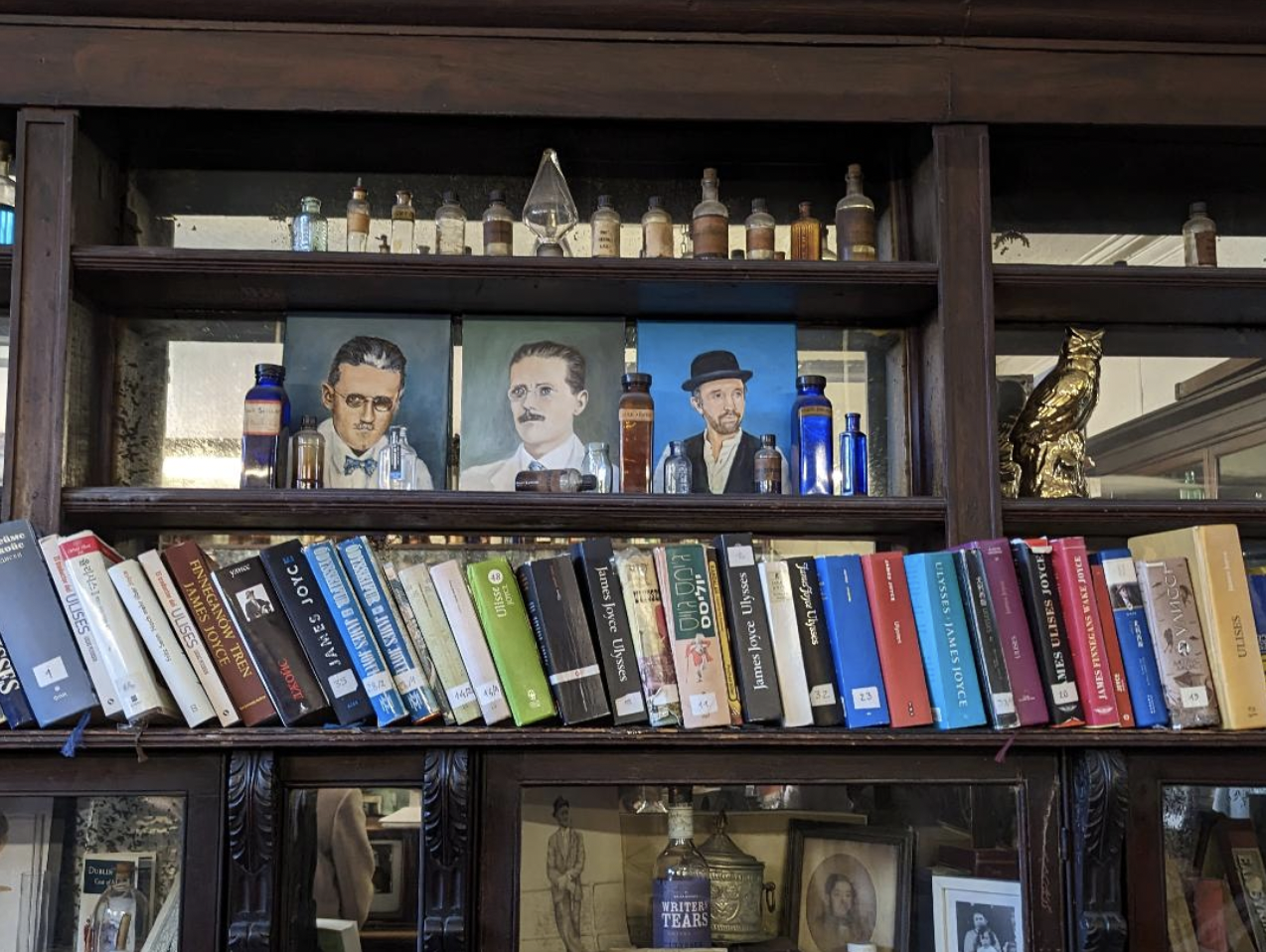
Some of the 45 editions of “Ulysses” all in different languages.

On our last full day in the Emerald Isle’s capital not too long ago, however, after getting happy in Kennedy’s Bar, established in 1850 and famous as a hangout for renowned writers Samuel Beckett and Oscar Wilde and James Joyce, I pointed kitty-corner and inexplicably suggested to my wife, “Let’s check it out.”

It proved to be like finding a four-leaf clover.

Built in 1847 as a physician’s office, six years later it became a pharmacy: “F.W. Sweny & Co. Ltd: Dispensing Chemists.” Flipping the calendar pages further forward to 1904, James Joyce stepped through the front door and consulted with the pharmacist, Frederick William Sweny himself, a visit that is described in great detail in Chapter 5 of Joyce’s novel for the ages, “Ulysses.”

Sweny’s also lies within 50 yards of the location where, that very same year, Joyce was stood up by Nora Barnacle. Two days later, on June 16, his future wife yielded to his advances and thus the date would famously become know as “Bloom Day” in honor of the hero, Leopold Bloom, in “Ulysses” which takes place entirely on that single day.

And so it is that Sweny’s has the great honor of being immortalized in sumptuous prose within the tome’s pages when Bloom comes into the shop. Two very brief excerpts: “He waited by the counter, inhaling the keen reek of drugs, the dusty dry smell of sponges and loofahs.” And: “He strolled out of the shop, the newspaper baton under his armpit, the cool wrappered soap in his left hand.”

More than a century later, I walked inside and inhaled not a reeky smell, but a lovely fragrance of a bookstore and later strolled out with a book in my left hand—Joyce’s “Dubliners,” a handsome limited edition green-cloth hardback with gilt lettering wrappered old-timey in brown paper.

The upper reaches of the soaring shelves, for the ceiling is as lofty as a poetic tree, remain stocked with antique medicine bottles of sea-glass green and ocean blue and fog white. The lower shelves, and handsomely old countertops too, are filled with a different medicine, for the mind—books.

Uniquely, every dose of pages for sale is by James Joyce: “Finnegans Wake”, “Dubliners”, “A Portrait of the Artist as a Young Man” … and, most prominently, “Ulysses”—including a collection of editions in 45 different languages. Also on display is a rare death mask of Ireland’s arguably most celebrated writer.

But what truly makes the Joyce-themed Sweny’s one of my all-time favorite bookshops is the proprietor, the great-great-great-great-grandson of Frederick William Sweny. Patrick Joseph Murphy, who goes simply by P.J., is as interesting as the day is long—rather, as interesting as “Ulysses” is long at 700-plus pages.

And I will tell you much more about P.J. here next time.

* * *

Essay copyrights Woody Woodburn

Woody’s new novel “The Butterfly Tree” is now available in paperback and eBook at Amazon (click here), other online bookstores, and is orderable at all bookshops.

*

Woody writes a weekly column for The Ventura County Star and can be contacted at WoodyWriter@gmail.com. Follow him on Twitter and Instagram at @woodywoodburn.