Column: Stan Smith stands tall

My new memoir WOODEN & ME is also available here at Amazon

*   *   *  

Ojai to Wimbledon, Stan Smith shined

Nearly two decades before fictional Iowa farmer Ray Kinsella built his “Field of Dreams,” a Court of Dreams was laid down in the middle of an Ohio cornfield for the inaugural 1970 Buckeye Open – now the ATP Western & Southern Open in Cincinnati.

The green hardcourt was built and they came – Arthur Ashe, Charles Pasarell, Tom Gorman, an aging Pancho Gonzales, and that year’s eventual singles champion, Bob Lutz.

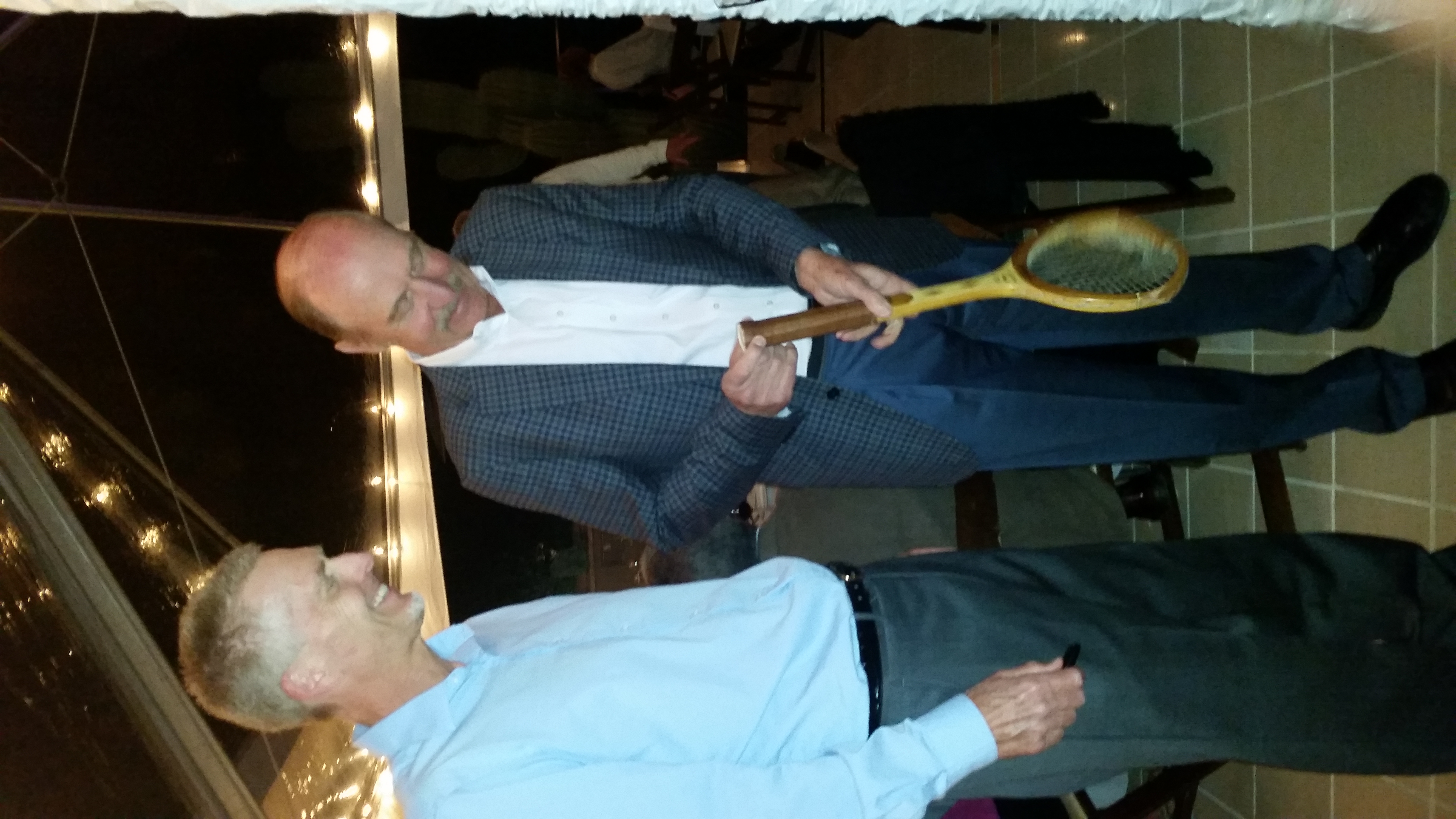
However, it was Lutz’s doubles partner out of the University of Southern California, Stan Smith, who made the quickest – and most lasting – impression upon me.1stansmith

I was a 10-year-old rookie ball boy working the very first match of the pro tournament. Like Smith, my forte was at net where I was quick and confident. But unlike the tall, lanky, blond Californian, I was not falling prey to my own miscues. The opening set was over quickly as Smith didn’t win a game.

In the second set, however, the three-time All-American from USC and 1968 NCAA singles champion found his form. Unleashing aces instead of double faults, put-away volleys and laser-guided passing shots instead of unforced errors, Smith won the second set as fleetly as he had lost the first. Ray Ruffels, a lefty out of Australia, suddenly became Ray Ruffled as Smith ran out the match, 0-6, 6-0, 6-0.

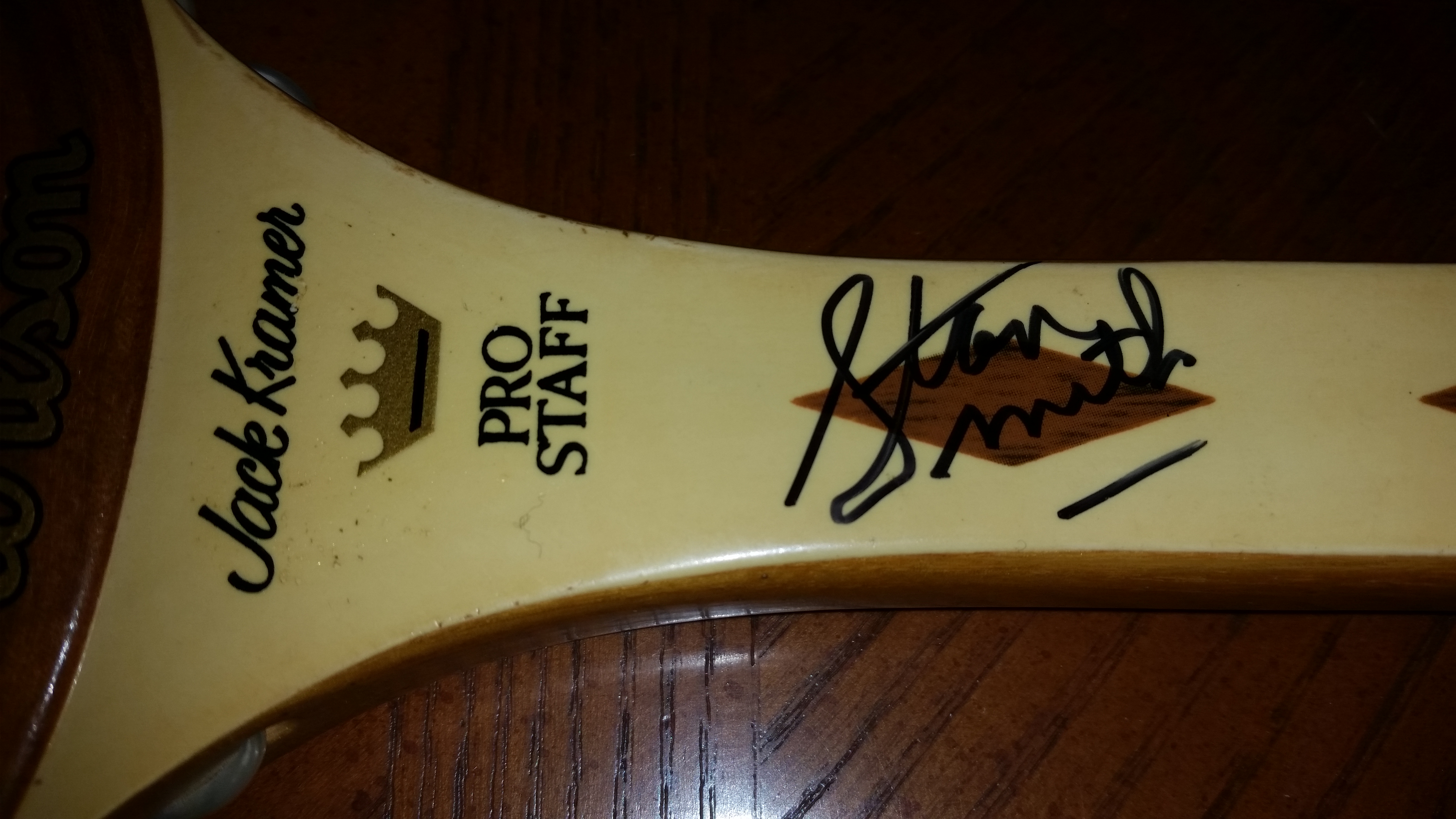
Walking off the court my new idol paused to sign “Good luck, Stan Smith” on the brim of my tennis hat. A week later I got more than an autograph. I scored one of Smith’s rackets – a custom Wilson Jack Kramer Pro Staff model, weighted “Heavy” with an oversized 4-7/8 grip.

On match point of the doubles final, Smith hit an overhead a fraction high of the sweet spot and the wooden racket head collapsed like a dry leaf. Still, the shot had enough power to win the point and give the title to Smith and Lutz.

Before shaking hands with their opponents at the net, Smith handed me his splintered racket. It was like having Babe Ruth give you a cracked bat before his home-run trot.

Behind a serve that came out of the treetops and a net game so monstrous that Romanian star Ilie Nastase nicknamed him “Godzilla,” the mustachioed Smith soon rose to No. 1 in the world. He won the 1971 U.S. Open. He won Wimbledon in 1972. He won the prestigious year-end WCT Finals twice.

Too, Smith was Mr. Clutch in Davis Cup play, going 15-5 in singles and 20-3 in doubles (13-1 with Lutz) while setting a record by personally clinching the Cup five times.

Stanley Roger Smith was inducted into the International Tennis Hall of Fame in 1987 but his credentials date back to The Ojai Tennis Tournament “Where Champions Are Discovered” and where he won the 1964 Boys’ Interscholastic singles title and added three Collegiate singles crowns, two Collegiate doubles titles and one Open Doubles championship.

More than a half-century after his first appearance at The Ojai, Smith will be back at this year’s 115th edition of the prestigious event. On April 23 he will attend the traditional Thursday Night BBQ and on April 24 will be the guest of honor at a special reception from 5:30 to 7:30 at the Ojai Vineyard Tasting Room to raise funds for capital improvements to the tournament. Tickets can be purchased online at: www.ojaitourney.org.

“The main goal, of course, was to play on the main Libbey Park courts,” Smith, now 68, recently recalled. “That was really special.”

The Pasadena native who now resides in Hilton Head Island, S.C. where he runs his own junior tennis academy, continued: “And the orange juice stand was the other highlight. It’s funny how certain things stand out in your mind.”

Funny indeed. When he was losing that six-love set to Ray Ruffels, this is what stands out in my mind: Stan Smith argued a line call – that had gone in his favor and ultimately gave the point to his opponent.

I think of that whenever I look at that broken keepsake racket hanging on my wall to this day.

*   *   *

Woody Woodburn writes a weekly column for The Ventura County Star and can be contacted at WoodyWriter@gmail.com.

Wooden-&-Me-cover-mock-upCheck out my new memoir WOODEN & ME: Life Lessons from My Two-Decade Friendship with the Legendary Coach and Humanitarian to Help “Make Each Day Your Masterpiece”

Column: Sweet and Sour Tale

My new memoir WOODEN & ME is also available here at Amazon

*   *   *  

True Tale of the Sweet Meatloaf

News item: The Dietary Guidelines Advisory Committee recently recommended that no more than 10 percent of daily calories – roughly 12 teaspoons – should come from added sugar.

Americans currently consume more than twofold that sweetness, which sounds like a lot unless you compare it to the 1960s when 1sugarcrsipkids’ diets consisted of the four basic food groups: meat, potatoes, dairy, and sugar. The ratio most commonly followed was five percent, five percent, ten percent and eighty percent.

A typical breakfast in The Sixties consisted of Super Sugar Crisp, Frosted Flakes, Cocoa Puffs, Froot Loops or cardboard-like Wheaties, the latter requiring adding six heaping spoonfuls of sugar on top in order to reach food group nutritional goals.

Indeed, if there wasn’t syrupy undissolved nectar at the bottom of the cereal bowl afterwards, you had not added enough sugar. Similarly, Tang – the drink of astronauts! – and Nestles Quick were best mixed by tripling the directions for the number of spoonfuls recommended.

Since my two older brothers, younger sister, and I could never agree on one cereal, when we went to Grandpa Ansel’s house for the weekend we were greeted with a mega-pack of single-serving boxes featuring a dozen different kinds. We would “draft” the mini-boxes by taking turns. Trades – and fights – followed. Only Risk and Monopoly were more contentious.

Cold cereal also made a great lunch when we grew tired of bologna on white Wonder Bread, peanut butter and jelly on white Wonder Bread, or hotdogs on white Wonder Bread.

Too, many a night at the dinner table when Pop said we had two choices – “Take it or leave it!” – regarding liver and lima beans or some other culinary punishment, we proved him wrong with a third choice: Cereal!

This is not to suggest Mom was a bad cook. She was terrific. I have yet to taste the equal of her spaghetti sauce, although Pop recently revealed her secret ingredient, I kid you not: a little sugar.

In The Sixties the granulated white stuff was considered as magically healthy as penicillin. Mary Poppins even advised in song: “A spoonful of sugar makes the medicine go down.”

Mom’s meatloaf – despite containing no sugar so far as I know – was legendary. This is not hyperbole. For some reason, perhaps the gross humor of three young sons rubbing off on her, when serving meatloaf Mom always mentioned she had mixed it with her bare feet, much like a winemaker stomping grapes.

This family joke – “gag” is perhaps the more appropriate word choice – soon had us boys delightedly asking, with feigned hope, if Mom had played tennis earlier in the day. To which she would playfully answer: “Yes, three sets, and I didn’t wash my feet afterwards so the meatloaf should be especially tasty tonight!”

One afternoon my best friend Dan was over and when dinnertime neared he phoned home to see what his mom was cooking. I asked my mom the same question. It was a tactic we routinely employed to decide where we wanted to eat. This time my house had the best menu.

1meatloafWhile washing our hands I mentioned that I hoped my mom hadn’t washed her feet before making the meatloaf and naturally Dan looked at me quizzically. When I explained how she mixed the meatloaf with her stinky toes, he of course did not believe me.

As we sat down at the dinner table, as if on cue, one of my big brothers asked Mom how smelly her feet were today. Mom, also as if rehearsed for this very moment, enthusiastically replied she had played an extra set of tennis because she knew Dan might be staying for dinner and she wanted the meatloaf to be extra delicious.

Dan, queasily but earnestly, asked: “Uh, Mrs. Woodburn” – in the 1960s kids didn’t know grown-ups’ first names, much less address a parent by one – “you don’t really use your bare feet, do you?”

Mom replied deadpan: “Why of course I do, Dan. Doesn’t your mom?”

I am certain it was not the first time Dan had Super Sugar Crisp for dinner.

*   *   *

Woody Woodburn writes a weekly column for The Ventura County Star and can be contacted at WoodyWriter@gmail.com.

Wooden-&-Me-cover-mock-upCheck out my new memoir WOODEN & ME: Life Lessons from My Two-Decade Friendship with the Legendary Coach and Humanitarian to Help “Make Each Day Your Masterpiece”


Column: Payphone Slot Machine

My new memoir WOODEN & ME is also available here at Amazon

*   *   *  

Hung Up On Saving a Sweet Dime

Anyone with a Facebook page or their own blog will find this hard to believe, but in the 1960s there were no personal computers. Also no VCRs, much less DVDs or DVRs. No microwave ovens or cell phones.

Largely no parental supervision, either.1payphone

Indeed, The Sixties seems a prehistoric era. We “dialed” numbers on rotary phones, listened to “records” and newfangled “eight-track” tapes, and if your car broke down or ran out of gas you had to find a telephone booth (Google it) which cost a dime to make a local call.

Usually a dime. My oldest brother discovered that if you hung up a payphone the very millisecond someone answered on the other end, the automated switchboard perceived the call had not gone through and your dime would drop into the change slot.

Hence, Oldest Brother told Mom that when she answered the phone and no one was there, it meant he needed to be picked up from school, football practice or a friend’s house.

One problem. This required Mom to know where Oldest Brother was. In The Sixties, 99.2 percent of parents did not concern themselves with such trivial matters as knowing the whereabouts of their children between 8 a.m. and 8 p.m.

My two older brothers and I could go next door to use power tools unsupervised, ride our bikes without helmets across town to the comic book store, or hop on a boxcar with hobos and so long as we were home by eight o’clock there would be no questions asked. Most likely, we would not have even been noticed missing.

Frequently as not, when Oldest Brother phoned home and quickly hung up Mom went to the wrong place to pick him up. She would waste a dollar of gasoline driving around town to find Oldest Brother, who was thrilled to have saved a dime.

More than once Mom went to the right place to get Oldest Brother only to learn had not called for a ride home yet – his “secret code” had been a wrong number hang-up. Amazingly, these miscommunications never seemed to ruffle Mom.

Even running out of gas, in a downpour, did not get Mom steamed up. It helped that the faux-wood-paneled station wagon sputtered dead at an intersection with gas stations on three of the four corners. An attendant across the street saw Mom wave in distress out the driver’s window and came running through the rain to the rescue with a gas can.

Amazingly, Mom happily escaped this “I Love Lucy”-like madcap situation without even getting wet. She made us three boys in the backseat swear to secrecy because Pop was forever admonishing her for acting as though “E” on the gas gauge stood for “Enough.”

As you might imagine, the moment Pop came home from work that evening we rushed to tell him all about our adventure; he just shook his head because he knew Mom had not learned her lesson.

Back to Oldest Brother’s hang-up ploy. The biggest problem came after he taught Middle Brother and me how to turn the payphone into a slot machine with a dime payout. Now Mom had no idea who had hung up on her, much less where we were.

1-pixieAll this hassle to save a dime might seem nuts, but back then ten cents bought a Snickers, or a six-pack of mini-Coke bottles made out of paraffin and filled with colored sugar water, or a roll of chalky Necco Wafers, or ten Pixie Stix paper straws filled with granulated sugar flavored grape, lemon-lime or cherry.

So when the Dietary Guidelines Advisory Committee recently recommended that no more than 10 percent of daily calories – roughly 12 teaspoons – should come from added sugar, I had to shake my head. In The Sixties, only 10 percent of a kid’s calories didn’t come from sugar.

Today, Americans gulp down an average of 22 teaspoons of added sugar daily, nearly twofold the new recommendation – or about the amount my brothers and I ate between calling home and when Mom finally picked us up.

To be continued next Saturday…

*   *   *

Woody Woodburn writes a weekly column for The Ventura County Star and can be contacted at WoodyWriter@gmail.com.

Wooden-&-Me-cover-mock-upCheck out my new memoir WOODEN & ME: Life Lessons from My Two-Decade Friendship with the Legendary Coach and Humanitarian to Help “Make Each Day Your Masterpiece”

Column: Homeless Compassion

My new memoir WOODEN & ME is also available here at Amazon

*   *   *  

Homeless Deserve Compassion

It was a recent evening, lovely even by California standards, and after enjoying dinner at an Italian restaurant my daughter and I were walking to a theater. Along the way, predictably, we encountered a homeless man encamped on the sidewalk.

Also, predictably, he was begging for spare change.1-homeless

Predictably, too, my daughter instead offered him a take-out box containing half of a savory dinner, complete with plastic utensils she had thought to ask our waiter to include in anticipation of this scene.

“What is it?” the unkempt and unshaven man asked.

“Pasta and chicken,” my daughter answered, adding: “It’s delicious!”

The man, wearing a knit cap despite the unseasonably warm evening, shook his head like a child who has been offered Brussels sprouts and waved his hands as though shooing away a pigeon. “Nah, I don’t think I’d eat that,” he said dismissively.

As we walked on, slightly stunned at the rejection, my daughter observed: “At least he was honest about it so we can give it to someone who will enjoy it.”

Curmudgeonly, I said: “If it was a Big Mac you know he would have been thrilled.”

Perhaps I was correct, but certainly my daughter was because on the very next block she succeeded in doing what Mother Teresa urged: “If you can’t feed a hundred people, feed just one.”

Truth is there are a hundred, and hundreds more, locally who need to be fed – and clothed and given a warm and dry place to sleep, especially on those nights far harsher than the one recalled above.

So I was dismayed by a Feb. 15 guest column in The Star under the headline: “How to end homelessness? No extra services.” The writer argued that the efforts of local faith leaders and their materialistic solutions to end homelessness will only worsen the problem, not help it.

Among the writer’s contentions is that “the majority of the chronically homeless have substance abuse and/or mental illness issues they simply refuse to deal with responsibly.”

But therein lies the Rubik’s cube: it is no simple matter for anyone struggling with mental illness or substance abuse – even those with the financial means to afford the best help – to deal with these challenges responsibly.

Indeed, to complain, as the commentary did, “If they would just get clean and sober,” is to diminish not only the problem but the individuals, as though mental illness and addiction are a choice.

Compassion, on the other hand, is a choice. Treating the down-and-out with respect, not scorn, is a choice. Offering a helping hand is a choice. Choices we must make.

To be sure, help and services will too often seem in vain. But if there were an easy fix, it would have happened already. I would rather have a citizenry that tries and fails to help the homeless than one that fails to try.

Just this week Pope Francis did something so small to help the poor that it is actually huge: a space off of St. Peter’s Square has been transformed to offer homeless men and women shower facilities daily and free haircuts and shaves every Monday. The biggest offering – a little dignity.

Closer to home, Scott Harris is also trying to help the least among us in a way that often goes overlooked. His local firm, Mustang Marketing, is holding a “Sleeping Bag Drive.” Used bags donated to its office at 3135 Old Conejo Road in Thousand Oaks by March 15 will be dry cleaned before being given out. Better yet, every $25 donation will pay for the purchase of a new sleeping bag. (Information: 805-498-8718)

“When it’s all said and done,” Harris says, “no one should go to bed cold. We can make a difference.”

Nor should anyone go to bed hungry. Walking back to our car after the show, my daughter and I again passed the homeless man who had wrinkled his nose at her pasta and chicken leftovers. He was eating a fast-food hamburger. Happily, someone else had made a small difference more to his liking.

*   *   *

Woody Woodburn writes a weekly column for The Ventura County Star and can be contacted at WoodyWriter@gmail.com.

Wooden-&-Me-cover-mock-upCheck out my new memoir WOODEN & ME: Life Lessons from My Two-Decade Friendship with the Legendary Coach and Humanitarian to Help “Make Each Day Your Masterpiece”


Column: Pooh Bear and Heartbreak

My new memoir WOODEN & ME is also available here at Amazon

*   *   *  

Pooh Bear No Match For These Tears

When my daughter was very young and in daycare, I would frequently pick her up and take her out on a lunch “date.” We always had a wonderful time, but when I would drop her off again so I could go back to work, she always cried.

And cried and cried, so much so that her grandmotherly caregiver eventually suggested it might be best to stop these noontime excursions.

Celine and Dallas lighting up Paris with their smiles.

Celine and Dallas lighting up Paris with their smiles.

The next time I dropped Dallas off after a lunch outing, I tried something crazy and gave her one of her favorite stuffed animals to remind her of me, and our bedtime reading ritual, as she went down for her afternoon nap.

Winnie the Pooh worked like a charm. The tears stopped and our dates continued.

Fast forward just over a dozen years. After hugging Dallas goodbye on move-in day her freshman year in college, I handed her a small stuffed Winnie the Pooh. Through her tears came a smile.

I needn’t have worried, of course. Minutes after we left, Dallas’ very first new college friend walked into her dorm room. This human Winnie the Pooh’s name was Celine. She lived across the hallway and came bearing an extra Popsicle.

Instant friends, they became roommates the following three years, and lasting friends who after graduation visited each other around the globe from Los Angeles and San Francisco to London and Paris, the latter where Celine moved to pursue a career in fashion.

Early Monday morning my daughter called me, heartbreak like I’ve never heard in her voice: “Celine is dead, Daddy.”

Celine was in India for a friend’s wedding and while riding in a taxi was hit by a bus. Twenty-six is far too young to lose your life and 27 is far too young to lose a best friend.

Talking to Dallas on the phone numerous times daily since – in truth, mostly listening to her because really a parent is hopelessly impotent to help in any other way in such a tragic time – I have been reminded of those long ago nights reading to her about another friendship, from A.A. Milne’s classic “Winnie the Pooh,” and specifically the passage where Christopher Robin tells Pooh Bear:

“If ever there is tomorrow when we’re not together, there is something you must always remember. You are braver than you believe, stronger than you seem, and smarter than you think.”

Celine, in a way, gave this same gift to Dallas, who recalls: Freshman year of college, when I broke up with my first real boyfriend, I remember fleeing to her room, sobbing, and she hugged me as I cried.

“Another time, when I was feeling down on myself because ‘no boys were ever going to like me, ever!’ she played me the song ‘Somebody’s Baby’ by Phantom Planet, saying it made her think of me because I was ‘so awesome that guys probably just assume you’re already taken.’ I still smile and think of her when I hear that song. Celine saw the very best in me, even when I didn’t see it in myself.”

The last time my daughter saw Celine was before Dallas’ birthday this past May. They caught up for brunch before Celine caught her flight back to Paris.

“I had a cold and I remember wondering whether I should cancel,” Dallas remembers. “I didn’t want to spread my germs to Celine, or to anyone else my path would cross on my commute into the city. But we were able to see each other so rarely that I thought, ‘To hell with it, I’m going!’ And I’m so grateful I did. We had a lovely visit, chatting in the sunshine over hot coffee and tea and scones, and before we hugged goodbye in the BART station I remembered to snap a photo.”

One could not wish to see two happier faces in a final selfie together.

Here is what Christopher Robin also tells Pooh Bear: “But the most important thing is, even if we’re apart . . . I’ll always be with you.”

He should have added, “Here, Pooh, have a Popsicle.”

*   *   *

Woody Woodburn writes a weekly column for The Ventura County Star and can be contacted at WoodyWriter@gmail.com.

Wooden-&-Me-cover-mock-upCheck out my new memoir WOODEN & ME: Life Lessons from My Two-Decade Friendship with the Legendary Coach and Humanitarian to Help “Make Each Day Your Masterpiece”

Column: Friendship Trumps All

My new memoir WOODEN & ME is also available here at Amazon

*   *   *  

Friendship Trumps Time and Separation

Tennessee Williams was spot-on when he observed, “Time doesn’t take away from friendship, nor does separation.”

Rarely has this been more clear personally than earlier this week when I met up with a boyhood friend I had not seen in a dozen years, if not more. Before that, it had been nearly as long again between reunions.

Jimmy and me: a poor picture of a rich friendship!

Jimmy and me: a poor picture of a rich friendship!

Prior to these long lapses, however, during our “Wonder Years,” Jimmy and I were thick as thieves, or scamps, or Tom and Huck. He was, in fact, my first friend upon moving to Ventura from Ohio at age 12.

Jimmy, four months my junior, wasn’t my friend so much as my “cousin” of which I have not a single biological one. Had he lived in Ventura, or I in Pasadena, we would have been “brothers.”

We first met because Jimmy’s aunt and uncle were my godparents. Each summer he stayed two weeks at their Solimar beach home and upon arriving here in 1972 I joined him. It became a yearly rendezvous through our teens.

Those beach days and nights were boyhood bliss. We stayed up late shooting pool and watching TV, slept in long, then spent the remaining sunlight in the waves and exploring tide pools, looking for seashells and ocean glass, playing basketball and talking about girls.

Too, I would annually stay a week with Jimmy and his mom – his father died when Jimmy was 4 and his only sibling, a sister, was 10 years older and already out of the house – in Pasadena. Summer at the beach is an idyllic playground that is hard to equal, but these vacations came close.

Jimmy was a California beach boy straight from Central Casting, with a toothpaste-ad smile, longish platinum hair, and a tan the color of an old penny. But his most striking feature, it always seemed to me, was his laugh.

Even at age 12, his laugh sounded like it came from an old man with emphysema – imagine Billy Crystal doing an out-of-breath character in a Brooklyn deli. Better yet, recall the wonderful hearty snicker of Muttley, the Hanna-Barbera cartoon dog. That was Jimmy’s laugh and he used it readily.

Separation of 70 miles – Jimmy still lives near Pasadena – is no excuse for the years of severance we allowed to pass.

Our last time together was when we saw John Wooden give a talk at the historic Pasadena Civic Center. Jimmy and I shared many similarities growing up and near top of the list was our idolization of the Wizard of Westwood. Indeed, we both went to Coach Wooden’s summer basketball camp and memorized every block in the Pyramid of Success.

Too bad we neglected Wooden’s preaching to “make friendship a fine art” – at least with each other. Annually our Christmas cards echoed sentiments to rekindle our friendship in the New Year, but we kept failing to keep the promise.

Taking the “Initiative” – a block in Wooden’s Pyramid – Jimmy’s 2014 holiday card included wishes of “Peace, Love & Joy” and a specific date in January to meet. When I walked into Brendan’s Irish Pub & Restaurant in Agoura Hills – a midway drive for both of us – the sight of my old friend was a time machine making me young again.

Our 15-year separation might as well have been five minutes. We picked up as if we had just been in the middle of a conversation before one of us left to go to the bathroom – the latter happening a number of times on this evening, causing Jimmy to say, “I guess we are in our fifties and not teenagers anymore.”

An anticipated hour visit lasted nearly four as we reminisced and caught up on wives and kids, work and play, and raised our glasses to the shared loved ones we have lost – his cousin and my second “sister”; his aunt and my godmother; his mom and my mom.

Bidding goodbye, Jimmy and I made plans for another hello very soon, and these words of Henry Wadsworth Longfellow came to mind: “Ah, how good it feels! The hand of an old friend.”

And the hug and the Muttley laugh, too.

*  *  *

Woody Woodburn writes a weekly column for The Ventura County Star and can be contacted at WoodyWriter@gmail.com.

Wooden-&-Me-cover-mock-upCheck out my new memoir WOODEN & ME: Life Lessons from My Two-Decade Friendship with the Legendary Coach and Humanitarian to Help “Make Each Day Your Masterpiece”


Column: An Unsalty Newsroom?

My new memoir WOODEN & ME is also available here at Amazon

*   *   *  

A Newsroom That Isn’t A Little Salty?

Journalism and free speech are under attack, but I am not talking about cartoonists and Charlie Hebdo.

Earlier this week, York (Pa.) Newspaper Company publisher Sara Glines sent a memo to her troops at the York Daily Record, Lebanon Daily News, Public Opinion News, and Evening Sun requesting they not only use spell-check on their print copy but swear-check on their verbal language. It read in part:

1swear“I’ve heard some troubling conversations recently, so I want to remind all employees that cursing is not appropriate in the work environment. … I know that newspapers have had a salty history and culture. And I know that we all will slip from time to time. Still, I believe we can express ourselves adequately without the use of profanity. Let’s clean up our language and make this a workplace that anyone can feel comfortable in.”

This would seem admirable except for one small thing – we are talking about newsrooms! Might as well try to rid a football locker room, foxhole or Chris Rock of salty language. Good luck, and besides, why?

Glines didn’t stop at nixing the high sodium content in the newsroom air. She followed up the punch to the potty mouth with a second to the stomach via another memo a day later:

“Happy 2015 everyone! If your new year resolution is to eat healthy, we’re here to help. Our Healthy Vending machines will be installed on Thursday! No more Mountain Dew, no more Snickers bars. But there will be plenty of tasty treats. … And an added bonus, the new machines will accept credit cards, so you can snack without borrowing cash from your colleagues.”

Is she salty-word serious? This smells of entrapment because the surest way to make journalists swear, next to taking away half the word count they were promised for a story, is taking away their junk food.

Normally the posted comments under an on-line story aren’t worth the electrons used to illuminate them on-screen, but in this case the responses are as nearly as fun as being in a newsroom near deadline. Here’s a sampling:

*

“No cussing, OR snickers bars? This. Must. Not. Stand. #JeSuisYorkPA”

*

“I don’t see this as a workplace that I would ‘feel comfortable in.’ ”

*

“How the hell are people supposed to work under these conditions?”

*

“We need to send these people some (salty word) Snickers bars and (four salty words) Mountain Dew RIGHT NOW.”

*

“It’s the dawn of a golden age in that newsroom for reporters with kids selling candy bars.”

*

“You’ve (salty word) got to be (salty word) me. Not about the swearing – about the notion that York Daily Record employees are paid well enough to have credit cards.”

*

“No cursing, no junk food, AND no bumming change from coworkers? Has she ever worked in a newsroom before?”

*

“Does this mean we have to surrender the fifth of Old Granddad in our bottom desk drawer? (Salty word) I mean – darn – journalism really is becoming just like any other business: boring, bland, and bound to go under. Murrow and The Boys are rolling in their graves.”

*

“Hell. On. Earth. Or Pennsylvania.”

*

“The place sounds like a living heck.”

*

“I’ll give up my Snickers when you pry it from my cold, dead hands. Don’t take away my right to bear bars.”

*

“(Three salty words)! Another publisher who probably gets her news tips at the hair salon on Thursdays and tells the M.E. (Managing Editor): ‘It’s all anybody is talking about.’ ”

*

“Once they installed carpeting in the newsroom, it was downhill from there.”

*

“Try as I might, I just can’t imagine myself saying aloud in any of the newsrooms where I toiled: ‘Gosh darn it, that silly ol’ mayor isn’t calling me back and I need to file this story right doggone now. Dag nab it!’ ”

*

“Paging George Carlin.”

*

            In closing, let me page the ol’ newspaperman Mark Twain, who said: “Profanity is more necessary to me than is immunity from colds” and “When angry count four; when very angry, swear.”

*  *  *

Woody Woodburn writes a weekly column for The Ventura County Star and can be contacted at WoodyWriter@gmail.com.

Wooden-&-Me-cover-mock-upCheck out my new memoir WOODEN & ME: Life Lessons from My Two-Decade Friendship with the Legendary Coach and Humanitarian to Help “Make Each Day Your Masterpiece”


Column: Off Court He’s Still Magical

My new memoir WOODEN & ME is also available here at Amazon

*   *   *  

Backboard to Boardroom, He’s Magic

It was the littlest of things, yet it remains an indelible memory more than a quarter century later. A small gesture of gracefulness telling a bigger story.

I was in the Los Angeles Lakers’ locker room as a rookie writer. It was after the game and reporters were boxing one another out around Magic Johnson’s locker stall like players battling for rebound position.

My kids Dallas and Greg enjoying a "Magic" moment at Cal Lutheran College two decades ago.

My kids Dallas and Greg enjoying a “Magic” moment at Cal Lutheran College two decades ago.

As the scrum of scribes and TV cameras thinned, I moved forward and finally asked a question to which Magic prefaced his answer: “Well, Woody… ”

Understand, I was not a familiar beat writer. Rather, this was my first time covering a Lakers game. But Magic had the grace to slyly spy the name on my media credential and made me feel welcomed.

Truth is, Magic made every media member feel welcomed – and made our working lives much easier.

Unlike Kareem Abdul-Jabbar, who would escape to the showers without talking, or Shaq O’Neal, who seemed to delight in mumbling so we couldn’t hear what he was saying, Magic would sit at his locker and thoughtfully answer each and every question until the very last reporter had what he or she needed.

I had the good fortune to interview Magic many more times during the final few years of his playing career and also enjoyed a couple lengthy one-on-one conversations with him at his youth basketball camps at Cal Lutheran University after he retired. Every encounter was a pleasure.

For good reason when people ask me who my favorite person to interview has been, the first name I mention after John Wooden is Magic Johnson.

So when the basketball legend-turned-mogul entrepreneur was a guest speaker not long ago as part of UC Santa Barbara’s Arts & Lectures series at the Arlington Theatre, I had to be there.

I’m glad I was. I have seen many wonderful speakers on stage – including Maya Angelou, Malcolm Gladwell and the Dalai Lama – and Magic was second to none.

He also did something unique – he ignored the lectern, eschewed a chair, and in fact shunned the stage entirely. Instead, in theatric terms he “broke the fourth wall” and gave his nearly two-hour-long talk from the floor in front of the stage as well as intimately walking up and down the aisles.

After recounting how he and his strapped college dorm mates would clip coupons and pool their money to buy one large pizza and sodas to share, Magic thoughtfully walked to the back of the auditorium to address the UCSB students who suddenly went from being in the cheap seats to having a front-row view.

Along the way, Magic’s extra dose of “charisma” DNA was evident as he stopped and talked – and posed for snapshots – with a handful of audience members. An hour later – reminiscent of my long-ago locker room encounter – he addressed a couple of these same strangers by first name.

Magic has treated F. Scott Fitzgerald’s famous declaration, “There are no second acts in American lives,” like a backpedaling defender. He faked it out and scored. Impossibly, Magic has been as successful in the business boardroom as fast-breaking between the backboards.

A tweet-length post-NBA summary in 140 characters: Part owner of the Dodgers; owner of movie theaters, Starbucks, 24 Hour Fitness and Burger King franchises serving urban areas; philanthropist; HIV/AIDS activist.

Directing his wisdom directly to the “young people” in the Santa Barbara audience, Magic, now 55, encouraged them get an education, find mentors, and dream big.

“I was a student-athlete who went to class,” he shared.

“People helped me along the way so I need to help others.”

“I was poor, but I didn’t dream poor.”

Further advice for success in the business world, and life, included: “Respect people’s time”; “always be early”; and “over-deliver.”

“I want you to over-deliver to everybody; your parents; your professor,” Magic concluded. “That’s what we all have to do now. It’s not enough just to deliver anymore. You have to over-deliver.”

It was not lip service: Magic was scheduled to speak for an hour and a half but graciously over-delivered by 20 minutes.

Happily, some things never change.

*  *  *

Woody Woodburn writes a weekly column for The Ventura County Star and can be contacted at WoodyWriter@gmail.com.

Wooden-&-Me-cover-mock-upCheck out my new memoir WOODEN & ME: Life Lessons from My Two-Decade Friendship with the Legendary Coach and Humanitarian to Help “Make Each Day Your Masterpiece”

Column: Balls Bouncing In

My new memoir WOODEN & ME is also available here at Amazon

Readers Deck Halls With Sports Balls

The day before my annual “Woody’s Holiday Ball Drive” kicked off, serial supporters Howard and Kathy Reich got things rolling – and bouncing – by donating two basketballs, two playground balls and two footballs.

Jim Cowan also enthusiastically jumped the gun by delivering ten basketballs – one each in honor of mentors who played important roles in his life – to the Ventura Boys & Girls Club. He happily noted: “They remembered me from past deliveries.”

BallDriveThe generosity has continued and to date, dear readers, you have donated 93 new sports balls to give local disadvantaged kids reason to smile.

There’s still time to drop off gift balls at any local youth organization – and please email word of your donation to woodywriter@gmail.com so it can be added to the final tally.

Here are some more generous givers to further inspire you:

Former Star – and all-star – sportswriter Jim Parker was as quick with the giving as he always was on a keyboard, and on Day 1 donated a basketball and soccer ball at St. Paul’s Episcopal Church in Ventura.

“I donated a football and basketball to the Montalvo Boys & Girls Club in honor of my brother, Michael Demeter, a great person and athlete who will be glad kids will be helped,” wrote Allison Johnson.

Draza Mrvichin dropped off two basketballs, four soccer balls and five baseballs to the Saticoy Boys & Girls Club.

Dorothy Jue Lee donated two official NFL footballs and one NBA basketball, noting: “As a retired elementary teacher I know how valuable balls are for children.” A week later, Dorothy decided she wanted to do more and gave another football and basketball to the Salvation Army, a recipient choice that honors the memory of Julius Gius who originated The Star’s annual Bellringer Campaign.

Kate Larsen, also a teacher, also donated to the Salvation Army, giving one football, one soccer ball and one basketball, noting: “It’s something to get the kids out of the house and off their electronic games.”

Another teacher, Kathy McAlpine, and her husband Ken, donated a soccer ball and Jane Montague dished out one basketball.

Glen Sittel donated one soccer ball, basketball and football and shared: “My son’s favorite ‘toy’ was always a ball and I think of the great times any parent can have with their children with something as simple as a ball. In addition, this gets the kids away from our electronic age and back to good old outdoor fun and exercise.”

Joann VanBuskirk, who donated two balls, similarly noted: “Sixty minutes a day is the new slogan to get kids outside and your ball drive will help a lot.”

Karyne and Tom Roweton gave one basketball, football and soccer ball.

Norma Zuber enlisted her sisterhood at Ventura’s Philanthropic Educational Organization Chapter FZ and donated four basketballs, four soccer balls and four regulation softballs. PEO’s motto is “Helping women reach for the stars” but it also helps girls – and boys – do so.

In addition to donating regulation-size basketball, football and soccer balls to Oxnard Fire Station No. 1, Sally and Tom Reeder added a fourth ball, explaining: “We lost a little boy this year – the grandson of our dear friends – who was 16 months old. In memory of Aiden we added one small soccer ball.”

Despite being hobbled by recent knee-replacement surgery, Audrey Rubin bought and delivered one soccer ball and football “in honor of my two bright, healthy (and athletic) darling grandkids.”

Linda and Jerry Mendelsohn did something even more important than donate 20 soccer balls to Westpark’s Police Activities League after-school sports program – they got their 4-year-old grandson involved in the philanthropy.

“I took Garrick shopping with me, explaining again why we do this – to help kids who might not get something for Christmas,” Jerry wrote. “He helped me pick out size 3, 4 and 5 soccer balls, load them into the shopping cart, then onto the conveyer at the register, and, finally, into the car for transport to my office, where we unloaded. The feeling that comes from doing this for disadvantaged kids is priceless.”

*   *   *

Wooden&Me_cover_PRWoody Woodburn writes a weekly column for The Ventura County Star and can be contacted at WoodyWriter@gmail.com.

Check out my new memoir WOODEN & ME: Life Lessons from My Two-Decade Friendship with the Legendary Coach and Humanitarian to Help “Make Each Day Your Masterpiece”

Column: Some Best Books

Dealing Out Some Winning Books

Amos Bronson Alcott, an 18th century teacher and writer, observed: “That is a good book which is opened with expectation and closed with profit.”

Annually, I try to expectantly open 52 books and in recent years have shared brief summaries here of a few I highly recommend.

1-MBFF_coverThis year, however, I’m listing only the titles and authors of nine books that you can check out further on-line – or, better yet, in a brick-and-mortar bookstore – and focusing my attention on a 10th book I think most everyone will close with lasting profit.

New also, at the suggestion of voracious reader Scott Harris, this year I kept track of my progress by using a deck of playing cards as 52 different bookmarks.

My endorsements off the fiction shelves: Bookmark two of spades was “To Kill a Mockingbird” by Harper Lee; ten of spades was “Beautiful Ruins” by Jess Walter; five of diamonds was “To Have and Have Not” by Ernest Hemingway; five of clubs was “Juncture” by Ken McAlpine; jack of clubs was “Pastures of Heaven” by John Steinbeck.

And nonfiction: Eight of clubs was “How We Got To Now: Six Innovations That Made the Modern World” by Steven Johnson; nine of clubs was “Death of a King: The Real Story of Dr. Martin Luther King Jr.’s Final Year” by Tavis Smiley; three of hearts was “The Innovators: How a Group of Hackers, Geniuses, and Geeks Created the Digital Revolution” by Walter Isaacson; jack of hearts was “Don’t Give Up, Don’t Give In: Lessons from an Extraordinary Life Hardcover” by Louis Zamperini.

Card No. 52, the king of hearts, was a serendipitous bookmark because “My Best Friend’s Funeral,” a new memoir by Ventura’s own Roger W. Thompson, gripped my heart royally.

“When you’ve cried and cried and your eyes can produce no more tears, they begin to come from someplace else,” Roger writes about the loss of his best friend of 20 years, Tim Garrety. “They come from pieces of your heart, broken like jagged stones, and must be pushed from your body. The pain is beyond bearing.”

For Roger, this unbearable pain also included his dad’s death. Roger was 13.

“I grew up believing in God and prayed earnestly for my dad to get better,” Roger writes. “I even believed the power of my prayers would save him. When he died in spite of my efforts to convince God otherwise, I eventually stopped praying. It’s hard to trust a God who doesn’t look after little kids.”

It was a kid who stepped forward to look after Roger; Tim befriended him when he most needed one.

1-insideMBFFWhile pain runs through the chapters like trout through High Sierra streams, more powerful is the friendship, fun and faith that flows. Indeed, this is a coming-of-age story revolving around surfing and skateboarding, guitars and girls, loss and love, play and work, marriage and fatherhood.

Ventura is also an important character, from Buena High School to downtown, from Hobo Jungle to Two Trees, from Surfer’s Point to Skate Street indoor skate park Roger and Tim cofounded.

Of his father’s long battle with drug addiction, Roger writes: “In the end, my hero lost. That was the day I stopped believing in heroes.”

Actually, as the pages turn and turn, we learn Roger hasn’t stopped believing. His father remains larger than life in his eyes; his grandfather is his hero; Tim’s own troubled father eventually becomes heroic, too, slaying his alcohol dragon.

And, of course, Tim is Roger’s hero.

To the reader, another hero emerges: Roger.

In the beautiful eulogy he delivers for Tim – who died at age 33, the same age Roger’s dad died – Roger said: “He lived full of faith, grace, hope, and love.”

It is an apt description of the author and “My Best Friend’s Funeral.”

Moments before delivering the eulogy for his best friend in the Ventura Theater filled – as they had once dreamed as boys in a rock band – to standing room only, Roger heard a question in his soul, in Tim’s voice: “Are you living a life that matters?”

Roger Thompson has certainly written a book that matters.

*   *   *

Wooden&Me_cover_PRWoody Woodburn writes a weekly column for The Ventura County Star and can be contacted at WoodyWriter@gmail.com.

 Check out my new memoir WOODEN & ME: Life Lessons from My Two-Decade Friendship with the Legendary Coach and Humanitarian to Help “Make Each Day Your Masterpiece”