Giving Causes Joyous Chain Reaction

STRAW_CoverWoody’s highly anticipated new book “STRAWBERRIES IN WINTERTIME: Essays on Life, Love, and Laughter” is NOW available! Order your signed copy HERE!

 * * *

Help a Child Have a Ball in Life

Before sharing a story of a small boy and a tall NBA star, as I do annually before kicking of “Woody’s Holiday Ball Drive,” I want to share two other stories about receiving joy by giving.

The first is about two brothers in middle school, in Los Angeles, in poverty. In fact, the brothers faced such hardship that they had only a single pair of shoes between them – shoes that were a tad too small for the older brother and too big for the younger brother. Moreover, the shoes had been repaired with duct tape.

But here is the real tragedy: the brothers alternated wearing the tattered shoes to attend school on alternate days.

Some of the gifts from "Woody's Holiday Ball Drive" last year.

Some of the gifts from “Woody’s Holiday Ball Drive” last year.

My son learned of this heartbreaking misfortune through a letter to his nonprofit organization, Give Running, from a third party who requested two pairs of gently used running shoes. Instead, my son bought two new pairs of in-fashion basketball sneakers in the correct sizes.

The obvious joy was that each brother now had his own pair of well-fitting shoes and could attend school every day, and without embarrassment.

But here is something more: the joy was magnified threefold. You see, my son also received joy in buying the gift shoes and the kind person who made the original request felt joy in delivering them to the brothers.

A similar chain of joy happened on my most recent birthday when a donation was made in my honor to an educational charity allowing me to select a specific teacher recipient. I chose a high school librarian and soon thereafter received my real gift: a warm letter of thanks.

But then something even more wonderful happened. The librarian opted to use my gift to her to help another teacher buy a classroom set of the award-winning YA novel “Chains.”

Here is part of the thank-you letter the librarian received and shared with me: “Thank you so much for your generous donation. I can’t tell you how thrilled the students are that you care enough to support their education. The majority of my students are from lower socio-economic circumstances, English language learners, and potentially the first member of their family to attend college – that’s the goal!”

And so the chain of joy went from the kids to the teacher to the librarian to me and to the person who gave me the original birthday gift.

Which brings me back to the boy and NBA star. About 20 years ago, I was at a local youth basketball clinic when Cedric Ceballos presented autographed basketballs to a handful of lucky attendees.

Leaving the gym afterward, I happened upon a 10-year-old boy who won one of the prized keepsakes – which he was dribbling on the rough blacktop outdoor court and shooting baskets with while perhaps imagining he was Ceballos.

Meanwhile, the real Ceballos’ Sharpie signature was wearing off.

Curious why the boy hadn’t carefully carried the trophy basketball home and put it safely on a bookshelf, I interrupted his playing to ask.

“I’ve never had my own basketball,” he answered matter-of-factly between shots.

That Christmastime, thinking of that boy – and other boys and girls who don’t have their own basketball to shoot, soccer ball to kick, football to throw – my Holiday Ball Drive was born.

This year, with the shoe-sharing brothers and bookless middle schoolers above in mind, I am asking you to multiply your joy by donating a new sports ball in honor of a family member or friend as a gift to them as well.

You can drop balls off at any local Boys & Girls Club, YMCA, youth club or church and they will find a worthy recipient.

Or drop them off (weekdays from 9 a.m. to 5 p.m. through Dec. 19) at the Ventura County Star offices at 550 Camarillo Center Drive or at Jensen Design & Survey at 1672 Donlon St. (near Target on Telephone Road in Ventura) and I’ll take it from there.

And please, no matter where you live, near or far, email me at woodywriter@gmail.com so I can add your generosity to this year’s tally. Together, we can unchain a lot of joy.

 *  *  *

Woody Woodburn writes a weekly column for The Ventura County Star and can be contacted at WoodyWriter@gmail.com.
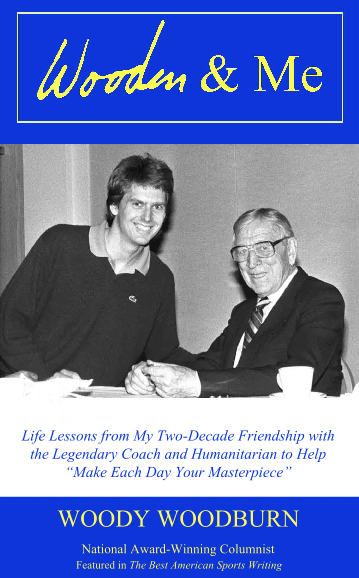
Wooden&Me_cover_PRCheck out my new memoir WOODEN & ME: Life Lessons from My Two-Decade Friendship with the Legendary Coach and Humanitarian to Help “Make Each Day Your Masterpiece”

Part IV: Peak and Valley

STRAW_CoverWoody’s highly anticipated new book “STRAWBERRIES IN WINTERTIME: Essays on Life, Love, and Laughter” is NOW available! Order your signed copy HERE!

 * * *

Peak and Valley at Mount Vernon

This is the final in a four-column series chronicling my recent father-son road trip to the homes of two Founding Fathers – and more.

* * *

George Washington’s Mount Vernon estate is the most popular historic home in America with more than one million visitors annually. People make the pilgrimage to see the 21-room mansion, the spectacular panoramic view of the Potomac River and, of course, the tomb where the “Father of Our Country” rests eternally.

Paying respects at the white marble sarcophagus, adorned with a raised eagle and shield and the simple inscription “Washington,” was a far more emotional experience than I had anticipated. The moment filled my heart with esteem, my eyes with moisture.

Arched entryway to the Slave Memorial and Burial Ground at Mount Vernon.

Arched entryway to the Slave Memorial and Burial Ground at Mount Vernon.

Following a brief downhill walk into the nearby woods, a few of the pooled tears overflowed. My son and I were at the Slave Memorial and Burial Ground.

A red-brick archway, similar to one at Washington’s Tomb, serves as an entrance to a lovely tree-shaded clearing. At the end of a narrow pathway is a cylindrical stone marker bearing this inscription: “In memory of the Afro Americans who served as slaves at Mount Vernon this monument marking their burial ground dedicated September 21, 1983.”

The marker rises from a circular stone foundation, framed by manicured shrubs, and adorned with three words around its perimeter at the 2 o’clock, 6 o’clock and 10 o’clock positions: “Faith”, “Hope” and “Love.”

At the Mount Vernon Museum, faith, hope and love were joined by heartbreak, tribulation and injustice in the “Lives Bound Together” exhibit documenting slavery at the plantation.

In its own right, the exhibit is powerfully moving. I found it fivefold so because a young family consisting of a father, mother and three sons – the oldest being age 10 – were perusing alongside me and at the same pace. Moreover, the African-American parents took turns reading the information plaques aloud to their sons.

For example, the dad read this: “George Washington was born into a world where slavery was common. At age 11, he inherited 10 enslaved people from his father.”

He then explained to his eldest son: “That would be like you, on your birthday next month, inheriting 10 slaves.”

I am not certain about the son, but this statement hit me like a flush roundhouse.

“Most enslaved people never had the opportunity to become literate,” the mom now read, adding: “If they did manage to learn, they could be punished for it. Can you imagine being whipped for learning to read?”

1sslavegravevernonAnd so it continued for an hour, a history lesson becoming more painfully real because slavery could very possibly be in this beautiful family’s roots. I felt a rising anger and disappointment at Washington.

And yet, to his credit, Washington recognized marriages between his slaves, even though the law did not. He also did not separate enslaved families.

Too, importantly, in his will Washington freed upon his death the 123 slaves he owned. It can be argued this was too little, too late, but also know this: of the Founding Fathers who owned slaves, Washington is the only one to give emancipation.

In his eulogy for Washington on December 29, 1799, Richard Allen, founder of the African Methodist Episcopal Church, put this final deed into perspective: “Unbiased by the popular opinion of the state in which is the memorable Mount Vernon – he dared to do his duty, and wipe off the only stain with which man could ever reproach him.”

Earlier, sitting contemplatively at the Slave Memorial and feeling downhearted about our greatest Founding Father’s ugly “stain,” something beautiful happened. All afternoon, walking the grounds from hilltop to riverbank, I had seen one lone butterfly – at Washington’s Tomb. Now, I spotted a second, fluttering above the stone marker honoring the slaves.

Butterflies serve as the archetype of metamorphosis and a symbol of resurrection. So it seemed fitting to see these two butterflies – or was possibly it the same one? – as a metaphor, not only for how our country changed in regards to slavery, but also how George Washington did.

* * *

Woody Woodburn writes a weekly column for The Ventura County Star and can be contacted at WoodyWriter@gmail.com.

Wooden&Me_cover_PRCheck out my new memoir WOODEN & ME: Life Lessons from My Two-Decade Friendship with the Legendary Coach and Humanitarian to Help “Make Each Day Your Masterpiece”

Save

Save

Save

Save

Save

Save

Save

Save

Part III: Visiting Mount Vernon

STRAW_CoverWoody’s highly anticipated new book “STRAWBERRIES IN WINTERTIME: Essays on Life, Love, and Laughter” is NOW available! Order your signed copy HERE!

 * * *

Goose Bumps on the Potomac River

This is the third in a four-column series chronicling my recent father-son road trip to the homes of two Founding Fathers – and more.

* * *

The evening before leaving New York City for Virginia on what we nicknamed our “Founding Father’s Field Trip,” my son took me to one of his favorite haunts, The Metropolitan Museum of Art. There was a specific painting he wanted to show me to set the mood for one of our primary destinations.

After a long hike, for The Met is the largest art museum in the United States, we arrived at a cavernous room, Gallery 670 to be precise, in the labyrinth American Wing, and there it was: George Washington, standing commandingly in a row boat with the flag raised behind him, crossing the icy Delaware River on Christmas night 1776 to attack by surprise the Hessians at Trenton.

George Washington's mansion at Mount Vernon

George Washington’s mansion at Mount Vernon

The oil-on-canvas painting by Emanuel Leutze is much larger than expected. Indeed, it is truly massive, a movie theater screen almost, measuring more than 21 feet wide by nearly 13 feet high. In other words, in the framework of how we tend to view Washington, it seems about life-sized.

Washington’s mansion at Mount Vernon, by contrast, in person comes into focus smaller than anticipated. Nonetheless, the impact of visiting the historic home and surrounding grounds is immense.

Thomas Jefferson’s Monticello manor, which we had toured the previous day, is grander and fancier. No matter, Washington’s home surpassed it in goose bumps delivered, not least of all for the breathtaking view of the Potomac River below.

As Washington wrote in a letter to a friend in 1793: “No estate in America is more pleasantly situated than this . . . on one of the finest rivers in the world.” He did not seem to be telling a lie.

“History is marble, and remains forever cold, even under the most artistic hand, unless life is breathed into it by the imagination,” historian Charles Gayarré wrote. “Then the marble becomes flesh and blood; then it feels, it thinks, it moves, and is immortal.”

Walking the halls and rooms at Mount Vernon, including the bedchamber where Washington – “first in war, first in peace, first in the hearts of his countrymen” – took his last mortal breath at age 67 on December 14, 1799, breathes life into one’s imagination; the cold statue, the profile on the quarter, becomes flesh and blood.

From the mansion, Washington’s Tomb is 10 minutes by foot. Within the iron-gated red-brick vault lie two white marble sarcophagi: the one on the left is inscribed on top “Martha, Consort of Washington” while the companion on the right has a raised eagle and shield, and one word: “Washington.”

George Washington's Tomb

George Washington’s Tomb

The latter’s inscription may be simple, but the emotions evoked standing before it are complex and powerful. One by one and in pairs, visitors take their turn viewing. All pay their respects; most snap a photo; many seemed to pray, their lips moving silently.

Even with a constant gathering of dozens, the tomb site remains eerily quiet, void even of whispering. Occasionally, songbirds break the contemplative hush in a lovely way.

Too, the solemn silence ceases briefly at 3 p.m. daily with the changing of the wreath. The ceremony includes a reading aloud of “George Washington’s Prayer for the Nation.” On this day, a lone butterfly fluttered over the tomb entrance.

Standing in this hallowed spot, looking at the cold marble where the “Father of our Country” rests eternally, my imagination breathed to life. Images of George Washington – from Independence Hall to Valley Forge to the Delaware River and beyond – flashed in my mind’s eye.

The great man’s presence seemed almost palpable. Truly, I was caught off guard by how overwhelming were my emotions; my gratitude, awe and affection. Leutze’s famous painting of Washington more than ever seemed life-sized.

For that moment, the noticeable tear in the giant canvas of Washington’s life disappeared. However, this blot was nearby just down the pathway: the burial ground and memorial to the slaves he owned.

We will walk there in this space next week.

* * *

Woody Woodburn writes a weekly column for The Ventura County Star and can be contacted at WoodyWriter@gmail.com.

Wooden&Me_cover_PRCheck out my new memoir WOODEN & ME: Life Lessons from My Two-Decade Friendship with the Legendary Coach and Humanitarian to Help “Make Each Day Your Masterpiece”

Save

Save

Save

Save

Save

Save

Save

Save

Part II: History Lesson at Monticello

STRAW_CoverWoody’s highly anticipated new book “STRAWBERRIES IN WINTERTIME: Essays on Life, Love, and Laughter” is NOW available! Order your signed copy HERE!

 * * *

Little Mountain’ and Big Heartbreak

This is the second in a four-column series chronicling my recent father-son road trip to the homes of two Founding Fathers and more.

* * *

More than two centuries before the creation of Twitter, Thomas Jefferson distilled his life’s accomplishments into this tweet-length epitaph inscribed on his tombstone:

“Author of the Declaration of Independence, of the Statute of Virginia for Religious Freedom, and Father of the University of Virginia.”

In truth, 140 pages in an encyclopedia would be insufficient to chronicle Jefferson’ genius, much less 140 characters. Still, it is difficult to fathom leaving out mention of being the third president of the United States.1monticelloback

Perhaps a greater omission is this deed: “Designed Monticello.”

Jefferson called Monticello – meaning “little mountain” in old Italian – his “essay on architecture.” The neoclassical mansion was four decades in the making and remains such a masterpiece it is recognized as a World Heritage Site by the United Nations.

Remarkably, Jefferson designed every aspect and angle, inside and out, despite having no formal architectural training.

As with most things that interested him, which means MOST things, Jefferson became an expert by reading extensively – in this case, studying architecture, particularly that of ancient Rome and the Italian Renaissance.

Greg Woodburn, in the flesh, and Thomas Jefferson, in bronze.

Greg Woodburn, in the flesh, and Thomas Jefferson, in bronze.

A true Renaissance man, his passions ranged from architecture to viticulture, music to bird watching, botany to beer making.

For good reason President Kennedy once famously quipped, at a dinner honoring 49 Nobel Prize winners: “I think that this is the most extraordinary collection of talent, of human knowledge, that has ever been gathered together at the White House, with the possible exception of when Thomas Jefferson dined alone.”

As pleasing as the Declaration of Independence is to the ear, Monticello is to the eye. Viewing the colossal columns and domed rooftop and arched windows from outside is like studying a Monet water scene; the longer you stare, the more perfection you see.

The interior – the grand entry hall filled with Native American artifacts collected by Lewis and Clark, the voluminous library, Jefferson’s bedroom chamber, the dome room above and cellar below – is equally breathtaking.

Too, there are the long and elegant north and south terraces that housed a dairy, smokehouse, kitchen, stables . . .

. . . and slave quarters.

More than being architecture as art, beyond the magnificent panoramic view that extends 45 miles on a clear day, the piece of Monticello that struck me most profoundly is that the man who wrote the Declaration of Independence containing the words “all men are created equal” owned men – and women and children.

Now, I knew Jefferson was a slave owner and that DNA tests support the claim he may have fathered as many as six children with Sally Hemings, a household slave. But these distressing truths do not resonate as deeply and poignantly in two dimensions in a textbook as they do in three dimensions in person.

Indeed, seeing the squalor slave quarters; walking the plantation fields where slaves toiled; hearing that 130 slaves were sold, families torn apart, after Jefferson’s death to pay off his debts, the ugly auction held right here on the lovely West Lawn of the mansion; opened my eyes wider than before.

One final sight – and site – opened my tear ducts as well. It was a graveyard near the parking lot. Not the wrought iron-fenced cemetery containing the tall obelisk tomb of the Founding Father who died on July 4, 1826 – 50 years to the day after the signing of the famous document he drafted – but rather a bare plot scattered with rocks and surrounded by trees, marked with a small sign reading:

“Buried in this graveyard are more than 40 of the nearly 400 men, women, and children who lived in slavery at Monticello from 1770 to 1827. Although the names of Monticello’s enslaved residents are known, it has not been possible to identify the individuals buried here.”

Reflecting in the shade at this unfairly solemn spot, this sinful truth was powerfully clear: “Life, Liberty and the pursuit of Happiness” were not unalienable rights for everyone at Monticello.

*  *  *

Woody Woodburn writes a weekly column for The Ventura County Star and can be contacted at WoodyWriter@gmail.com.

Wooden&Me_cover_PRCheck out my new memoir WOODEN & ME: Life Lessons from My Two-Decade Friendship with the Legendary Coach and Humanitarian to Help “Make Each Day Your Masterpiece”

Save

Save

Save

Save

Save

Save

Save

Save

Part I: Pit Stop and the Pendulum

STRAW_CoverWoody’s highly anticipated new book “STRAWBERRIES IN WINTERTIME: Essays on Life, Love, and Laughter” is NOW available! Order your signed copy HERE!

 * * *

Visiting Poe’s Home Upon a Midday Dreary

This is the first in a four-column series chronicling my recent father-son road trip to the homes of two Founding Fathers and more.

* * *

Monticello, the Virginia estate of Thomas Jefferson, is nearly 350 miles as the crow flies from my son’s shoebox-sized apartment in lower Manhattan.

Make that as “The Raven” flies, because to break up our drive we stopped midway at the Edgar Allen Poe House Museum in Baltimore.

1poemug

Edgar Allen Poe

“Once upon a midnight dreary” begins the poem that launched Poe’s fame, and this certainly describes the midday of our visit two Saturdays past. Stepping out of the drizzle and inside the claustrophobic three-story brick home, a docent asked us how we learned about the museum. She seemed almost surprised to have visitors.

As if trying to ensure that we bought tickets, the docent told us we had arrived on an auspicious day because this date – October 8 – was the 167th anniversary of Poe’s funeral. She further explained, her voice dripping with drama, it had been a similarly rainy day.

My initial reaction was that the docent made this eerie claim every day for effect. However, a placard in the museum documented her claim: Poe died at age 40 on October 7, 1849, and his burial took place a day later at the nearby Westminster Burying Ground. Furthermore, so few people showed up because of the rain that the reverend decided not to bother with a sermon.

Poe lived at 203 North Amity Street only briefly, from 1833 to 1835 while in his mid-20s, yet he wrote voluminously during this span. The home was saved from demolition in 1941 and is now a National Historic Landmark that is nearly as hidden in plain sight as “The Purloined Letter.” I am glad we found it.

The narrow winding stairway leading up to Poe’s bedroom had a foreboding “rapping, rapping at my chamber door” feel. Artifacts on display include Poe’s chair and lap desk.

Poe’s legacy as a writer is remarkable; he invented the detective story and advanced the genres of horror and science fiction. And, of course, he penned a poem so great that an NFL team is named in its honor.

1poe-graveSerendipity smiled further on our side trip when the docent informed us that a anniversary ceremony commemorating Poe’s funeral was to be held at the Westminster Burying Ground, little more than a mile a way, starting in about five minutes.

Normally we would have walked, even in the rain, but for time’s sake we decided to drive. Confusing one-way streets and a dearth of parking spaces turned this into a bad decision. We finally made it to the church 10 minutes after the appointed 3 p.m. start.

Poe’s grave was easy to find by the size of its 7-foot tall marble monument, not by the size of the crowd gathered, because there was no one else present.

We hurried inside the beautiful gothic church, thinking the special observance for the great writer must be going on there instead of in the rain, but again we were alone.

Back into the drizzle we ventured to pay respects at the gravesite – the first of a handful of graves my son and I would visit, and be moved by, on our four-day journey.

Leaving the grounds, we finally encountered another person, an employee at the church. I inquired about the Poe ceremony, saying it must have been quite brief and we were sorry to have missed it.

It turns out that because of the dreary weather no one showed up and the planned sermon was cancelled. How eerily fitting.

In truth, the quaint museum had been a tad disappointing. But the mysticism of Poe having lived – and written – inside its walls, and the auspicious date of our visit, had magnified the magic.

Leaving the museum, the church, and a lunch of Maryland crab cakes at Lexington Market that dates back to 1763, we were accosted each time by panhandlers, one unnervingly aggressive. All in all, one visit to Poe’s city had been enough.

“Quoth the Raven, ‘Balti-nevermore.’ ”

*  *  *

Woody Woodburn writes a weekly column for The Ventura County Star and can be contacted at WoodyWriter@gmail.com.

Wooden&Me_cover_PRCheck out my new memoir WOODEN & ME: Life Lessons from My Two-Decade Friendship with the Legendary Coach and Humanitarian to Help “Make Each Day Your Masterpiece”

Save

Save

Save

Save

Save

Save

Save

Long Column of Super Short Stories

STRAW_CoverWoody’s highly anticipated new book “STRAWBERRIES IN WINTERTIME: Essays on Life, Love, and Laughter” is NOW available! Order your signed copy HERE!

 * * *

Simplifying the Short Story to the Extreme

“Simplify, simplify,” advised Henry David Thoreau, to which Ralph Waldo Emerson wryly, and wisely, replied: “One ‘simplify’ would have sufficed.”

Another writing master, Ernest Hemingway, once accepted a challenge of simplifying from colleagues who bet him he couldn’t write a complete story in a mere six words. The master wordsmith made them pay up with this gem: “For sale: baby shoes, never worn.”

Ernest Hemingway , according to literary lore, once won a bet with a masterful six-word short story.

Ernest Hemingway , according to literary lore, once won a bet with a masterful six-word short story.

It is the work of a genius, indeed, for the reader can instantly imagine another 1,000 words to fill out the story.

With this in mind, I challenged some friends and social media pals to write their own six-word story of fiction or memoir.

My good buddy Jeff McElroy, an accomplished author who is familiar with Papa Hemingway’s complete body of work from long to supremely short, responded thusly: “Here’s an attempt to make the most heartbreaking shortest story into a happier one: ‘Free baby shoes. Well-worn.’ ”

Here are a few more six-word stories . . .

From Marcella Williams: “The skiff landed. My life metamorphosed.”

Mitch Gold: “My kids are my greatest achievements.”

Scott Harris: “He was blessed with good friends.”

Karen Biedebach-Berry: “Sun, surf, sea-glass, Pierpont Beach house!”

Terry Wieser: “I tripped but never fell hard.”

Arlys Tuttle: “My phone rang; never guess who.”

Deborah Sutherlan-Hocamp: “Last surviving human hears the doorbell.”

From Ed Wehan, an ultra-marathoner who conquered the Western States 100 Mile Race in his younger days and is still a long-distance marvel at age 72-going-on-52: “I ran but age caught me!”

Allyson McAuley: “Read books, traveled world, shared books.”

Tom Koenig: “Viewed, pursued, aged, still pursuing her!”

Karen Lindell: “Her heart gently listens, loves, aches.”

Jill Shaffer: “Life is short, cherish every day.”

And my own mini-memoir six-pack: “Tries to make today a masterpiece.”

*

Seeking even further simplicity, I posed a second challenge of brevity: write a happy story – fiction or memoir – in only four words.

Houston Wolf: “Lived happily ever after.”

From Allyson McAuley: “It wasn’t too late.”

Randall Richman offered, “Peace on Earth occurred,” and Kris Young echoed: “World peace is here.”

Teri Hu: “My kids are home!”

Susan Goodkin: “I’m at LAX arrivals.”

Elizabeth Black: “Then I saw you.”

Rebekah Reddy: “And then they hugged.”

Sandy O’Brien: “We named him Bennett.”

Irene Henry: “Babies’ unconditional loving smiles.”

Here’s three vivid images: Nancy Kirk, “I see a rainbow”; Althea Carlson, “There are puppies everywhere”; and Susan Jorgensen, “Yum, so much cake!”

Jon Gold: “Pastrami sandwich, half price.”

David Spruill: “Reading ‘Harry Potter’ again!”

Tom Spence: “It’s in the hole!

From Jayce Yeh, “Your son’s vitals stabilized,” and similarly from Mark Jasper, “My child is healthy.”

Toni Tuttle-Santana: “Family growing and thriving.”

Mike Davis: “Joy in my heart.”

Lisa Iannucci: “Smiled often, laughed much.”

Steve Cook: “I painted all day.”

Lisa Iannucci: “My screenplay was sold!”

Anne Kallas: “I adopted a dog/cat.”

From Joe Siddens came “Will you marry me?” to which Jill Shaffer added this happy sequel: “She said ‘yes!’ ”

From Keith Pillow, “Then she loved me”; from Jim Gstettenbauer: “She laughed, I smiled”; and from Josh Crowder, “We found love together.”

Nicole Marsella-Jensen: “Passport, a new stamp.”

Cary Ginell: “Trump falls off cliff.”

From Suz Montgomery, “I am cancer free,” and similarly from Deborah Sutherland-Hocamp: “The X-rays were negative.”

Ronna Streeton, “I have four grandchildren!” and Carol Roth, “Seven grandchildren equals joy!”

Wayne Kempton wrote a matrimonial memoir: “48th anniversary with Shari.”

Barry Sackett offered, “She loved the puppy,” and my former Star colleague Melissa Eastman Wantz made it happier yet with this slight rewrite: “The puppy loved her.”

Annie Elizabeth: “My heart is full.”

And Michelle Rogers wrote this heartwarming gem, which is memoir not fiction: “I donated my kidney.”

The last four words come from yours truly: “Column written for me.”

*  *  *

Woody Woodburn writes a weekly column for The Ventura County Star and can be contacted at WoodyWriter@gmail.com.

Wooden&Me_cover_PRCheck out my new memoir WOODEN & ME: Life Lessons from My Two-Decade Friendship with the Legendary Coach and Humanitarian to Help “Make Each Day Your Masterpiece”

Save

Save

Save

Save

Jester’s Life Inspiring, not Comedic

STRAW_CoverWoody’s highly anticipated new book “STRAWBERRIES IN WINTERTIME: Essays on Life, Love, and Laughter” is NOW available! Order your signed copy HERE!

 * * *

Jester’s Life is Inspiring, not Comedic

It is a rare writer who makes one think of the great Ernest Hemingway, but Stephen Michael Jester, II is such an exception. Specifically, he brings to mind Hemingway’s observation: “The world breaks everyone, and afterward, some are strong at the broken places.”

The world did not take long to break Stephen. In just his 23rd hour of life, in the hospital nursery following a birth with complications, his heart stopped beating and he was recorded clinically dead.

Stephen Jester at a book signing at Mrs. Figs' Bookworm.

Stephen Jester at a book signing at Mrs. Figs’ Bookworm.

Miraculously, Stephen was resuscitated. Doctors, however, expressed no hope for his long-term survival. They were wrong.

But the world was not finished trying to break Stephen. At age 18 months he was diagnosed with cerebral palsy, a neurological disorder permanently affecting muscle strength and coordination.

Asked about his difficult entry into the world, and being strong at the broken places, Stephen, now 28, replies: “If I have a special calling or reason to still be here today, I feel that it is to show others that anything you set your mind to is possible.”

His entire life, Stephen has been told a big list of things that are impossible for him to do. The native-born Camarillo resident thrives on proving small-minded naysayers wrong. This includes making those who said he would never become a published author eat their words.

“A Jester’s Life: Sometimes It’s Just Not Funny” was published in 2012 followed earlier this year by his second book, “Ode to Legend & Myth.” Both collections of poems are available at Mrs. Figs’ Bookworm in Camarillo, as well as through Amazon.

“It was a very emotional moment for me,” Stephen says, recalling the moment he saw “A Jester’s Life” in print for the first time.

Seeing his name stitched on a pro sports uniform would not have been more thrilling because instead of dreaming of dunking in the NBA or throwing NFL touchdowns passes, as a small boy Stephen had literary aspirations.

Stephen's dream as a 5-year-old came true with the publication of his first book in 2012.

Stephen’s dream as a 5-year-old came true with the publication of his first book in 2012.

“At the age of five, my goal was to someday write and publish a book,” he recalls. “I was always fascinated by language, writers and their books.”

As a sixth-grader, Stephen began writing seriously. And laboriously. Cerebral palsy not only makes typing on his laptop difficult, if he sits in one position very long painful cramps beset his back and legs. Indeed, “writer’s block” is the least of his challenges.

Classified as “spastic quadriplegia,” Stephen’s cerebral palsy affects muscular tone and movement in all four extremities. He cannot walk and requires an electric wheelchair to get around – except in his dreams.

“In every dream that I have,” Stephen shares, “I am not in a wheelchair. In my dreams I do anything and everything.”

In his waking hours he writes about anything and everything. About life and death; love and loss; nature and religion; and much more. Here is a sampling from three poems in “A Jester’s Life”:

First from “Dreams” – “It was a time of belief / That all things were possible.”

From “Wishes” – “I wish that my legs were strong and able / So I might simply walk away.”

And from “The Prodigal Returns” – “Even at the grimmest of times / Life is still a gift.”

During his own grimmest times, in fact especially then, Stephen sees writing as his gift.

“Writing is my favorite thing in the world,” he says. “If there’s only one thing that really makes sense about why I am who I am, it is that I know writing is what I’m meant to be doing.”

He is now pouring his soul into his third book, a collection of 365 haikus with the working title “Journal Entries of an Addict.”

“Basically ‘Addict’ refers to the idea of writing as an addiction,” Stephen explains. “In one form or another, I feel compelled to write daily. My advice for any young aspiring writer: don’t be afraid to dream, don’t be afraid to pursue your dreams, and never allow anyone to dictate your dreams.”

Wise advice for everyone, not just writers, and exemplified in this Jester’s life.

* * *

Woody Woodburn writes a weekly column for The Ventura County Star and can be contacted at WoodyWriter@gmail.com.

Wooden&Me_cover_PRCheck out my new memoir WOODEN & ME: Life Lessons from My Two-Decade Friendship with the Legendary Coach and Humanitarian to Help “Make Each Day Your Masterpiece”

Save

Save

Save

Act of Giving Requires Two

STRAW_CoverWoody’s highly anticipated new book “STRAWBERRIES IN WINTERTIME: Essays on Life, Love, and Laughter” is NOW available! Order your signed copy HERE!

 * * *

Act of Giving Requires the Gift of Receiving

The lovely music of a violin requires not just its strings but also a bow. A writer’s words are meaningless without a reader. It takes two hands, not one, to applaud.

And the act of giving is an empty gesture without someone on the receiving end. At times, however, we can become so focused on doing kind deeds that we forget this important truth.

I received a refreshing reminder last weekend.

1watercoldI am neither a mad dog nor Englishman, but I was out in the midday sun Saturday getting in my 4,829th consecutive daily run. Despite the mercury inching up toward triple-digits, causing a friend to shout out, perhaps accurately, “You’re crazy!” as he drove by, I stubbornly completed my planned 13-miler consisting of 26 laps around the perimeter of the three soccer fields at the southeast corner of the Kimball Aquatic Center Community Park.

As I was stretching and cooling down, that term being relative on this unseasonable and unreasonable autumn afternoon, I was approached and greeted by a burly man with a jet-black beard so long and thick it would make Edward Teach – aka Blackbeard the Pirate – envious.

It should not matter – and yet with racial tensions and tragedies making headlines daily, perhaps it does bear mention – that the bearded burly man and I are of different ethnicities.

“Do you want some water?” he asked.

“Thanks,” I answered, “but I’ve got a Gatorade in my car.”

After the man turned and walked away, I had second thoughts. While it was true I had a sports drink in my car, I suddenly realized this was beside the point.

What was important was John Wooden’s maxim: “There is great joy in helping others.” It now occurred to me that I had just denied this friendly man a slice of joy. Also, of course, I had denied myself the joy of receiving his kindness.

“Hey,” I called out while he was still within earshot. “I would like to take you up on that water.”

The man’s reaction reminded me of a scene in the movie “Wedding Crashers” when Owen Wilson’s character, John Beckwith, reconsiders after having earlier turned down an offer for meatloaf from Chaz, played by Will Ferrell.

“You know what,” John says, “I will have some meatloaf. Let’s have some meatloaf.”

“You want some?” Chaz says, excitedly. “Hey, Ma! The meatloaf! We want it now! The meatloaf!”

Hearing my change of mind, the man flashed a toothpaste-ad smile that burst through his beard like sunshine from behind a parting a cloud. He enthusiastically said: “You do? Great!”

With that he bolted off to the parking lot and from a cooler in the bed of his pickup truck pulled out not one, but two, bottles of ice-cold water.

“I’ve seen you running laps for close to two hours so you need to drink up,” he said, offering me both bottles as well a glucose tablet.

I chugged the first bottle of water about as fast as it would pour out, not only because I was parched but also in an attempt to truly show the man my appreciation in a way a mere “thank you” could not.

As we chatted briefly, I learned my Samaritan’s name is Eric and that he has coached youth soccer for nearly a decade. When I got home I understood why he was perhaps a little worried about me: my black running hat was stained half-white while my face was also heavily peppered with salt.

Too, a lingering smile was on my face because Eric had not only refreshed my body but also given my mind a refresher in this insight from British author Alexander McCall Smith:

“Gracious acceptance is an art – an art which most never bother to cultivate. We think that we have to learn how to give, but we forget about accepting things, which can be much harder than giving. Accepting another person’s gift is allowing him to express his feelings for you.”

Wise food – or rather, ice-cold water – for thought.

*  *  *

Woody Woodburn writes a weekly column for The Ventura County Star and can be contacted at WoodyWriter@gmail.com.

Wooden&Me_cover_PRCheck out my new memoir WOODEN & ME: Life Lessons from My Two-Decade Friendship with the Legendary Coach and Humanitarian to Help “Make Each Day Your Masterpiece”

Save

Save

Save

Save

Father of the Bride, Part II

STRAW_CoverWoody’s highly anticipated new book “STRAWBERRIES IN WINTERTIME: Essays on Life, Love, and Laughter” is NOW available! Order your signed copy HERE!

 * * *

Masterpiece Day of Masterpiece Days

When my son was seven, he and I hiked to the summit of Yosemite Falls where we triumphantly enjoyed day-old pizza, warm soda and a heavenly view of the magnificent valley below. As I tucked him into bed that night, the tired little Mountain Boy said, “Daddy, this was the best day of my life.”

It was a masterpiece day, to be certain, but I have always felt there is no “best” day, no single day that is the ultimate masterpiece above all others. Rather, the very best days are different hues in a rainbow.

That day on the mountain was a beautiful hue of sky blue.

September 4th, three Sundays past, the glorious yellow of a field of sunflowers was added to my life’s rainbow. More accurately, of a church aisle decorated with sunflowers and a matching bridal bouquet.1_daldadaislewalk

I had not planned to do a follow-up column on my daughter’s wedding after having written about it the day before vows were exchanged. But so many people have requested one that, to borrow the signature phrase from the late radio broadcaster Paul Harvey, here is “the rest of the story.”

A friend, who had already walked a church aisle in my wedding wingtips, told me it would be one of the top five days of my life. By evening’s end, I realized he had understated matters. Indeed, contrary to my earlier proclamation, I dare say it was the best day of my life.

I say this without diminishing my other all-time favorite days, the gorgeous reds and blues and golds in my life’s rainbow. I say this because this single masterpiece day had me reliving many, many masterpiece days.

For example, walking my 29-year-old daughter down the aisle, her hand in my arm, brought to mind walking her to the first day of kindergarten; our hand-in-hand evening walks around the neighborhood when she was young; our own hikes in Yosemite when she was a little older.

Seeing her holding the bridal bouquet of sunflowers, which have always been her favorite, had me reliving her 16th birthday when I surprised her at school with a bouquet of 16 sunflowers.

It was not only hues relating to my daughter that enveloped me. That “best” day climbing Yosemite Falls also resurfaced as the Mountain Boy, now 26, stood tall at the alter beside his big sister as her Man of Honor. The masterpiece day when he delivered the commencement speech at his college graduation flashed to memory as he charismatically gave a heartfelt toast to the bride and groom.

All weddings remind me of my own, but this one did so far more than all others because it was on my wife’s and my anniversary date. Too, the two brides – 34 years past, and present – share the same beauty and radiance.

On and on, my life’s rainbow hues shined everywhere on this masterpiece of masterpiece days.

As I walked my daughter down the aisle, not only did countless images of her – from the day she was born, through her youth, now into young womanhood – flip through my mind’s photo album, but the emotions of each page resurfaced as well. My eyes, like my heart, overflowed as this collage of moments made this the best moment of all.

And then came our father-daughter dance, 3 minutes and 50 seconds of just she and I alone on the dance floor as Tim McGraw’s “My Little Girl” played, and somehow this was an even greater moment still.

A number of people asked me afterward what my little girl and I were talking about, crying about, laughing about intimately out there on the dance floor, and my answer was this: “Everything.”

I will share one specific thing Dallas whispered to me a little earlier, in the church as I escorted her down the aisle to her new husband, because I think there is something universal in the personal: “Daddy, of all the walks we have taken, this one is my favorite.”

Mine, too, Dally. It was a walk on a rainbow.

*  *  *

Woody Woodburn writes a weekly column for The Ventura County Star and can be contacted at WoodyWriter@gmail.com.

Wooden&Me_cover_PRCheck out my new memoir WOODEN & ME: Life Lessons from My Two-Decade Friendship with the Legendary Coach and Humanitarian to Help “Make Each Day Your Masterpiece”

Save

Save

Save

Save

Save

Save

“Hello, this is Vin Scully . . .”

STRAW_CoverWoody’s highly anticipated new book “STRAWBERRIES IN WINTERTIME: Essays on Life, Love, and Laughter” is NOW available! Order your signed copy HERE! 

*   *   *

End of an Era Stirs Dodger Blues

            The phone rang and my wife answered and the voice on he other end of the line was unmistakable even before the caller identified himself.

“Hello, this is . . .”

Vin Scully was returning my call. However, I had not mentioned to my wife that I was trying to set up an interview and since it is not every day that The Voice of the Dodgers phones home, my wife was caught off guard.1scully

“You aren’t Vin Scully,” she said, amused, thinking it was one of my friends pulling a prank.

And she hung up.

The phone rang again, again the golden voice asked for me, and this time my wife realized her embarrassing mistake.

A few days later, I didn’t interview Scully so much as I pulled up a chair in the Dodger Stadium press box and listened, enchanted, to his storytelling. At one point, he mentioned having just read “The Professor and the Madman” about how the Oxford English Dictionary was compiled by two men – one turning out to be an insane murderer. It struck me, as Scully spun the synopsis, that he could read a random page from the dictionary and make it a listening pleasure on the radio.

About a year after formally meeting Scully we crossed paths a second time at a gala dinner – washing hands in the restroom. Remarkably, he remembered my name, but the greater display of his peerless people skills was his insistence I come meet his wife.

I have been reading The Star for the better part of four decades, writing in its pages for more than a quarter century, and in all this time I cannot recall a more terrific on-going feature, “Peanuts” included, than the daily “Visions from Vin” compiled by Jim Carlisle chronicling Scully’s life and career. The sports-section serial came about because, after being the rivet holding the franchise together for the past 67 seasons, Scully is hanging up his mic following the Dodgers’ regular-season finale in two weeks.

While the gems Carlisle has uncovered from various books, magazines and newspaper interviews have been enjoyable, even more so have been the personal encounters with “Vin” shared by local readers. The common denominator of their remembrances is this: the next time Scully is rude to someone will also be the very first time.

Scully’s friendliness is authentic.

“I enjoy people, so I don’t mind autograph requests at all,” Scully told me. “Why not sign? They’re paying me a compliment by asking.”

And what are some of the stranger “compliments”?

“I’ve signed a lot of baseballs, as you can imagine,” he answered. “But also golf balls and even a hockey puck, which is sort of strange. Paper napkins seem popular, even dirty napkins – I think it’s all they have on hand. I don’t expect them to keep it, but I sign anyway because hopefully they will keep the moment.”

As personal tale after tale shared in “Visions from Vin” attest, these moments are indeed kept, safely wrapped in red velvet in each person’s mind.

One more red-velvet moment. Our interview concluded, I asked Scully if he would put me at the plate in Dodger Stadium. Pat Riley once diagramed for me the Lakers’ “Fist Up” play to Kareem Abdul-Jabbar, and my goodness how I wish I had kept that doodled napkin. Even more, however, I wish I had recorded Scully’s imaginary calling of my Major League at-bat against the great fireball-throwing Bob Gibson.

No matter, for I can hear it in my mind’s ears yet, working the count full before Scully ended my fantasy with a wink, so to speak: mighty Woody struck out. It was perfect.

To borrow from Ernest Thayer’s famous poem, “Casey at the Bat,” come game’s end on Oct. 2, the tale will be this: “Oh, somewhere in this favored land the sun is shining bright; the band is playing somewhere, and somewhere hearts are light; and somewhere men are laughing, and somewhere children shout . . .”

. . . but there is no joy in Dodgerville, mighty Vinny has called his final out.

*  *  *

Woody Woodburn writes a weekly column for The Ventura County Star and can be contacted at WoodyWriter@gmail.com.

Wooden&Me_cover_PRCheck out my new memoir WOODEN & ME: Life Lessons from My Two-Decade Friendship with the Legendary Coach and Humanitarian to Help “Make Each Day Your Masterpiece”

Save

Save

Save

Save

Save