Column: A Kind Word Lifts Spirits

A Kind Word Can Lift Low Spirits

*  *  *

“We have not yet begun to use kind words in such abundance as they ought to be used.”

                                                                                     – Blaise Pascal, French philosopher

*

Given a quarter-full glass, or three-quarters empty depending on one’s perspective, my mindset is usually, “That’s a lot to drink because that’s a big glass.”

The other day, however, I saw that glass as 75 percent empty – and dirty and cracked. Some cranky e-mails about a column had me feeling low. Then a note from another reader lifted my fallen spirits and brought to mind the poem “On Friendship” by my hero Coach John Wooden:

At times when I am feeling low, / I hear from a friend and then

My worries start to go away / And I am on the mend

No matter what the doctors say – / And their studies never end

The best cure of all, when spirits fall, / Is a kind word from a friend

My cure came from a friend I have never met. Jon Gold, a Los Angeles sportswriter who grew up in Thousand Oaks, wrote me succinctly but with kindness in abundance: “I became a writer because I got to read you write like this when I was 10.”

His words were penicillin for what ailed me. That I somehow inspired someone even a small fraction of the way Jim Murray made me want to become a writer is as nice a compliment as I have ever received.

Jon’s note did something more – it reminded me of this wisdom from Russian screenwriter Sonya Levien: “Good intentions are not enough; they’ve never put an onion in the soup yet.”

How many times have I failed to put an onion in the soup; thought about sending a kind note but not followed up in deed? Thankfully, I have not faltered completely in letting those who have changed my life know it. I wrote to my first newspaper boss last year; my sixth-grade teacher before that; Jim Murray and Coach Wooden before their deaths.

My two adult kids, on the other hand, are chef-like at putting onions in the soup. This very week my daughter wrote a two-page letter to one of her favorite university professors, thanking him for his past and present mentorship. She has similarly written notes of gratitude to numerous other teachers, colleagues, friends.

My son also regularly puts pen to paper to express thanks to professors, mentors, coaches and friends who have influenced his life’s journey. Just recently he mailed a card, albeit three years belatedly, to someone he met only once.

Unfortunately it was returned as undeliverable. However, he was able to locate the person on-line at her new place of employment and resent it. It began: “Dear Liz Williams, I don’t know if you remember me, but I want to thank you for changing my life. . . .”

He proceeded to explain how she had been instrumental in his taking his first humanitarian trip to Africa – Mali – a momentous event that opened his eyes and heart, opened doors, and inspired him to return to Africa – Ghana – as well as make a four-week goodwill visit to Sri Lanka.

My son concluded: “I apologize for getting caught up in other things and not telling you all this sooner – it is one of the lessons from Mali that I have had to re-learn looking back. This long-overdue thanks is to let you know that you have taught me the greatest lesson of all: that we can profoundly change the lives of anyone we come in contact with, and while we may not always know if we do, I wanted you to know that in this case you have made a world of difference.”

Not surprisingly, his thoughtful words were as welcomed as Jon Gold’s were to me. “Thank you for reaching out!” Liz wrote back. “Wow, I am truly overwhelmed by the kindness of your words. It made my day (maybe even my year) . . .”

Now if you will excuse me, I am going to put an onion in the soup and write a long-overdue note of gratitude to my favorite college professor, Mr. Ridland.

— Woody Woodburn writes a weekly column for the Star. You can contact him at WoodyWriter@gmail.com or through his website at www.WoodyWoodburn.com


Writing Essay: Emulate Marathoners

Writing Essays

(2012)

Write Like a Runner Training For a Marathon

Few feelings of personal satisfaction rival the accomplishment of completing a marathon. While the race distance measures an imposing 26.2 miles, in truth having a finisher’s medal placed around your neck requires hundreds and hundreds of training miles over many months, even on days you feel too tired to lace on your running shoes and head out the door. Perhaps especially on such days. As renown track coach Bill Dellinger once observed, “Good things come slow, especially in distance running.”RunningSilhoette

Good things also come slow in writing. Like training for a marathon, it requires day-in, day-out discipline sweating at the keyboard, even on days when writer’s block strikes. Perhaps especially on such days.

As an award-winning newspaper columnist for more than two decades, deadlines in the press box kept me in tip-top writing shape. However, I lost this welcomed discipline and had to leave the daily grind after I was rear-ended by a speeding drunk driver; the collision caused permanent nerve damage and required disc-fusion surgery in my neck. Following the life-changing event, I have found that the approach used in marathon training is equally effective for freelance writing. I have completed more than a dozen marathons, including the prestigious 2009 Boston Marathon, and by applying these long-distance training methods to my writing I recently completed a non-fiction manuscript I am now shopping to agents.

Just as a marathon training schedule aims to improve a runner’s speed as well as his or her stamina, I am confident you can improve both the quantity and quality of your writing by following these key distance running doctrines.

BUILD YOUR BASE. In order to run 26.2 miles on race day without cramping up or breaking down, a person has to build a solid “base” of 500 miles or more over the preceding months. This entails slowly and consistently increasing your mileage as you grow stronger until you are running 30, 40 or even 60-plus miles each week. Consistency is the key; running 20 miles one week and 40 the next will only lead to injury or burnout.

So, too, must a writer build a base – rather than miles on the road, hours at the keyboard are crucial. Set a weekly goal to begin with, perhaps as moderate as two hours (six days of 20 minutes), and then build on it. A simple way to do so would be to add five minutes on average to each writing session. In just over three months from such a humble start you will have built up to writing 10 hours a week! (If you prefer, your goals could be in words or pages written.) Once you achieve your goal base, be it four hours a week or 40, try to maintain it.

Training for a marathon requires running nearly every day. As the late, great University of Oregon coach Bill Bowerman exhorted his runners: “There’s no such thing as bad weather, just soft people.”

Similarly, writers must avoid daily excuses; there can be no such thing as writer’s block.

LOG YOUR MILEAGE. To stay on track to reach your goal it is important for a runner to keep a training log or journal. Ditto for a writer. If your goal this week is to write for three hours, that does not necessarily mean you must write 30 minutes a day for six days. If you only manage 20 minutes one day, you can pick up the pace with two days of 35 minutes or perhaps one day of 40 minutes. However, unless by design (see Long Runs below) it is best to not to skip days or stray too high from the average daily quota required to meet the weekly goal. Inconsistency will turn a pleasant writing or running routine into a daunting chore as you try to make up for lost time. Again, to do so is to flirt with injury and burnout.

Writers, like runners, are often pleasantly surprised by how quickly the words and miles pile up when the “workout” becomes a habit. For me these habits have become a daily obsession: I have a consecutive streak of running at least three miles daily for more than six years. Two years ago, this inspired me to start a writing streak of at least 20 minutes daily. I find these streaks to be great cures for the occasional running and writing blahs. In fact, most often three miles turns into a run of five or eight miles and 20 minutes writing becomes 45 minutes or an hour.

HARD DAYS, EASY DAYS. After building a solid base, a distance runner turns to focusing on getting faster and running farther in a single workout. This is accomplished with a “hard day” followed by one or two “easy days.” A hard day may consist of “speed work” in the form of a shorter run than usual with much of it at a faster pace; or a longer run than usual; or even a combination of the two.

“Easy days” – also called “recovery days” – are generally shorter and at an easier intensity, or may even be a complete day off. Don’t underestimate the importance of recovery days because the rest allows you to recharge your spirit and also makes it possible to give your best on the hard days.

At the writer’s desk, a hard day of “speed work” might entail completing a magazine piece on deadline; crafting a number of quality queries; or perhaps putting your nose to the grindstone and working though a section of your manuscript that has been giving you great difficulty.

For both the runner and the writer, it is important to follow up each hard day with at least one easy day. For some writers, this might mean editing their raw work; for others it might consist of writing freely without worrying about spelling or grammar. You can get away with a consecutive string of hard days over the short term, but break the rule often and you are dancing with injury or burnout down the road. In this same vein, with running and writing it is important to mix in an occasional easy week (perhaps during a vacation) now and then as well.

LONG RUNS. Finishing a marathon requires not only stamina of the body, but also of the mind; long runs build both, making the legs and lungs stronger as well as one’s confidence and power of concentration. Indeed, a successful marathon training schedule features a few long runs of 20 miles. Of course, a runner slowly builds up to this by adding a mile or two at a time to their weekly long run.

Not only does a 16-or-20-mile run provide an instant boost in morale (Maybe I can run a marathon after all!) it also makes the workouts to follow that much easier. Compared to an 18-mile run, four miles of speed work is much less daunting. Similarly, putting in an extra-long session at the writing desk every week or two provides a dose of confidence and accomplishment while also making it much easier to wrestle with the keyboard for your normal writing “workouts.”

TUNE-UP RACES. Most runners enter a 5K or 10K race, and probably a half-marathon too, while training for a marathon. These shorter races offer a sense of one’s growing fitness level, and also provide confidence and motivation towards the bigger task ahead. The same is true for a writer working on novel or other manuscript; taking a break to write a short fiction story or magazine piece can sharpen your skills and provide a welcome break from your grander challenge.

GET A TRAING PARTNER. Having a training partner, or weekend running group, can keep you from experiencing the “loneliness of the long-distance runner” while providing valuable motivation, support and feedback. Similarly, a writing partner or group can be invaluable in helping keep you on track and growing as you pursue your writing milestones.

BE PROUD OF YOUR MEDAL (AND METTLE). “Running is the greatest metaphor for life, because you get out of it what you put into it,” talk-show host – and marathon finisher – Oprah Winfrey has said. To finish a marathon requires putting in the endless training miles; to finish a manuscript requires putting one’s butt in the chair day after week after month. As renown author Norman Vincent Peale put it: “Anybody can do just about anything with himself that he really wants to and makes up his mind to do. We are capable of greater than we realize.”

To be sure, writing a book is a marathon of an endeavor; one you might feel is beyond you. Think again. By following in marathoners’ footsteps, you can – and will! – reach the finish line.

Book Review: “The Art of Fielding”

THE ART OF FIELDING: A Novel, by Chad Harbach (544 pages). FLASH REVIEW:  This is not a baseball novel or a sports novel, it is simply a terrific novel with a backdrop that just happens to be a baseball diamond. Imagine Rocky Balboa as a scrawny shortstop at a tiny college suddenly destined for greatness in the Big Leagues — although underdog Henry Skrimshander’s gift could be music or painting or any other passion. Add in handful of other characters the reader comes to care about; love and death and second chances and friendships; and a series of roller-coaster story lines perfectly woven, plus beautiful writing and phrase-making, and you have a 1-hit shutout that keeps you on the edge of your seat until the final out . . . or throwing error. RATING: 4.5 STARS out of 5.

Running Essay: We Can Be Like “Pre”

Steve Prefontaine came to mind during my run yesterday. This is not unusual as Pre is a running idol – forever 24 years old and still record-breaking fast in the mind’s eye nearly 37 years after his tragic death – for most everyone who regularly laces up running shoes.

Hanging around my neck, bouncing slightly on my breastbone with each stride, is a small medallion designed by Prefonaine’s artist sister,Linda (http://www.prefontaineproductions.com/). Given to me by my son a few years ago after I qualified for the Boston Marathon, it is a bronze oval representing the track at Oregon’s Hayward Field made so famous by “Pre” in the early 1970s and bears the words “Love To Run.”

I do Love To Run, as evidenced by a consecutive-day streak dating back to July 6, 2003. Moreover, Pre has a presence in my home as the walls in my son’s boyhood bedroom remain decorated with posters and pictures of the late, great runner, including one with Pre going all out – although I suppose no other kind of photograph was ever snapped of Pre in a race – and featuring this hallmark quote: “To give anything less than your best is to sacrifice the gift.

It is this Pre-ism that surprisingly popped into my head during yesterday’s 11-mile run. I say “surprising” because what inspired the thought was not my necklace or my hell-bent effort for my pace was easy recovery, but rather crossing paths with a middle-aged, heavily perspiring, heavyset, heavy-breathing, heavy-footed jogger. In other words, at first glance he did suggest the fleet-footed Pre.

However, this was not my first glance. I have seen this man now and again for the past year or so, but only yesterday did this realization hit home: he has become noticeably lighter of foot and weight; his familiar cotton T-shirt takes more loops, and at faster speed, to grow dark from sweat; the plodder who sometimes needed to walk has become a fitter runner who does not.

Something even more important also struck me, something I should have understood the first time I saw him out there working up a good sweat, something that had no relation to his former heavier weight or slower pace: he was out there giving no less than his best. After all, we do not all share the same gifts; what matters is that we don’t sacrifice them on a couch.

As always, the man and I exchanged waves as we passed each other going opposite directions around a park loop. The next time around, I said, “You look great!”

“Thanks!” he said, smiley widely, and the following go-round added proudly without being short of breath: “I’ve lost forty pounds!”

“Congratulations!” I replied quickly as we passed head-on, turning to add with a shout at his back: “That’s awesome!”

Then I quickened my own pace, inspired by a fellow runner who is very little like Pre except for the one way that matters most: he is not sacrificing his own gift.

Running Essay: Little Fellow Passes Me

(2011)

Being Passed by The Little Fellow Who Follows Me

Twenty-two Decembers ago, upon the birth of my son, legendary basketball coach John Wooden sent me a copy of a poem he had been presented in 1936 when his own son was born.

My "Little Fellow" many years ago during a youth cross-country race.

My “Little Fellow” many years ago during a youth cross-country race.

It is titled, “A Little Fellow Follows Me,” and begins:

     A careful man I want to be,

     A little fellow follows me;

     I dare not to go astray,

     For fear he’ll go the self-same way.

I re-read the poem often, and especially each Father’s Day, and think of that littler fellow every day – even as my own not-so-little fellow has grown six-feet-three-inches tall. I especially was reminded of the poem recently when he and I went on a run together.

Like most father’s and sons, we play basketball in the driveway and catch in the park, but The Little Fellow Who Follows Me especially likes to run.

No. Loves to run. Always has. He even wrote a poem in the second grade that said so, titled: “I Am A Boy Who Loves To Run.”

I am not sure where this pedestrian passion comes from. Track and cross country were never my sports. Or my two older brothers’ sports. Or my dad’s.

But they are my son’s. Instead of posters and pictures of Peyton manning and Shaquille O’Neal, his boyhood bedroom wall is plastered with ones of U.S. Olympic distance running legends Steve Prefontaine and Billy Mills and Deena Kastor.

* * *

     I cannot once escape his eyes,

     Whatever he sees me do, he tries;

     Like me he says he’s going to be,

     The little chap who follows me.

Greg representing USC on the track with true "Fight On!" spirit.

Greg representing USC on the track with true “Fight On!” spirit.

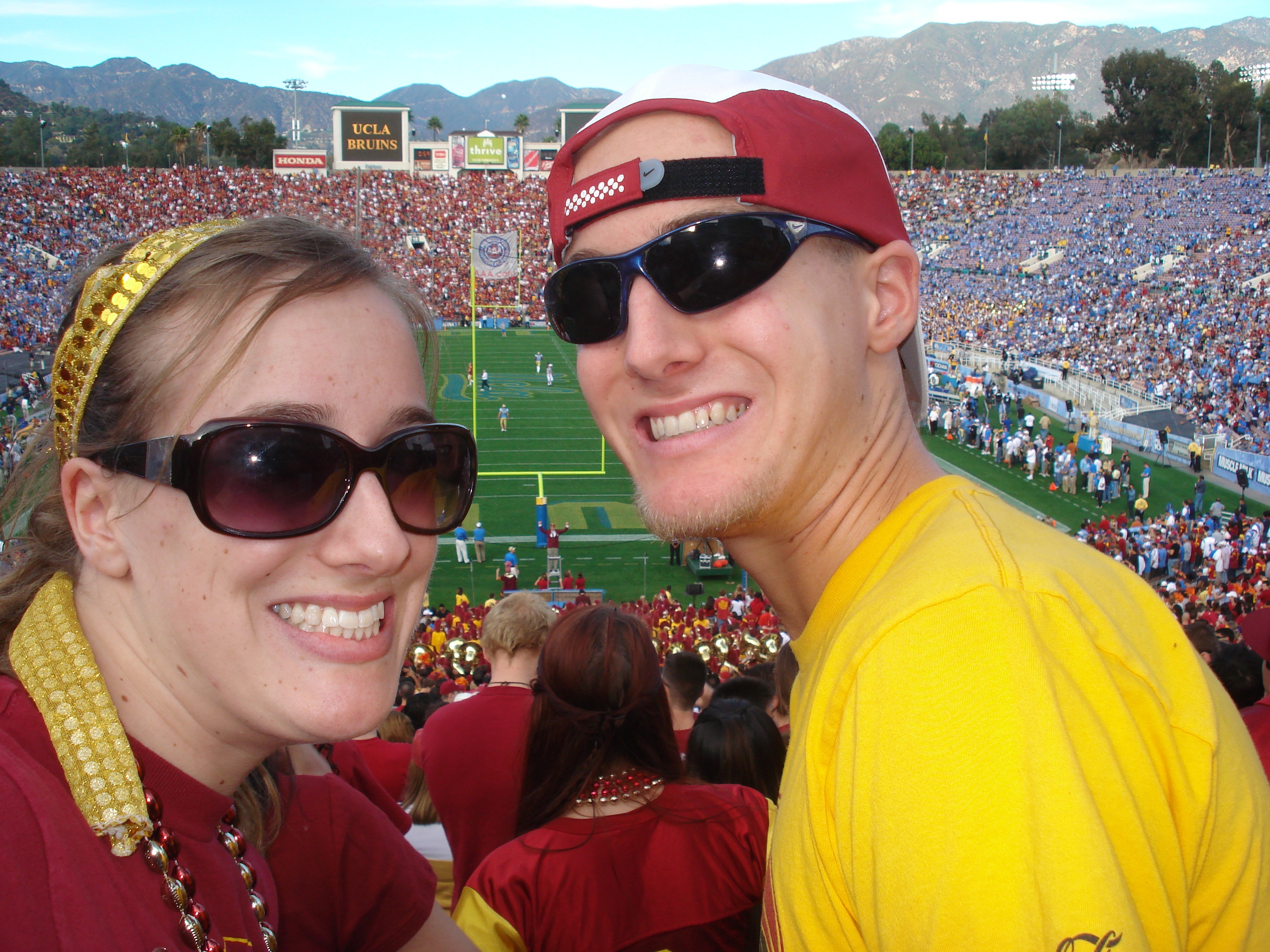
My son is much too fast for me these days – he was a four-year walk-on for the University of Southern California Track & Field team and Distance Captain last season as a senior. His event was the 5,000 meters with some 1,500s. Now we only run together occasionally when he is home on a break from running his nonprofit organization Give Running www.giverunning.org and has an “easy” day training for road races. Indeed, even though I am fast enough to have qualified for the Boston Marathon, his “easy” runs are my speed workouts just trying to keep up with him!

But we used to run together a lot. In fact, The Little Chap Who Follows Me actually would run next to me. We talked a lot. Actually, he did. Me, I mostly listened.

He would tell me about his friends, about school, about video games, about what moves he would make if he coached the Lakers.

Our running conversations also included a lot of questions. Usually his. Often they made me laugh out loud. Like, “Was Gramps really a kid once?”

And, “Is Mom growing shorter?”

“What?”

“Dad, I really think she’s shrinking!”

“No, I think you’re just growing taller.”

“Oh yeah, I guess so.”

You can see why I always savored running with The Little Fellow Who Follows Me, even when the pace was slower than I’d like to keep him from actually following me. Admittedly, I knew this wouldn’t last long. Indeed, like his shrinking mother, his dad is growing slower.

More than that, The Little Fellow also simply became a faster fellow who at age 11 ran a 5:37 mile, broke 20 minutes in the 5K and competed in the cross country nationals in his age group.

* * *

     He thinks that I am good and fine,

     Believes in every word of mine;

     The base in me he must not see,

     The little chap who follows me.

I specifically, and fondly, remember one magical day 11 years ago – I know the year because it’s in my running diary, the memory preserved like a pressed rose in a scrapbook. The Little Chap Who Follows Me wanted to go on a 3-mile run. When we reached the turnaround point, I was struggling not to be The Old Man Who Follows Him.

Slowly, but methodically, The Little Chap Who Follows Me took the lead and widened it.

When he finally sensed that I was no longer with him, he turned around and came back for me. I told him to go ahead and I’d meet him at the park, but he would have none of that and ran alongside me at my pace the rest of the way.

I had envisioned this watershed day coming, the day when I couldn’t keep up – but not for a few more years I thought.

I thought wrong. Indeed, it was no fluke.

A couple days later, we went for a run in the hills and again I struggled to keep pace. Midway up “The Long Monster Hill That Makes Your Legs Burn,” as he has nicknamed this stretch of heartbreak road, I breathlessly insisted that The Little Fellow Who Follows Me go on ahead and wait for me at the top.

* * *

     I must remember as I go,

My not-so-lIttle "Little Fellow" and me.

My not-so-little “Little Fellow” and me.

     Through summer’s sun and winter’s snow;

     I am building for the years to be

     That little chap who follows me.

With the summer’s-like sun setting behind the mountains, I finally crested the Monster Hill long after The Little Chap Who Follows Me did.

When I at last came into his view, he waved at me and smiled a big smile that seemed equal parts I-missed-you-Dad and pride. My pride was even greater. It is a mental snapshot I will remember as I go through the rest of my summer suns and winter snows.

Running, of course, is just a metaphor. My 11-year-old son’s flying Nikes as he effortlessly sailed up The Long Monster Hill That Makes Your Legs Burn and left me behind were a reminder of time’s winged flight, that The Little Fellow Who Follows Me wouldn’t be little for long.

Yes, figuratively I had glimpsed the future, and it is as it should be. Sons should grow taller and faster and stronger and more talented than their dads. And handsomer and funnier and wiser, too.

In short, become better.

Become, also, careful men with their own little fellows who follow them.

Until then, The Little Fellow Who Follows Me, now 22, gets to lead me. And I could not be happier.