
Hall-of-Fame Campsite Cleaners

Woody’s award-winning novel “The Butterfly Tree” is available at Amazon (click here), other online retailers, and orderable at all bookshops.

*

The long road to the International Tennis Hall of Fame is paved with tireless hard work and endless dedication, bottomless talent also, naturally, but the surprising thing is the roadside is remarkably clean of litter.

Mike and Bob Bryan shared this revelation as the capstone of their induction speech, more than 15 minutes of eloquence punctuated at conclusion with a trademark Bryan Brothers Chest Bump, last month in Newport, R.I., for which I was fortunate to be in attendance, further privileged in the third row.

Wearing their newly bestowed navy blazers emblazoned with a white tennis racket and “ITHF” over the heart, Camarillo’s favorite identical twin sons made it easy for the assemblage, even those in the back row of folding wooden chairs that filled the historical 145-year-old lawn court, to tell them apart: Bob’s tie was striped, Mike’s dotted.
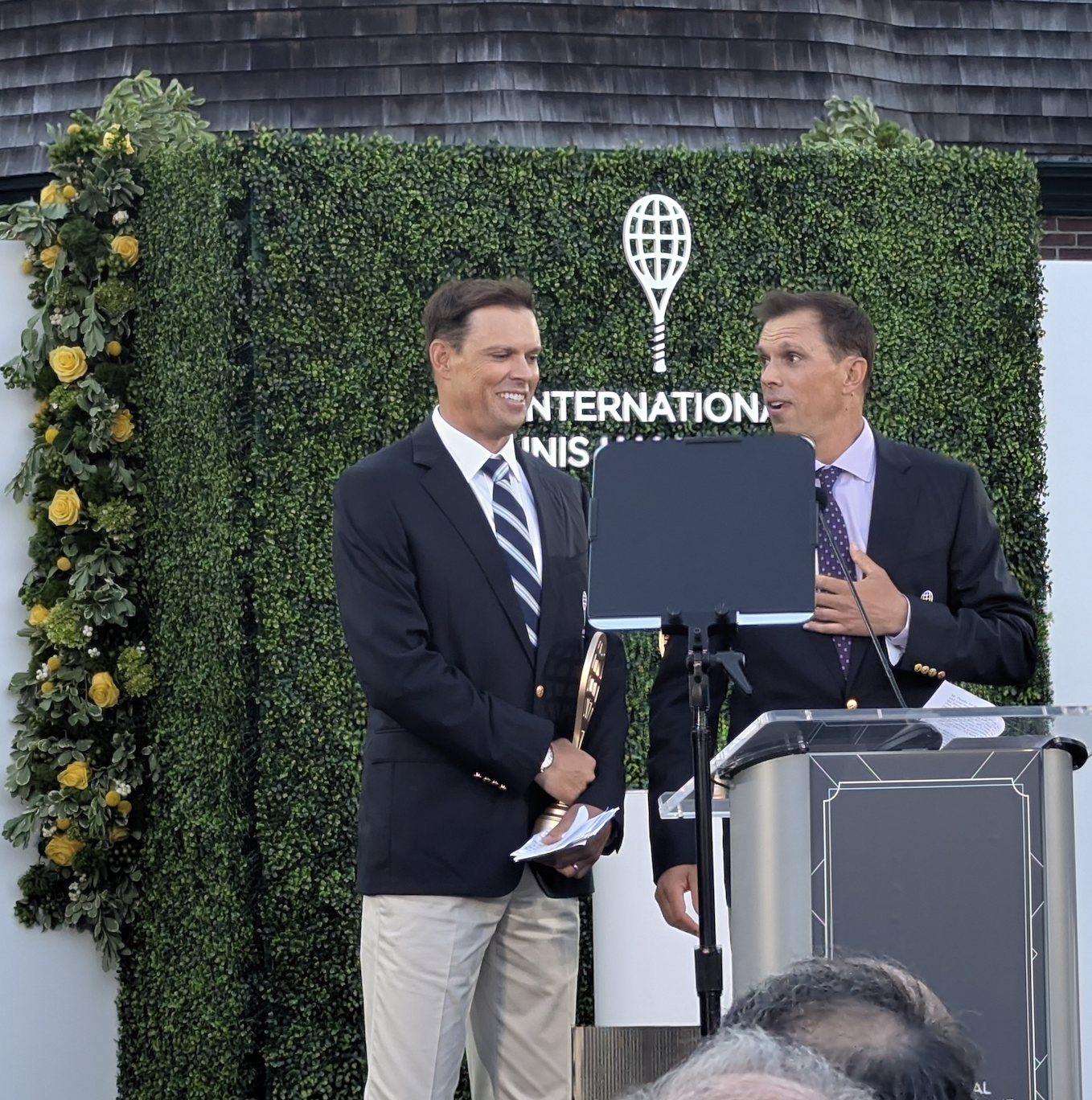
Bob (left) and Mike Bryan’s exemplary Hall-of-Fame speech was filled with heart — and humor, too.

Displaying the same synchronicity they used with rackets to become tennis’s most titanic tandem of all time with 16 Grand Slam championships and 119 professional titles overall, both records by a mile, Mike and Bob seamlessly took turns at the microphone recounting their shared career; dispensed heartfelt thanks to those who helped make it possible, most emotionally to their tearful parents Kathy and Wayne; then ended by coming full circle to journey’s beginning.

“Each day,” Mike now said, his mind’s eye looking back four decades, “when we made that seven-minute drive to the Cabrillo Racquet Club, if our dad ever saw a piece of trash on the side of the road he’d pull the car over, we’d jump out and pick it up. He’d often say to us, ‘Always leave the campsite cleaner than you found it.’ ”

Instantly, I was reminded of two more Hall of Famers I likewise had the inspiring pleasure to know well: basketball coach John Wooden and baseball manager Sparky Anderson.

The first time I joined Coach Wooden on one of his daily four-mile walks was memorable for myriad reasons, including when he abruptly stopped, stepped behind me and across the sidewalk, then bent down for a piece of litter – a hamburger wrapper, I still recall – that I had not noticed. He continued to contribute to the cleanup of his neighborhood, and I followed his example, as we briskly padded on.

“Pick up your own orange peels,” Coach called it, his Wooden-ism version of the Boy Scout’s clean campsite rule.

Sparky, on his morning walks in Thousand Oaks, not only picked up “orange peels,” he would deliver onto front doorsteps any newspapers still resting in driveways. Moreover, on trash day he would go for a second stroll in the early evening and roll empty garbage barrels from curbside up to garage doors.

“Woody, it don’t cost nothing at all to be nice,” Sparky said, a core tenet the Bryan Brothers exhibited to the fullest during their playing careers, from signing the very last autograph request after every match to sending flowers to staff after each tournament.

“Always leave the campsite cleaner than you found it…” Mike had quoted their father; posthaste, as if he were poaching at the net, Bob stepped sideways and leaned into the Hall-of-Fame mic:

“…and Mike and I have tried to live by this rule, not just on the side of the road, but with the tennis fans, with our Foundation, and we’ve tried to give back to the sport that has given us so much. We hope in some small way we’ve left the tennis campsite a little cleaner and a little better than we found it.”

Indeed, Coach Wooden and Sparky would be proud.

* * *

Essay copyrights Woody Woodburn
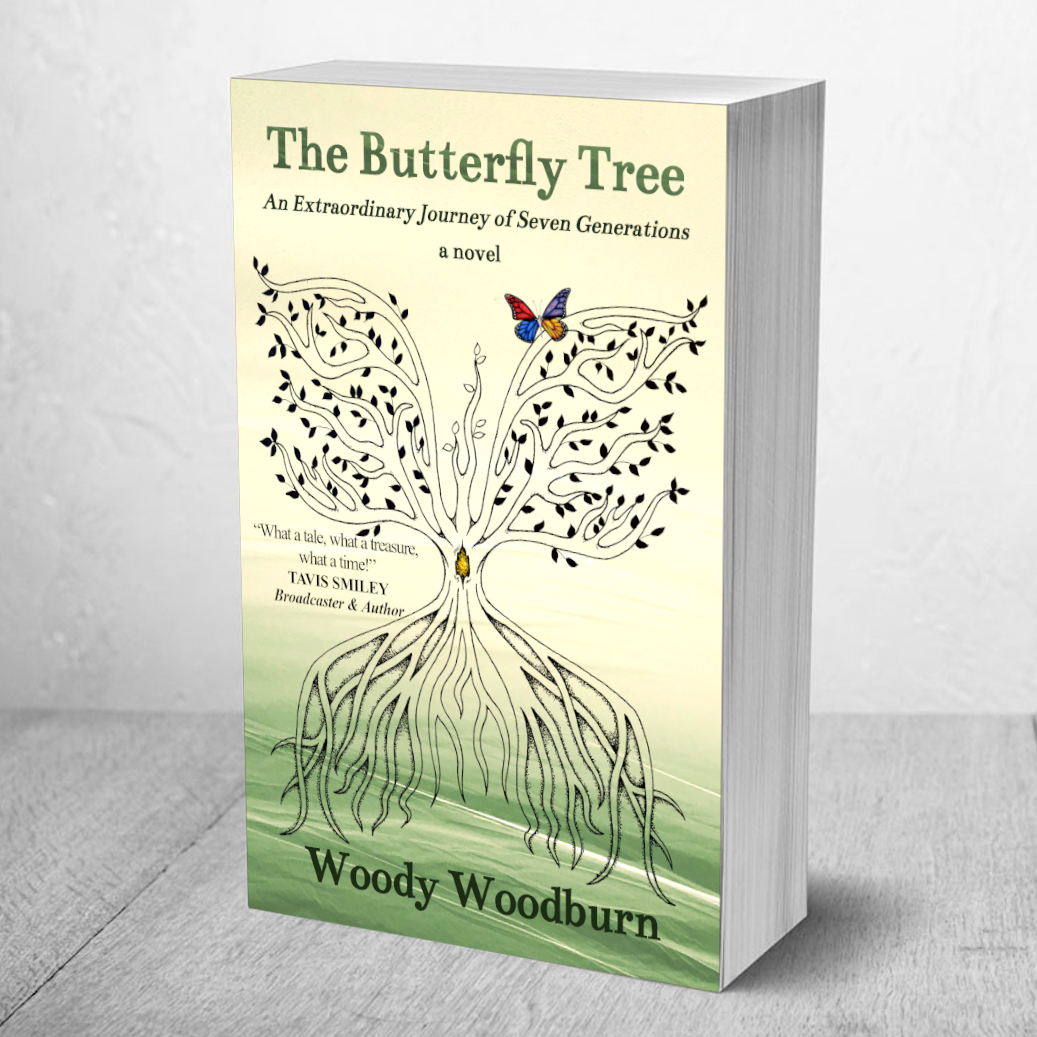
Woody’s new novel “The Butterfly Tree” is now available in paperback and eBook at Amazon (click here), other online bookstores, and is orderable at all bookshops.

*

Woody writes a weekly column for The Ventura County Star and can be contacted at WoodyWriter@gmail.com. Follow him on Twitter and Instagram at @woodywoodburn.

Hole Leads To Whole New Beauty

Woody’s award-winning novel “The Butterfly Tree” is available at Amazon (click here), other online retailers, and orderable at all bookshops.

*

Because Ol’ Green recently needed another small repair, and further inspired by my late mom’s quilt shared in this space last week, here is a column from my archives from four years ago…

*

Imagine a teenager looking in the mirror while getting ready for prom and seeing an eyesore pimple. That is the kind of chill I felt the other day when I put on my favorite pullover and spotted a small hole, but impossible to miss, in front.

Understand, I have had this wool, olive green, quarter-zipper, vintage Patagonia pullover for close to two decades and babied it most of that span so as to keep it pristine as long as possible. As a result, it has spent more time sequestered inside a dresser drawer than out in the world, which is not a good thing.

Ol’ Green keeping me warm at the Ventura Pier…

Also as a result, it has made more than its share of appearances at happy gatherings and special events, which is a good thing. The unsightly new blemish, however, promised to retire Ol’ Green from marquee billing.

While age finally claimed its youthful beauty, I did not want the small hole to get stretched and pulled and torn into a larger one. “A stitch in time saves nine” but, alas, my skill with needle and thread is limited to sewing a button back on a shirt. Meanwhile, my wife felt the emotional pressure of a surgeon being asked to operate on a loved one and begged out.

My dear friend Kathy, who possesses Betsy Ross skills, saved the day – and saved Ol’ Green. I wish you could see her handiwork. Darned if her darning isn’t masterful. The interwoven needlework is nearly invisible.

Since I know where to look, however, I can see it – and this makes me surprisingly happy. I say this after thinking about the Shakers who were renowned for their furniture craftsmanship yet deliberately introduced a “mistake” into each piece they made in order to show that man should not aspire to the perfection of God. Flawed, they believed, could be ideal.

Ol’ Green is now similarly ideal.

Navajos, likewise, weave a single imperfection into their handmade blankets. To their eyes this makes the blankets more, not less, beautiful. In “Blood and Thunder: The Epic Story of Kit Carson and the Conquest of the American West,” author Hamptom Sides elaborates on this mindset:

Navajos hated to complete anything – whether it was a basket, a blanket, a song, or a story. They never wanted their artifacts to be too perfect, or too close-ended, for a definitive ending cramped the spirit of the creator and sapped the life from the art. So they left little gaps and imperfections, deliberate lacunae that kept things alive for another day.

“Even today, Navajo blankets often have a faint imperfection designed to let the creation breathe – a thin line that originates from the center and extends all the way to the edge, sometimes with a single thread dangling from its border. Tellingly, the Navajos call the intentional flaw the ‘spirit outlet.’ ”

Henceforth, I will take the Shakers’ and Navajos’ perspectives to heart when I wear Ol’ Green and embrace its repaired imperfection as a “spirit outlet.”

“Kintsugi” also comes to mind, this being the Japanese practice of repairing broken pottery with seams of gold and, in the process, making the object more beautiful for having been broken. That is exactly how I feel about my beloved pullover.

From now on, instead of saving Ol’ Green for special occasions I am going to wear it regularly. And when future holes and “spirit outlets” appear, and surely they will, I may ask Kathy to perform her seamstress wizardry with gold thread instead of perfectly matched olive.

Ol’ Green-and-Gold will then be even more beautiful than ever.

* * *

Essay copyrights Woody Woodburn

Woody’s new novel “The Butterfly Tree” is now available in paperback and eBook at Amazon (click here), other online bookstores, and is orderable at all bookshops.

*

Woody writes a weekly column for The Ventura County Star and can be contacted at WoodyWriter@gmail.com. Follow him on Twitter and Instagram at @woodywoodburn.

A Tale of Two Handmade Quilts

Woody’s award-winning novel “The Butterfly Tree” is available at Amazon (click here), other online retailers, and orderable at all bookshops.

*

Imagine a painting by Monet of a pond shimmering with a hundred shades of blue, deep ocean to summer sky, on a canvas larger than a king-size mattress.

Now imagine a different masterpiece, every inch as large and lovely and beautiful and blue, but instead of oil brushstrokes on stiff canvas its medium is five-inch squares of age-worn denim sewn together and framed by a twill border.

“Priceless” is a greatly overworked word, but it is rightly employed to describe the patchwork quilt my mother, gone 33 years now, made for me before I headed off to college.

To begin, Mom surreptitiously saved my old blue jeans, Levi’s mostly, for a number of years. From these she harvested enough squares, or “blocks,” to build a quilt of 19 rows by 13 – 13 being a lucky number in her heart because she met my dad on a blind date on the thirteenth of October – measuring an oceanic six feet wide by more than seven feet long.

She arranged these pixels of denim with an artist’s eye and a mother’s care, forming pleasing patterns from the spectrum of faded hues and varying textures. For example, a small number of blocks have inseams running through them and a few others have front or side pockets removed, leaving behind silhouettes that resemble suntan lines.

One noteworthy square has the white frayed beginnings of a hole, probably at a knee, chosen because Navajos to this day intentionally weave a faint imperfection into each blanket to make it more human and thus more treasured.

Less seriously, near the quilt’s bull’s-eye is a signature 501 Button Fly. Naturally, one square features a rectangular Levi’s label – the waist and inseam sizes erased by age – and a trademark Red Tab tag adorns another square.

In the heart of the blue-denim field, which features nearly 300 tasseled quilting knots securing the touching corners of each and every block, is a large diamond pattern comprised of 16 squares of colorful tartan, in homage to our Irish roots, an eyesore pair of 1970s bellbottoms metamorphosed into handsomeness.

Weighing nearly 11 pounds, thanks furthermore to heavy-duty twill backing and thick batting inside, sleeping beneath this heirloom quilt feels like being hugged. In time, it hugged my daughter throughout college and then my son during his university years. No worse for wear, it now awaits four grandchildren.

Speaking of grandkids, the quilt’s four main corners each have a complete back pocket that my mom said, with a wink, were for condoms because she did not wish to become a grandmother too early.

And yet when I eventually made her a grandmother (for the fourth time) it was indeed too early, for my daughter was born three months premature weighing just 2 pounds, 6 ounces. Dallas remained in the Neonatal Intensive Care Unit for two months that seemed like a hundred years. If there is such a thing as angels on earth, I will tell you NICU nurses indeed have invisible halos.

September is National NICU Awareness Month, which brings me to a second priceless quilt. It is crib-sized and new and conjures a field of sunflowers painted by Van Gogh. I purchased it from an on-line shop for my granddaughter, Auden, who is named in honor of my mom.

More than being beautiful, what makes this quilt beyond special is the accompanying note from the seller, written in purple ink in smooth looping letters, explaining that her mom donates the money from her handmade quilts to NICUs.

All quilts are works of art, but some are works of heart.

* * *

Essay copyrights Woody Woodburn

Woody’s new novel “The Butterfly Tree” is now available in paperback and eBook at Amazon (click here), other online bookstores, and is orderable at all bookshops.

*

Woody writes a weekly column for The Ventura County Star and can be contacted at WoodyWriter@gmail.com. Follow him on Twitter and Instagram at @woodywoodburn.

Can Black Thumb Turn Green?

Woody’s award-winning novel “The Butterfly Tree” is available at Amazon (click here), other online retailers, and orderable at all bookshops.

Inspired by a white orchid received when my dad passed away a year and a half ago, which I have miraculously kept alive since, I am sharing this slightly revised column from my archives because, even more miraculously, Spikey is still in my care and thriving four years later!

*

In college, for a girl I had a crush on, I agreed to care for her cat and a houseplant over winter break. The CliffsNotes plot summary: I overwatered the plant, overfed the feline, and overestimated the girl’s feelings for our relationship.

Of the three, only the fat cat survived.

For a different girl I soon after met in college, I years later planted a dwarf orange tree as a gift for her fifteenth wedding anniversary. I did everything the gardening expert at the local nursery advised, from choosing a location with optimal sunshine to digging a hole of the prescribed circumference and dept to using the right soil mixture and watering amply but with care.

Alas, for our sixteenth anniversary I did not give my wife a glass of homegrown freshly squeezed orange juice in bed because the tree had already perished. Fortunately, this was not an omen as our wedded family tree now has forty-three annual growth rings.

Some people – such as my great-grandfather, who developed his own registered “Woodburn Golden Dent” corn variety that won numerous gold medals at the State Fair and was popular well beyond the borders of Ohio – have green thumbs.

My thumb, on the other hand (on both hands, in fact) is funeral black. To trees, plants, lawns, roses, even full gardens, I am the Grim Reaper. A Human Dust Bowl. And so it was with great trepidation that I agreed to care for my son and his lovely wife’s small potted succulent named Spikey.

While my wife has developed a light minty-colored thumb to compensate for my inabilities, I wanted to make amends for the long-departed orange tree and thus assumed full care of Spikey.

How is it going, you might wonder?

Believe it or not, Spikey is thriving as never before! A big reason is because my dear friend Sus, whose thumb brings to mind the Emerald Isles, shared some of her secrets.

To begin, she told me I must occasionally take Spikey outside for “recess” in the fresh air. This sounded reasonable and doable.

Secondly, less reasonable and much less doable, she advised that I sing to Spikey. Sus leans towards church hymns for her houseplants and specifically noted her bonsai tree named Little Harmony is partial to “I Come To The Garden Alone.”

Understand, Sus sings in a choir, her voice so enchanted I imagine it can turn weeds into roses. My singing voice, I fear, would do the opposite. Sus suggested I instead play radio music for Spikey so long as I also read to him.

“You’re joking, right?” I said.

It turns out Spikey seems to enjoy hearing “The Runaway Bunny” and “Goodnight Moon” from my lips nearly as dearly as do my three young granddaughters. When I confessed to Sus that I felt silly reading children’s books to a plant, she suggested trying a novel.

“You’re kidding, right?”

I think Spikey’s vocabulary is growing almost as steadily as are his sharp leaves.

It seems I have become a plant whisperer of sorts. As such, I have now been temporarily entrusted with six of Spikey’s relatives: Lundy, short for London, who needs to avoid direct sunlight; Lexa, who likes a little sunshine; Phillip and Mariposa, who must have their support stakes routinely checked for straightness; and Verny and Junior, who prefer to be watered sparsely.

As for books, I was thinking they might all enjoy if I read aloud “Where The Red Fern Grows” – but certainly not “The Giving Tree” for it would surely give them nightmares.

* * *

Essay copyrights Woody Woodburn

Woody’s new novel “The Butterfly Tree” is now available in paperback and eBook at Amazon (click here), other online bookstores, and is orderable at all bookshops.

*

Woody writes a weekly column for The Ventura County Star and can be contacted at WoodyWriter@gmail.com. Follow him on Twitter and Instagram at @woodywoodburn.