Woody’s new novel “The Butterfly Tree” is available at Amazon (click here), other online retailers, and orderable at all bookshops.
*

Don’t judge a bookstore by its front façade is a lesson I learned in Ireland, in Dublin, in the late afternoon after stepping inside a dog-eared shop, taller than wide, with a recessed front entryway bookended by two display windows above which are three rising arched panes, each one topped by rectangular signage of capitalized gold letters on black, reading left to right:
DRUGIST / SWENY / CHEMIST
To be sure, nothing on the outside suggested a bookshop. My first impression—and second, third, sixth, for I walked past it the daily from across the street for nearly a week—was that it was a pawnshop. And so, while I adore bookshops as dearly as I do ocean sunsets, I kept passing by without stopping to look more closely.
On our last full day in the Emerald Isle’s capital not too long ago, however, after getting happy in Kennedy’s Bar, established in 1850 and famous as a hangout for renowned writers Samuel Beckett and Oscar Wilde and James Joyce, I pointed kitty-corner and inexplicably suggested to my wife, “Let’s check it out.”
It proved to be like finding a four-leaf clover.
Built in 1847 as a physician’s office, six years later it became a pharmacy: “F.W. Sweny & Co. Ltd: Dispensing Chemists.” Flipping the calendar pages further forward to 1904, James Joyce stepped through the front door and consulted with the pharmacist, Frederick William Sweny himself, a visit that is described in great detail in Chapter 5 of Joyce’s novel for the ages, “Ulysses.”
Sweny’s also lies within 50 yards of the location where, that very same year, Joyce was stood up by Nora Barnacle. Two days later, on June 16, his future wife yielded to his advances and thus the date would famously become know as “Bloom Day” in honor of the hero, Leopold Bloom, in “Ulysses” which takes place entirely on that single day.
And so it is that Sweny’s has the great honor of being immortalized in sumptuous prose within the tome’s pages when Bloom comes into the shop. Two very brief excerpts: “He waited by the counter, inhaling the keen reek of drugs, the dusty dry smell of sponges and loofahs.” And: “He strolled out of the shop, the newspaper baton under his armpit, the cool wrappered soap in his left hand.”
More than a century later, I walked inside and inhaled not a reeky smell, but a lovely fragrance of a bookstore and later strolled out with a book in my left hand—Joyce’s “Dubliners,” a handsome limited edition green-cloth hardback with gilt lettering wrappered old-timey in brown paper.
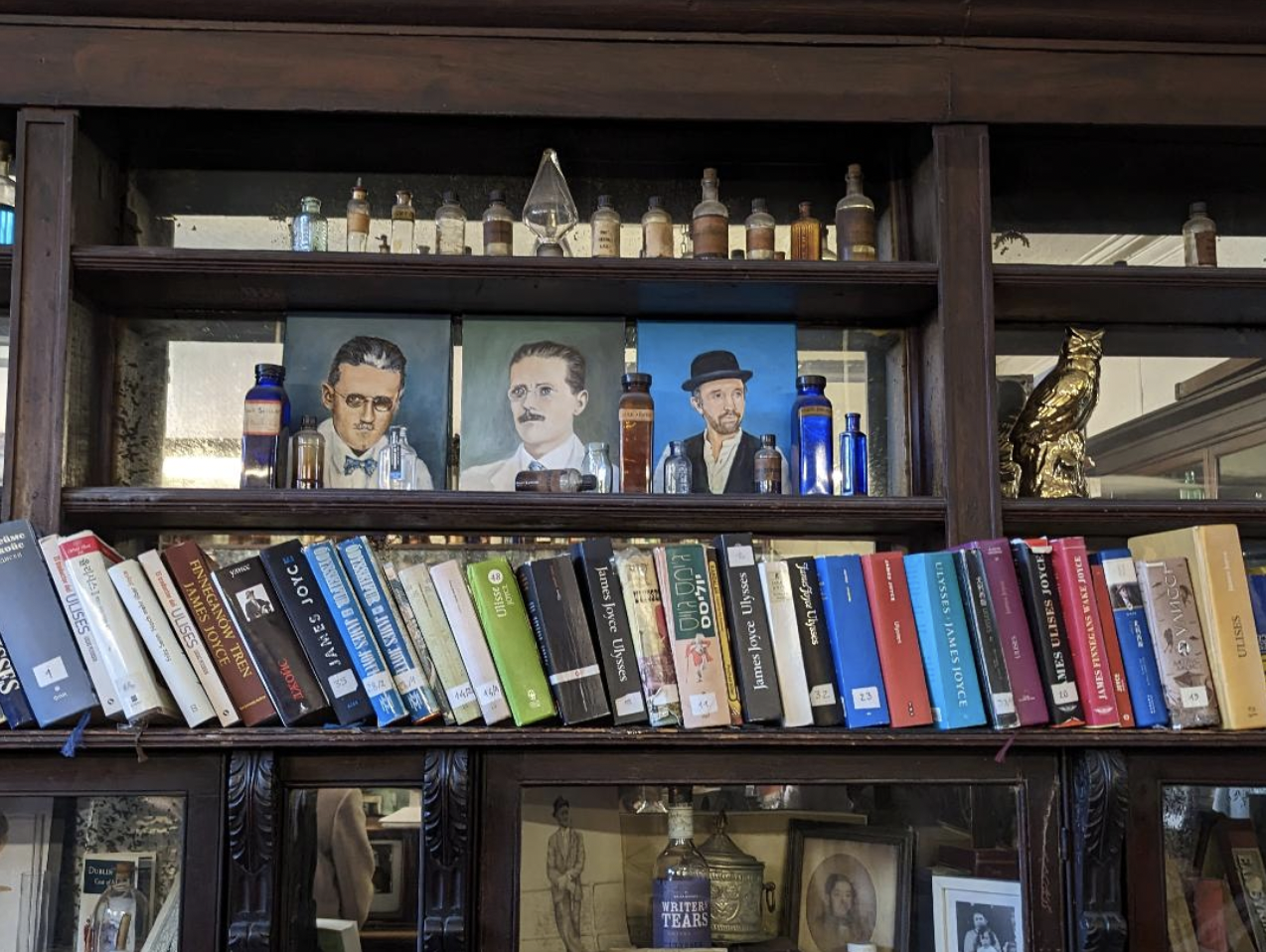
The upper reaches of the soaring shelves, for the ceiling is as lofty as a poetic tree, remain stocked with antique medicine bottles of sea-glass green and ocean blue and fog white. The lower shelves, and handsomely old countertops too, are filled with a different medicine, for the mind—books.
Uniquely, every dose of pages for sale is by James Joyce: “Finnegans Wake”, “Dubliners”, “A Portrait of the Artist as a Young Man” … and, most prominently, “Ulysses”—including a collection of editions in 45 different languages. Also on display is a rare death mask of Ireland’s arguably most celebrated writer.
But what truly makes the Joyce-themed Sweny’s one of my all-time favorite bookshops is the proprietor, the great-great-great-great-grandson of Frederick William Sweny. Patrick Joseph Murphy, who goes simply by P.J., is as interesting as the day is long—rather, as interesting as “Ulysses” is long at 700-plus pages.
And I will tell you much more about P.J. here next time.
* * *
Essay copyrights Woody Woodburn
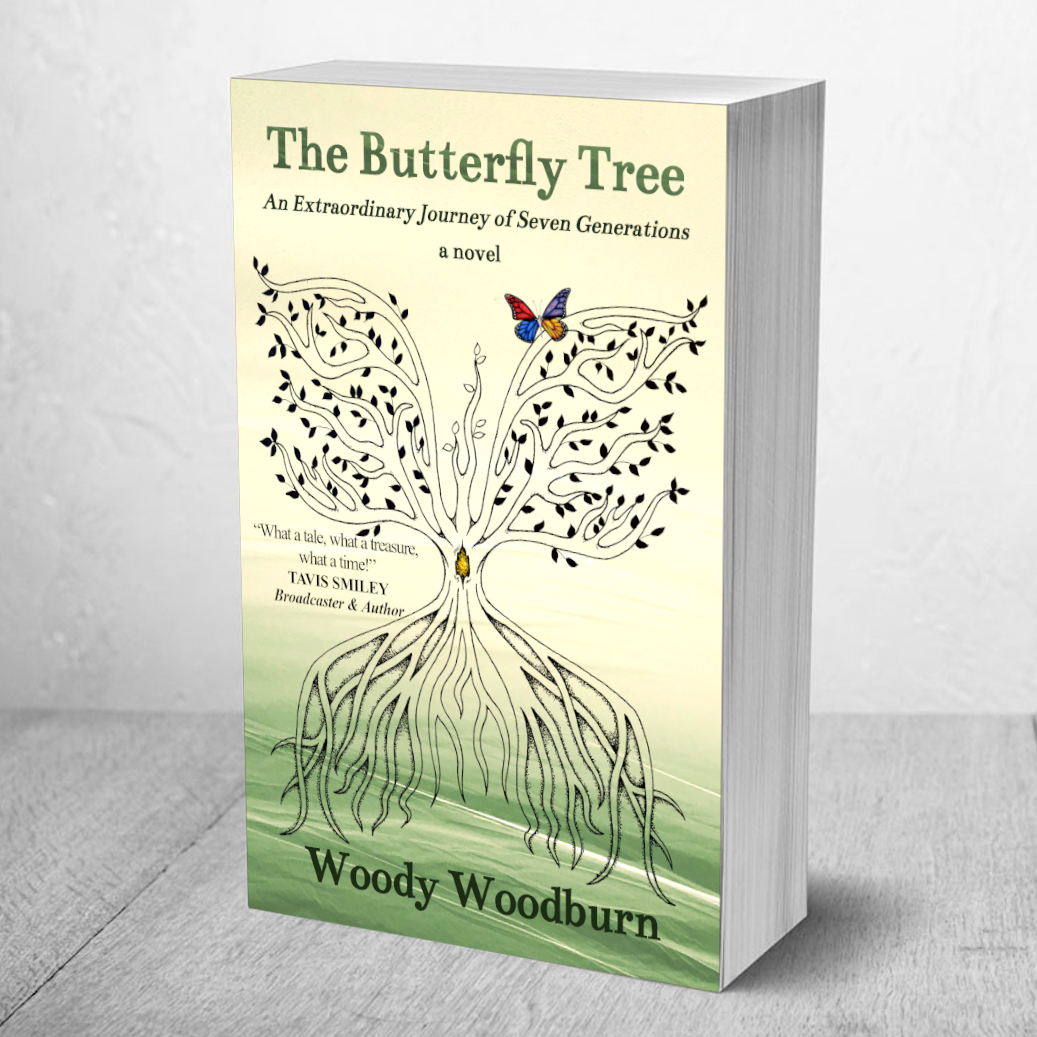
Woody’s new novel “The Butterfly Tree” is now available in paperback and eBook at Amazon (click here), other online bookstores, and is orderable at all bookshops.
*
Woody writes a weekly column for The Ventura County Star and can be contacted at WoodyWriter@gmail.com. Follow him on Twitter and Instagram at @woodywoodburn.