Fireside Tales in the Twain Home

Is your Club or Group looking for an inspiring guest speaker or do you want to host a book signing? . . . Contact Woody today!

* * *

1StrawberriesCoverWooden-&-Me-cover-mock-upFor a Personalized Autographed copy of STRAWBERRIES IN WINTERTIME” or “WOODEN & ME” use the PayPal link on my home page or mail a check for $25 to:

Woody Woodburn

400 Roosevelt Court

Ventura, CA 93003

* * *

Fireside Tales in the Twain Home

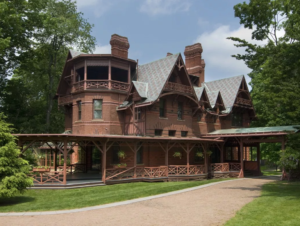
Samuel Clemens’ home in Hartford, Connecticut, is almost as expansive as Mark Twain’s bibliography. The great author wrote some thirty books; his stately residence, built in 1874, checks in with twenty-five rooms.

The three-story mansion features a facade of mostly red brick with some painted orange, and others black, to create intricate patterns. Everywhere there are exterior angles and corners, gabled roofs and four chimneys, ornamental trusses and awnings, balconies and porches.

Inside, it was a marvel of its day featuring the latest “modern” innovations such as hot and cold running water in the seven bathrooms, flush toilets, and gaslight. It even had a newfangled telephone in the kitchen and a burglar alarm powered by batteries.

From the grand entry foyer up to the third-floor billiard room, the interior is breathtaking. To give you an idea of the opulence, nearly every inch of the walls and ceilings are decorated with intricate silver and gold stenciling designed by Louis C. Tiffany, the son of the famed jewelry store founder.

In the billiard room, hidden away from the busyness of the family, is where Twain wrote. Indeed, he penned his most important works here, including Adventures of Huckleberry Finn, The Adventures of Tom Sawyer, and A Connecticut Yankee in King Arthur’s Court.

While I could imagine Twain at work with a thick fog of cigar smoke in the air and his notes spread out on the billiard table, my favorite room was the first-floor library. And my favorite part of the library was not the bookshelves filled to capacity, but rather the fireplace mantel.

It seems that Twain loved to play a nightly game with his three daughters – Susy, Clara and Jean – when they were young in which he would spin stories incorporating all of the items resting on the elaborately carved oak mantelpiece that came from Ayton Castle in Scotland.

From left to right, these items are: a painted round vase; large seashell; marble figure of a woman; tall blue vase; silver round serving platter; at the mantelshelf’s middle, a framed painting of a woman wearing a red winter coat and black hat; bronze tile of Twain’s profile; matching tall blue vase; white pottery water jar; small blue vase; a typing paper-sized painting of a cat’s face; and a tiny bronze harp figurine. Surely only a genius could invent new tale after original tale with these artifacts.

At first blush, the cat painting is not striking. It is of an ordinary grey feline with a pink nose, white whiskers and green eyes. Also, however, the cat is wearing a white ruffled collar – a “ruff” the tour guide noted – of the sort a Shakespearean character might wear.

Despite the house being filled with many more-remarkable framed artworks, “Cat in a Ruff” is said to have been Twain’s favorite – “beloved” is the word the tour guide used. This explains why the key rule to his storytelling game was that while the tale changed each and every night, one thing remained constant: it had to begin with “Cat in a Ruff.”

A decorative brass smoke shield above the firebox suggests that the warm feelings within the library extended throughout the house, and also beyond family, for Twain had it engraved with this sentiment from Ralph Waldo Emerson: “The ornament of a house is the friends who frequent it.”

Picturing myself as a friend who was blessed to frequent the Clemens’ house, and listen to his fireside storytelling, was reason enough to take home from the souvenir shop a refrigerator magnet of “Cat in a Ruff.”

* * *

Woody Woodburn writes a weekly column for The Ventura County Star and can be contacted at WoodyWriter@gmail.com.

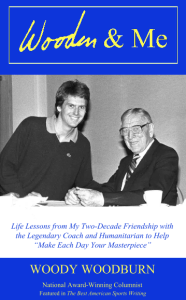
Wooden & Me Kickstarter Front PhotoCheck out my memoir WOODEN & ME: Life Lessons from My Two-Decade Friendship with the Legendary Coach and Humanitarian to Help “Make Each Day Your Masterpiece” and my essay collection “Strawberries in Wintertime: Essays on Life, Love, and Laughter” …

Lobster Couple Tops a National Park

Is your Club or Group looking for an inspiring guest speaker or do you want to host a book signing? . . . Contact Woody today!

* * *
1StrawberriesCoverWooden-&-Me-cover-mock-upFor a Personalized Autographed copy of STRAWBERRIES IN WINTERTIME” or “WOODEN & ME” mail a check for $25 to:

Woody Woodburn

400 Roosevelt Court

Ventura, CA 93003

* * *

Lobster Love Outshines a National Park

Opening acts are not supposed to outshine the marquee attraction, yet that is exactly what happened.

In port for the day in Bar Harbor, Maine, my wife and I took a four-hour bus-and-hiking tour of Acadia National Park. The 47,000-acre expanse of rocky beaches and granite peaks, wild woodlands and serene lakes, made arm hairs rise in awe.

And yet this picturesque landscape was surpassed by a one-hour side visit to the nearby tiny Mount Desert Oceanarium Lobster Hatchery. Specifically, co-directors Audrey and David Mills made it a mental rose petal to be pressed inside the pages of a scrapbook.

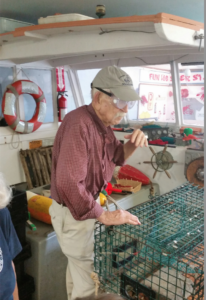
David, a longtime lobster fisherman before becoming a charismatic octogenarian, began his presentation boat side: “Three things I know about a cell phone. One – don’t keep it in your breast pocket if you’re going to learn over the side to look down into the water.

David Mills displays a steel lobster pot.

“Two – it will not sink like a rock, but instead flutter to the bottom like a falling leaf.” He waved his hand in demonstration and continued: “Three – don’t bother retrieving it because it won’t work after its been in the salt water.”

For the next ten minutes, David paddled further and further away from the promised topic. Finally, as if suddenly remembering why we were all gathered, he pointed to a sign resting on the gunwale: “Talk About Lobsters Will Begin In A Bit.”

His grey droopy mustache danced above a quick smile and he said, “You thought I forgot to take this down, didn’t you?”

The mustache danced again: “It’s true – I’ll get around to talking about lobsters in a bit.”

The audience laughed. A bit later we learned a lot about lobsters. We learned about pots and trap bait and a hundred things more. We laughed some more, too.

Relating that he used to retrieve lost lobster traps from the depths of Maine’s frigid waters as a hired Scuba diver, David feigned a shiver and noted: “I charged 35 dollars an hour – 30 dollars was for the first five minutes.”

We learned that lobsters grow beyond 40 pounds; an adult lobster sheds its shell – molts – almost annually; and lobsters go into hiding until their new shells harden.

We learned that Atlantic lobsters are left- or right-handed, no kidding, depending on which side the more massive pincer claw – used to crush armored prey such as crabs and clams – is located. The opposite more slender pincer captures fast food like small fish.

We learned that Maine law requires lobstermen to cut a notch in the tail of egg-bearing females before throwing them back to sea. This “V-notch” thereafter serves as a get-out-of-jail card, so to speak.

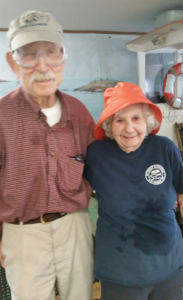
Lobster couple Audrey and David Mills have been married for 62 years.

Best of all, we learned this: true love lasts a lifetime. Audrey and David are proof. They have been married 62 years and still come into focus like honeymooners.

When it was Audrey’s turn to lecture about crustacean biology, David couldn’t take his twinkling eyes off her. I know this because I couldn’t take my eyes off him watching her.

When Audrey told little jokes, quips that couldn’t possibly be funny after one has heard them thousands of times, David laughed as genuinely as if it were the first time.

For example, after explaining that a lobster’s sense of smell is one million times that of a human, she added: “Yuck, right?” and David’s mustache danced anew.

Here was my favorite moment of all. Afterward, when I asked David to pose for a boat-side photo, he politely excused himself to retrieve Audrey. He wanted her in the picture with him.

The lobster couple is actually a pair of lovebirds.

* * *

Woody Woodburn writes a weekly column for The Ventura County Star and can be contacted at WoodyWriter@gmail.com.
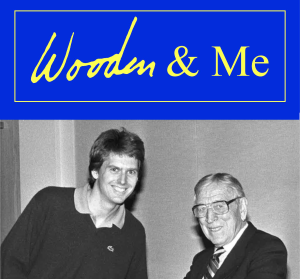
Wooden & Me Kickstarter Front PhotoCheck out my memoir WOODEN & ME: Life Lessons from My Two-Decade Friendship with the Legendary Coach and Humanitarian to Help “Make Each Day Your Masterpiece” and my essay collection “Strawberries in Wintertime: Essays on Life, Love, and Laughter” …

Fishing Village Has Solemn History

Is your Club or Group looking for an inspiring guest speaker or do you want to host a book signing? . . . Contact Woody today!

* * *

1StrawberriesCoverWooden-&-Me-cover-mock-upFor a Personalized Autographed copy of STRAWBERRIES IN WINTERTIME” or “WOODEN & ME” mail a check for $25 to:

Woody Woodburn

400 Roosevelt Court

Ventura, CA 93003

* * *

Quaint Fishing Village’s Solemn History

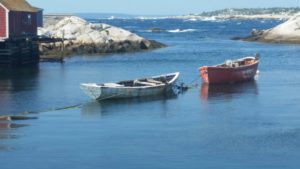
Peggy’s Cove is a quaint fishing village with brightly painted cottages of yellow and red and blue on the south shore of St. Margarets Bay in Halifax, Nova Scotia.

Its charm is not without alarm. On the path nearing Peggy’s Point Lighthouse is a bronze plaque with a green patina of age and rogue sea: “Warning: Injury And Death Have Rewarded Careless Sight-Seers Here. The Ocean And Rocks Are Treacherous. Savour The Sea From A Distance.”

An idyllic calm inlet within the rough waters of Peggy’s Cove.

An even starker reminder of the ocean’s treacherousness came just a few miles away when my wife and I visited Fairview Lawn Cemetery. A wooden sign, white with blue lettering, offers solemn notice: “Titanic Grave Site.”

Rising up a grassy slope are three rows of grave markers where 121 victims of the infamous sea disaster are interred. They found their final resting places here because two ships based in Halifax – the Mackay-Bennett and the Minia – assisted the search for bodies.

Viewing downhill from the crest of the site an idyllic image comes into focus: meeting at a single gravestone at the top, the three rows of markers bow outward suggesting the contour of a ship’s hull.

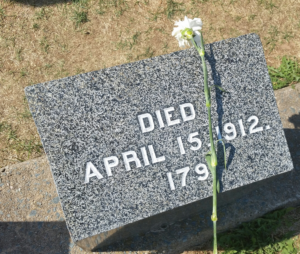
The top marker, a waist-high granite pedestal, is inscribed: “Erected To The Memory Of An Unknown Child Whose Remains Were Recovered After The Disaster To The ‘Titanic’ April 15, 1912.”

In 2002, after forensic testing identified the unknown child, a smaller plaque was added: “Sidney Leslie Goodwin, Sept. 9, 1910 – April 15, 1912.”

Daily, something else is added: visitors leave memorial offerings. On this day they included crayons and coloring markers, a porcelain angel figurine, and two teddy bears.

An unidentified marker at the Titanic grave site.

Almost impossibly, a nearby grave pulls on one’s heartstring fivefold harder – for here rests Alma Paulsen and her four children, ages 8, 6, 4 and 2. It is claimed it took the 29-year-old mother so long to get her children dressed that they missed the lifeboats. It is also said she lovingly played the harmonica to soothe and distract them as the doomed ship sank.

Remarkably, the Fairview Lawn Cemetery also holds the remains of victims from another epic maritime calamity – the Great Halifax Disaster of 1917. Its death toll actually surpassed the Titanic’s by more than 200 with an estimated 1,950 instant casualties. An additional 9,000 were injured.

It happened on a December morning after two cargo ships collided in the Halifax Harbor. The initial damage was actually minor. However, one of the ships was carrying a full load of explosives for the war effort in Europe, including 400,000 pounds of TNT.

That disabled ship floated downstream and ran aground and caught fire. The ensuing explosion leveled a full square mile of Halifax. A half-ton chunk of the ship’s anchor still lies where it landed 2.5 miles away. Shockwaves shattered windows 50 miles in the distance.

It was, according to experts, the most-powerful man-made blast until the arrival of The Atomic Age.

Here is something else powerful: Americans, especially volunteers from Boston, rushed to Halifax’s aid. The city continues to send a 40-foot spruce tree to Beantown each Christmas season as a thank you.

A more significant thank you came in the aftermath of the September 11 terrorist attacks. After the U.S. closed its airspace, a total of 224 planes were diverted to Canada. Halifax, as well as other Canadian cities, opened shelters and provided food and comfort.

Our tour guide, a local resident, put it this way: “At the end of the day, it was our American neighbors coming to our rescue in 1917 – so when we had the chance, we did the same on 9-11.”

* * *

Woody Woodburn writes a weekly column for The Ventura County Star and can be contacted at WoodyWriter@gmail.com.

Wooden & Me Kickstarter Front PhotoCheck out my memoir WOODEN & ME: Life Lessons from My Two-Decade Friendship with the Legendary Coach and Humanitarian to Help “Make Each Day Your Masterpiece” and my essay collection “Strawberries in Wintertime: Essays on Life, Love, and Laughter” …

Old Lighthouses Offer New Thrills

Is your Club or Group looking for an inspiring guest speaker or do you want to host a book signing? . . . Contact Woody today!

* * *

1StrawberriesCoverWooden-&-Me-cover-mock-upFor a Personalized Autographed copy of STRAWBERRIES IN WINTERTIME” or “WOODEN & ME” mail a check for $25 to:

Woody Woodburn

400 Roosevelt Court

Ventura, CA 93003

* * *

Old Lighthouses Offer New Thrills

The wood steps were narrow and shallow and steep, more ladder rungs than stairs, rising nearly vertically as if to a tree house.

It was a white-knuckle climb of three flights. The blind descent would prove more unnerving. No matter, even for someone with an aversion to heights the round trip was well worth taking.

The reward at the top, 60 feet in the sky, was a 360-degree view to treasure – open sea as far as the eye could see. This “tree house,” round as a giant sequoia, was made of brick and covered by white shingles.

The Point Prim Lighthouse is the oldest seafarer’s beacon on Canada’s Prince Edward Island. It marks the entrance at the outer waters of Charlottetown Harbor.

If you were asked to close your eyes and imagine an iconic lighthouse, Point Prim Lighthouse is what you would conjure. Hollywood would cast it in a movie. Solitarily situated on a thumb of land jutting into the turbulent seas, the tapering tower is topped by a fire engine-red crow’s nest, the cherry on top.

This stanza from Henry Wadsworth Longfellow’s poem “The Lighthouse” perfectly suggests the guiding beacon at Point Prim:

“The rocky ledge runs far into the sea,

“And on its outer point, some miles away,

“The Lighthouse lifts its massive masonry,

“A pillar of fire by night, of cloud by day.”

The lantern room atop the massive masonry at Point Prim today features an energy-efficient solar light as its modern “fire by night.” Originally, however, when built in 1845, four lamps fueled by seal oil provided its beaming light.

Next came kerosene lamps, twelve used in unison here, offering a brighter navigational signal.

Angus Murchison, Point Prim’s lightkeeper from 1920-1955, was said to be so “in tune” to the intensity of the kerosene light at night that even while he slept he could perceive when the beacons began to dim. As if by sixth sense, he would jolt awake and refill the lamps in time to keep mariners safe.

  • As vigilant steward of the light for 35 years, Angus was the longest serving of the succession of 16 keepers who lived at the Point Prim Lighthouse. However, he was not the lone Murchison to perform the lonely task – his son, grandson, and great-grandson followed in his footsteps up the steep ladder/stairs.

With astronaut Neil Armstrong’s first footstep on the moon in 1969, electricity at long last replaced kerosene as the light source at Point Prim. With this belated modernization, Mason Murchinson retired as its final keeper and a romantic era ended.

Touring a lighthouse makes time skip backward. Savoring the view from the lantern room, even on a T-shirt-warm clear day, one could imagine a ship in the distance, in the night, in a storm or in the fog, relying on this shepherding “pillar of fire.”

A visit to nearby Wood Island Lighthouse, 20 miles southwest on the Northumberland Straight, was equally enchanting. Prior to being built in 1876, its founder, Donald Duncan MacMillan, displayed a simple kerosene lantern in the second-story bedroom window of his house to aid sailors.

The poem “The Light-Keeper” by Robert Louis Stevenson hangs on a wall inside the Wood Island Lighthouse and includes these powerful lines:

“The life of the light-keeper,

“Held on high in the blackness

“In the burning kernel of night,

“The seaman sees and blesses him.”

No lightkeeper could have saved the Titanic and earned its captain’s blessing. In consequence, 121 victims of the iceberg disaster are buried in the Fairview Lawn Cemetery in Halifax, Nova Scotia – the next port on my travels.

* * *

Woody Woodburn writes a weekly column for The Ventura County Star and can be contacted at WoodyWriter@gmail.com.

Wooden & Me Kickstarter Front PhotoCheck out my memoir WOODEN & ME: Life Lessons from My Two-Decade Friendship with the Legendary Coach and Humanitarian to Help “Make Each Day Your Masterpiece” and my essay collection “Strawberries in Wintertime: Essays on Life, Love, and Laughter” …