Part II: History Lesson at Monticello

STRAW_CoverWoody’s highly anticipated new book “STRAWBERRIES IN WINTERTIME: Essays on Life, Love, and Laughter” is NOW available! Order your signed copy HERE!

 * * *

Little Mountain’ and Big Heartbreak

This is the second in a four-column series chronicling my recent father-son road trip to the homes of two Founding Fathers and more.

* * *

More than two centuries before the creation of Twitter, Thomas Jefferson distilled his life’s accomplishments into this tweet-length epitaph inscribed on his tombstone:

“Author of the Declaration of Independence, of the Statute of Virginia for Religious Freedom, and Father of the University of Virginia.”

In truth, 140 pages in an encyclopedia would be insufficient to chronicle Jefferson’ genius, much less 140 characters. Still, it is difficult to fathom leaving out mention of being the third president of the United States.1monticelloback
Perhaps a greater omission is this deed: “Designed Monticello.”

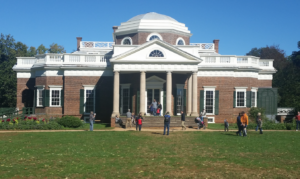
Jefferson called Monticello – meaning “little mountain” in old Italian – his “essay on architecture.” The neoclassical mansion was four decades in the making and remains such a masterpiece it is recognized as a World Heritage Site by the United Nations.

Remarkably, Jefferson designed every aspect and angle, inside and out, despite having no formal architectural training.

As with most things that interested him, which means MOST things, Jefferson became an expert by reading extensively – in this case, studying architecture, particularly that of ancient Rome and the Italian Renaissance.
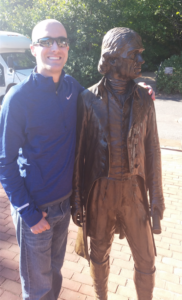
Greg Woodburn, in the flesh, and Thomas Jefferson, in bronze.

Greg Woodburn, in the flesh, and Thomas Jefferson, in bronze.

A true Renaissance man, his passions ranged from architecture to viticulture, music to bird watching, botany to beer making.

For good reason President Kennedy once famously quipped, at a dinner honoring 49 Nobel Prize winners: “I think that this is the most extraordinary collection of talent, of human knowledge, that has ever been gathered together at the White House, with the possible exception of when Thomas Jefferson dined alone.”

As pleasing as the Declaration of Independence is to the ear, Monticello is to the eye. Viewing the colossal columns and domed rooftop and arched windows from outside is like studying a Monet water scene; the longer you stare, the more perfection you see.

The interior – the grand entry hall filled with Native American artifacts collected by Lewis and Clark, the voluminous library, Jefferson’s bedroom chamber, the dome room above and cellar below – is equally breathtaking.

Too, there are the long and elegant north and south terraces that housed a dairy, smokehouse, kitchen, stables . . .

. . . and slave quarters.

More than being architecture as art, beyond the magnificent panoramic view that extends 45 miles on a clear day, the piece of Monticello that struck me most profoundly is that the man who wrote the Declaration of Independence containing the words “all men are created equal” owned men – and women and children.

Now, I knew Jefferson was a slave owner and that DNA tests support the claim he may have fathered as many as six children with Sally Hemings, a household slave. But these distressing truths do not resonate as deeply and poignantly in two dimensions in a textbook as they do in three dimensions in person.

Indeed, seeing the squalor slave quarters; walking the plantation fields where slaves toiled; hearing that 130 slaves were sold, families torn apart, after Jefferson’s death to pay off his debts, the ugly auction held right here on the lovely West Lawn of the mansion; opened my eyes wider than before.

One final sight – and site – opened my tear ducts as well. It was a graveyard near the parking lot. Not the wrought iron-fenced cemetery containing the tall obelisk tomb of the Founding Father who died on July 4, 1826 – 50 years to the day after the signing of the famous document he drafted – but rather a bare plot scattered with rocks and surrounded by trees, marked with a small sign reading:

“Buried in this graveyard are more than 40 of the nearly 400 men, women, and children who lived in slavery at Monticello from 1770 to 1827. Although the names of Monticello’s enslaved residents are known, it has not been possible to identify the individuals buried here.”

Reflecting in the shade at this unfairly solemn spot, this sinful truth was powerfully clear: “Life, Liberty and the pursuit of Happiness” were not unalienable rights for everyone at Monticello.

*  *  *

Woody Woodburn writes a weekly column for The Ventura County Star and can be contacted at WoodyWriter@gmail.com.
Wooden&Me_cover_PRCheck out my new memoir WOODEN & ME: Life Lessons from My Two-Decade Friendship with the Legendary Coach and Humanitarian to Help “Make Each Day Your Masterpiece”

Save

Save

Save

Save

Save

Save

Save

Save

Part I: Pit Stop and the Pendulum

STRAW_CoverWoody’s highly anticipated new book “STRAWBERRIES IN WINTERTIME: Essays on Life, Love, and Laughter” is NOW available! Order your signed copy HERE!

 * * *

Visiting Poe’s Home Upon a Midday Dreary

This is the first in a four-column series chronicling my recent father-son road trip to the homes of two Founding Fathers and more.

* * *

Monticello, the Virginia estate of Thomas Jefferson, is nearly 350 miles as the crow flies from my son’s shoebox-sized apartment in lower Manhattan.

Make that as “The Raven” flies, because to break up our drive we stopped midway at the Edgar Allen Poe House Museum in Baltimore.

1poemug

Edgar Allen Poe

“Once upon a midnight dreary” begins the poem that launched Poe’s fame, and this certainly describes the midday of our visit two Saturdays past. Stepping out of the drizzle and inside the claustrophobic three-story brick home, a docent asked us how we learned about the museum. She seemed almost surprised to have visitors.

As if trying to ensure that we bought tickets, the docent told us we had arrived on an auspicious day because this date – October 8 – was the 167th anniversary of Poe’s funeral. She further explained, her voice dripping with drama, it had been a similarly rainy day.

My initial reaction was that the docent made this eerie claim every day for effect. However, a placard in the museum documented her claim: Poe died at age 40 on October 7, 1849, and his burial took place a day later at the nearby Westminster Burying Ground. Furthermore, so few people showed up because of the rain that the reverend decided not to bother with a sermon.

Poe lived at 203 North Amity Street only briefly, from 1833 to 1835 while in his mid-20s, yet he wrote voluminously during this span. The home was saved from demolition in 1941 and is now a National Historic Landmark that is nearly as hidden in plain sight as “The Purloined Letter.” I am glad we found it.

The narrow winding stairway leading up to Poe’s bedroom had a foreboding “rapping, rapping at my chamber door” feel. Artifacts on display include Poe’s chair and lap desk.

Poe’s legacy as a writer is remarkable; he invented the detective story and advanced the genres of horror and science fiction. And, of course, he penned a poem so great that an NFL team is named in its honor.

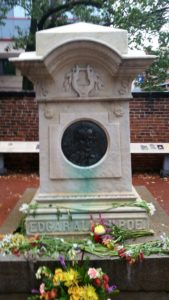
1poe-graveSerendipity smiled further on our side trip when the docent informed us that a anniversary ceremony commemorating Poe’s funeral was to be held at the Westminster Burying Ground, little more than a mile a way, starting in about five minutes.
Normally we would have walked, even in the rain, but for time’s sake we decided to drive. Confusing one-way streets and a dearth of parking spaces turned this into a bad decision. We finally made it to the church 10 minutes after the appointed 3 p.m. start.

Poe’s grave was easy to find by the size of its 7-foot tall marble monument, not by the size of the crowd gathered, because there was no one else present.

We hurried inside the beautiful gothic church, thinking the special observance for the great writer must be going on there instead of in the rain, but again we were alone.

Back into the drizzle we ventured to pay respects at the gravesite – the first of a handful of graves my son and I would visit, and be moved by, on our four-day journey.

Leaving the grounds, we finally encountered another person, an employee at the church. I inquired about the Poe ceremony, saying it must have been quite brief and we were sorry to have missed it.

It turns out that because of the dreary weather no one showed up and the planned sermon was cancelled. How eerily fitting.

In truth, the quaint museum had been a tad disappointing. But the mysticism of Poe having lived – and written – inside its walls, and the auspicious date of our visit, had magnified the magic.

Leaving the museum, the church, and a lunch of Maryland crab cakes at Lexington Market that dates back to 1763, we were accosted each time by panhandlers, one unnervingly aggressive. All in all, one visit to Poe’s city had been enough.

“Quoth the Raven, ‘Balti-nevermore.’ ”

*  *  *

Woody Woodburn writes a weekly column for The Ventura County Star and can be contacted at WoodyWriter@gmail.com.

Wooden&Me_cover_PRCheck out my new memoir WOODEN & ME: Life Lessons from My Two-Decade Friendship with the Legendary Coach and Humanitarian to Help “Make Each Day Your Masterpiece”

Save

Save

Save

Save

Save

Save

Save

Long Column of Super Short Stories

STRAW_CoverWoody’s highly anticipated new book “STRAWBERRIES IN WINTERTIME: Essays on Life, Love, and Laughter” is NOW available! Order your signed copy HERE!

 * * *

Simplifying the Short Story to the Extreme

“Simplify, simplify,” advised Henry David Thoreau, to which Ralph Waldo Emerson wryly, and wisely, replied: “One ‘simplify’ would have sufficed.”

Another writing master, Ernest Hemingway, once accepted a challenge of simplifying from colleagues who bet him he couldn’t write a complete story in a mere six words. The master wordsmith made them pay up with this gem: “For sale: baby shoes, never worn.”

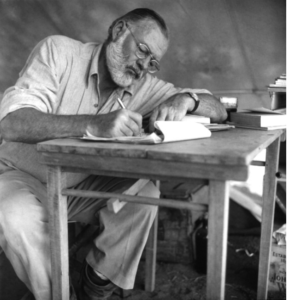
Ernest Hemingway , according to literary lore, once won a bet with a masterful six-word short story.

Ernest Hemingway , according to literary lore, once won a bet with a masterful six-word short story.

It is the work of a genius, indeed, for the reader can instantly imagine another 1,000 words to fill out the story.

With this in mind, I challenged some friends and social media pals to write their own six-word story of fiction or memoir.

My good buddy Jeff McElroy, an accomplished author who is familiar with Papa Hemingway’s complete body of work from long to supremely short, responded thusly: “Here’s an attempt to make the most heartbreaking shortest story into a happier one: ‘Free baby shoes. Well-worn.’ ”

Here are a few more six-word stories . . .

From Marcella Williams: “The skiff landed. My life metamorphosed.”

Mitch Gold: “My kids are my greatest achievements.”

Scott Harris: “He was blessed with good friends.”

Karen Biedebach-Berry: “Sun, surf, sea-glass, Pierpont Beach house!”

Terry Wieser: “I tripped but never fell hard.”

Arlys Tuttle: “My phone rang; never guess who.”

Deborah Sutherlan-Hocamp: “Last surviving human hears the doorbell.”

From Ed Wehan, an ultra-marathoner who conquered the Western States 100 Mile Race in his younger days and is still a long-distance marvel at age 72-going-on-52: “I ran but age caught me!”

Allyson McAuley: “Read books, traveled world, shared books.”

Tom Koenig: “Viewed, pursued, aged, still pursuing her!”

Karen Lindell: “Her heart gently listens, loves, aches.”

Jill Shaffer: “Life is short, cherish every day.”

And my own mini-memoir six-pack: “Tries to make today a masterpiece.”

*

Seeking even further simplicity, I posed a second challenge of brevity: write a happy story – fiction or memoir – in only four words.

Houston Wolf: “Lived happily ever after.”

From Allyson McAuley: “It wasn’t too late.”

Randall Richman offered, “Peace on Earth occurred,” and Kris Young echoed: “World peace is here.”

Teri Hu: “My kids are home!”

Susan Goodkin: “I’m at LAX arrivals.”

Elizabeth Black: “Then I saw you.”

Rebekah Reddy: “And then they hugged.”

Sandy O’Brien: “We named him Bennett.”

Irene Henry: “Babies’ unconditional loving smiles.”

Here’s three vivid images: Nancy Kirk, “I see a rainbow”; Althea Carlson, “There are puppies everywhere”; and Susan Jorgensen, “Yum, so much cake!”

Jon Gold: “Pastrami sandwich, half price.”

David Spruill: “Reading ‘Harry Potter’ again!”

Tom Spence: “It’s in the hole!

From Jayce Yeh, “Your son’s vitals stabilized,” and similarly from Mark Jasper, “My child is healthy.”

Toni Tuttle-Santana: “Family growing and thriving.”

Mike Davis: “Joy in my heart.”

Lisa Iannucci: “Smiled often, laughed much.”

Steve Cook: “I painted all day.”

Lisa Iannucci: “My screenplay was sold!”

Anne Kallas: “I adopted a dog/cat.”

From Joe Siddens came “Will you marry me?” to which Jill Shaffer added this happy sequel: “She said ‘yes!’ ”

From Keith Pillow, “Then she loved me”; from Jim Gstettenbauer: “She laughed, I smiled”; and from Josh Crowder, “We found love together.”

Nicole Marsella-Jensen: “Passport, a new stamp.”

Cary Ginell: “Trump falls off cliff.”

From Suz Montgomery, “I am cancer free,” and similarly from Deborah Sutherland-Hocamp: “The X-rays were negative.”

Ronna Streeton, “I have four grandchildren!” and Carol Roth, “Seven grandchildren equals joy!”

Wayne Kempton wrote a matrimonial memoir: “48th anniversary with Shari.”

Barry Sackett offered, “She loved the puppy,” and my former Star colleague Melissa Eastman Wantz made it happier yet with this slight rewrite: “The puppy loved her.”

Annie Elizabeth: “My heart is full.”

And Michelle Rogers wrote this heartwarming gem, which is memoir not fiction: “I donated my kidney.”

The last four words come from yours truly: “Column written for me.”

*  *  *

Woody Woodburn writes a weekly column for The Ventura County Star and can be contacted at WoodyWriter@gmail.com.

Wooden&Me_cover_PRCheck out my new memoir WOODEN & ME: Life Lessons from My Two-Decade Friendship with the Legendary Coach and Humanitarian to Help “Make Each Day Your Masterpiece”

Save

Save

Save

Save

Jester’s Life Inspiring, not Comedic

STRAW_CoverWoody’s highly anticipated new book “STRAWBERRIES IN WINTERTIME: Essays on Life, Love, and Laughter” is NOW available! Order your signed copy HERE!

 * * *

Jester’s Life is Inspiring, not Comedic

It is a rare writer who makes one think of the great Ernest Hemingway, but Stephen Michael Jester, II is such an exception. Specifically, he brings to mind Hemingway’s observation: “The world breaks everyone, and afterward, some are strong at the broken places.”

The world did not take long to break Stephen. In just his 23rd hour of life, in the hospital nursery following a birth with complications, his heart stopped beating and he was recorded clinically dead.

Stephen Jester at a book signing at Mrs. Figs' Bookworm.

Stephen Jester at a book signing at Mrs. Figs’ Bookworm.

Miraculously, Stephen was resuscitated. Doctors, however, expressed no hope for his long-term survival. They were wrong.

But the world was not finished trying to break Stephen. At age 18 months he was diagnosed with cerebral palsy, a neurological disorder permanently affecting muscle strength and coordination.

Asked about his difficult entry into the world, and being strong at the broken places, Stephen, now 28, replies: “If I have a special calling or reason to still be here today, I feel that it is to show others that anything you set your mind to is possible.”

His entire life, Stephen has been told a big list of things that are impossible for him to do. The native-born Camarillo resident thrives on proving small-minded naysayers wrong. This includes making those who said he would never become a published author eat their words.

“A Jester’s Life: Sometimes It’s Just Not Funny” was published in 2012 followed earlier this year by his second book, “Ode to Legend & Myth.” Both collections of poems are available at Mrs. Figs’ Bookworm in Camarillo, as well as through Amazon.

“It was a very emotional moment for me,” Stephen says, recalling the moment he saw “A Jester’s Life” in print for the first time.

Seeing his name stitched on a pro sports uniform would not have been more thrilling because instead of dreaming of dunking in the NBA or throwing NFL touchdowns passes, as a small boy Stephen had literary aspirations.

Stephen's dream as a 5-year-old came true with the publication of his first book in 2012.

Stephen’s dream as a 5-year-old came true with the publication of his first book in 2012.

“At the age of five, my goal was to someday write and publish a book,” he recalls. “I was always fascinated by language, writers and their books.”

As a sixth-grader, Stephen began writing seriously. And laboriously. Cerebral palsy not only makes typing on his laptop difficult, if he sits in one position very long painful cramps beset his back and legs. Indeed, “writer’s block” is the least of his challenges.

Classified as “spastic quadriplegia,” Stephen’s cerebral palsy affects muscular tone and movement in all four extremities. He cannot walk and requires an electric wheelchair to get around – except in his dreams.

“In every dream that I have,” Stephen shares, “I am not in a wheelchair. In my dreams I do anything and everything.”

In his waking hours he writes about anything and everything. About life and death; love and loss; nature and religion; and much more. Here is a sampling from three poems in “A Jester’s Life”:

First from “Dreams” – “It was a time of belief / That all things were possible.”

From “Wishes” – “I wish that my legs were strong and able / So I might simply walk away.”

And from “The Prodigal Returns” – “Even at the grimmest of times / Life is still a gift.”

During his own grimmest times, in fact especially then, Stephen sees writing as his gift.

“Writing is my favorite thing in the world,” he says. “If there’s only one thing that really makes sense about why I am who I am, it is that I know writing is what I’m meant to be doing.”

He is now pouring his soul into his third book, a collection of 365 haikus with the working title “Journal Entries of an Addict.”

“Basically ‘Addict’ refers to the idea of writing as an addiction,” Stephen explains. “In one form or another, I feel compelled to write daily. My advice for any young aspiring writer: don’t be afraid to dream, don’t be afraid to pursue your dreams, and never allow anyone to dictate your dreams.”

Wise advice for everyone, not just writers, and exemplified in this Jester’s life.

* * *

Woody Woodburn writes a weekly column for The Ventura County Star and can be contacted at WoodyWriter@gmail.com.

Wooden&Me_cover_PRCheck out my new memoir WOODEN & ME: Life Lessons from My Two-Decade Friendship with the Legendary Coach and Humanitarian to Help “Make Each Day Your Masterpiece”

Save

Save

Save

Act of Giving Requires Two

STRAW_CoverWoody’s highly anticipated new book “STRAWBERRIES IN WINTERTIME: Essays on Life, Love, and Laughter” is NOW available! Order your signed copy HERE!

 * * *

Act of Giving Requires the Gift of Receiving

The lovely music of a violin requires not just its strings but also a bow. A writer’s words are meaningless without a reader. It takes two hands, not one, to applaud.

And the act of giving is an empty gesture without someone on the receiving end. At times, however, we can become so focused on doing kind deeds that we forget this important truth.

I received a refreshing reminder last weekend.

1watercoldI am neither a mad dog nor Englishman, but I was out in the midday sun Saturday getting in my 4,829th consecutive daily run. Despite the mercury inching up toward triple-digits, causing a friend to shout out, perhaps accurately, “You’re crazy!” as he drove by, I stubbornly completed my planned 13-miler consisting of 26 laps around the perimeter of the three soccer fields at the southeast corner of the Kimball Aquatic Center Community Park.

As I was stretching and cooling down, that term being relative on this unseasonable and unreasonable autumn afternoon, I was approached and greeted by a burly man with a jet-black beard so long and thick it would make Edward Teach – aka Blackbeard the Pirate – envious.

It should not matter – and yet with racial tensions and tragedies making headlines daily, perhaps it does bear mention – that the bearded burly man and I are of different ethnicities.

“Do you want some water?” he asked.

“Thanks,” I answered, “but I’ve got a Gatorade in my car.”

After the man turned and walked away, I had second thoughts. While it was true I had a sports drink in my car, I suddenly realized this was beside the point.

What was important was John Wooden’s maxim: “There is great joy in helping others.” It now occurred to me that I had just denied this friendly man a slice of joy. Also, of course, I had denied myself the joy of receiving his kindness.

“Hey,” I called out while he was still within earshot. “I would like to take you up on that water.”

The man’s reaction reminded me of a scene in the movie “Wedding Crashers” when Owen Wilson’s character, John Beckwith, reconsiders after having earlier turned down an offer for meatloaf from Chaz, played by Will Ferrell.

“You know what,” John says, “I will have some meatloaf. Let’s have some meatloaf.”

“You want some?” Chaz says, excitedly. “Hey, Ma! The meatloaf! We want it now! The meatloaf!”

Hearing my change of mind, the man flashed a toothpaste-ad smile that burst through his beard like sunshine from behind a parting a cloud. He enthusiastically said: “You do? Great!”

With that he bolted off to the parking lot and from a cooler in the bed of his pickup truck pulled out not one, but two, bottles of ice-cold water.

“I’ve seen you running laps for close to two hours so you need to drink up,” he said, offering me both bottles as well a glucose tablet.

I chugged the first bottle of water about as fast as it would pour out, not only because I was parched but also in an attempt to truly show the man my appreciation in a way a mere “thank you” could not.

As we chatted briefly, I learned my Samaritan’s name is Eric and that he has coached youth soccer for nearly a decade. When I got home I understood why he was perhaps a little worried about me: my black running hat was stained half-white while my face was also heavily peppered with salt.

Too, a lingering smile was on my face because Eric had not only refreshed my body but also given my mind a refresher in this insight from British author Alexander McCall Smith:

“Gracious acceptance is an art – an art which most never bother to cultivate. We think that we have to learn how to give, but we forget about accepting things, which can be much harder than giving. Accepting another person’s gift is allowing him to express his feelings for you.”

Wise food – or rather, ice-cold water – for thought.

*  *  *

Woody Woodburn writes a weekly column for The Ventura County Star and can be contacted at WoodyWriter@gmail.com.

Wooden&Me_cover_PRCheck out my new memoir WOODEN & ME: Life Lessons from My Two-Decade Friendship with the Legendary Coach and Humanitarian to Help “Make Each Day Your Masterpiece”

Save

Save

Save

Save