Column: Zoey’s will be missed

Zoey’s – Those Were The Good Old Nights


Frank Sinatra’s 1973 song “There Used to Be a Ballpark Right Here” came melancholically to mind when the 101 Drive-In theater was demolished in 2001 and again when the Cabrillo Racquet Club permanently took down its tennis nets in the winter of 2007.


In the summer of 2008 it was the treasured indie bookstore Adventures For Kids that was lost, reminding me of Carly Simon’s 1971 hit “Anticipation” because when I took my two children to A4K (as loyal patrons called it) I knew “these are the good old days” that couldn’t last.Zoeys


Now another local touchstone has been lost. Zoey’s Cafe, a magical music mecca, killed its mics for good last Saturday. Another song from the early 1970s, “America Pie” by Don McLean, fits the moment beginning with the very second line: “I can still remember how that music used to make me smile.”


The music at Zoey’s made me, and countless others since Steve and Polly Hoganson bought it seven years ago, smile. The names of the musicians I saw there – mostly at the original location on Ventura’s Main Street with its upstairs “listening room” that was as intimate as a home den – escape me, but I remember this: those “good old days” in cozy Zoey’s were as magical as big-name concerts I have seen in the Hollywood Bowl.


A sample of this homey magic from my 26-year-old daughter: “I saw many wonderful singers at Zoey’s – most recently my friend from high school, Lauren Sexton, who came out with her debut CD ‘Home by Morning.’ And when I was going to Purdue in Indiana, I remember being homesick and feeling so happy and comforted when I saw ‘Zoey’s, Ventura, CA’ listed on Tony Luca’s concert T-shirt as a stop on his tour!”


In honor of Zoey’s and in thanks to the Hogansons – and also as a reminder of how important it is for each of us to frequent and support locally owned-and-run businesses – here is a “mash-up” created with lyrics from “Anticipation” (Simon), “America Pie” (McLean) and “There Used to Be a Ballpark Right Here” (Sinatra).

* * *

I can still remember how that music used to make me smile (McLean)


And the air was such a wonder (Sinatra)


And, I knew if I had my chance that I could make those people dance (McLean)


And maybe they’d be happy for a while (McLean)


And the people watched in wonder (Sinatra)


And, there we were, all in one place (McLean)


With a joy I’d never seen. (Sinatra)


How they’d laugh and how they’d cheer (Sinatra)


Them good ol’ boys were drinking whiskey and rye, singing (McLean)


And tomorrow we might not be together (Simon)


Man, I dig those rhythm and blues (McLean)


’cause these are the good old days (Simon)


Can you teach me how to dance real slow? (McLean)


I rehearsed those lines just late last night (Simon)


Can music save your mortal soul? (McLean)


I met a girl who sang the Blues (McLean)


These are the good old days (Simon)


Now, do you believe in Rock and Roll? (McLean)


We can never know about the days to come (Simon)


But we think about them anyway, yay (Simon)


We all got up to dance, oh, but we never got the chance  (McLean)


I knew I was out of luck the day the music died  (McLean)


I went down to the sacred store (McLean)


Now the children try to find it (Sinatra)


Where I’d heard the music years before, but (McLean)


The man there said the music wouldn’t play (McLean)


And the sky has got so cloudy (Sinatra)


When it used to be so clear (Sinatra)


And the summer went so quickly this year (Sinatra)


And, in the streets (McLean)


We (Simon)


Cried (McLean)


On (McLean)


The coast the day the music died (McLean)


Yes, there used to be (Sinatra)


Lovers (McLean)


And poets (McLean)


Right here (Sinatra)


Bad news on the doorstep (McLean)


Something touched me deep inside the day the music died (McLean)


So, bye bye (McLean)


Z (Sinatra) O (Simon ) EY (McLean ) ’S (McLean).


*


Woody Woodburn writes a weekly column for the Ventura County Star and can be contacted at WoodyWriter@gmail.com. His new memoir WOODEN & ME is available at www.WoodyWoodburn.com and Amazon.com.



Column: Enlightened Darkness

Shining Example Amid Darkness


Hearing my 23-year-old son talk about seeing kids in Ghana who walk three miles to and from school, and they consider it a privilege because there are some years when their village cannot afford to hire a teacher, shines a new light on education.


From another Third World trip, to Mali, my son tells of village children cut off from attending secondary school for four months each winter because a river with no adequate bridge floods during the rainy season.DarkBooks


            And so every time I see a new report with same old news that the United States is slipping down the educational ladder – ranking 17th according to a global report by the education firm Pearson – it angers me. Any excuse offered for this dismal showing is as lame as a fourth-grader claiming, “My dog ate my homework.”


            I wish every American youth could travel to Ghana or Mali or someplace similar and witness first-hand how kids there value the opportunity to attend school.


            More simply, I wish every classroom in America would require its students – and parents – to watch a three-minute documentary by award-winning filmmaker Eva Weber titled “Black Out.” (You can see it online at http://www.one.org/us/2013/10/08/the-dark-side-of-education/).


            Imagine countless Rocky Balboas with a tattered textbooks and you get a feel for “Black Out.” It should make every American student embarrassed to not finish a homework assignment or fail to study for an exam.


            The powerful video opens with this somber statistic: “Only a fifth of Guinea’s 10 million people have access to electricity” followed by this dark reality: “Every day during exam season, as the sun sets, hundreds of school children begin a nightly pilgrimage to find light.”


            Onscreen on a dark, lonely night we see a teenage boy, wearing a backpack, sitting next to a gas pump and studying under the outdoor lights overhead.


 “We don’t know what to do,” the boy says, his words translated into English. “We don’t have electricity at home. We have to go outside where the electricity is working. We study out here and then go back home.”


A handful more students turn the gas station into a library al fresco. One boy uses a trashcan as his desk and a girl speaks this cold truth: “I come from far away to study here. Sometimes I have to spend the night here. As a woman it can be dangerous to go back around 11 p.m. Sometimes were are forced to spend the night here because of the lack of electricity.”


One recent evening shortly after first seeing this video, I saw a girl of similar age reading a textbook at a local soccer practice. As dusk arrived she did not move to beneath a light at the restrooms or in the parking lot. There was no need; there will be illumination at home later. She pulled out a video game.


The kids in “Black Out” have no lamps, no desks, no chairs. They balance schoolbooks on their knees and on trashcans; they sit on curbs and on the ground.


Two minutes into the mini-documentary comes the most chilling, and yet the most inspiring, footage of all. Outside the international airport is a large parking lot. The lined spaces are empty of cars, but the lot is not at all vacant – the blacktop is filled with kids reading, doing math problems, studying.


            A boy in the parking lot explains the young human gridlock: “We all come here because we don’t want to fail our final exams.”


Jets arrive and depart, but the kids stay through the night.


Another boy with no electricity at home adds this: “My parents are a little bit worried. We are worried, too. We want a different future. That’s why we come here.”


They come by the hundreds. Beneath the glow of streetlights meant to prevent crime, crime is being prevented in the best way possible – with education for brighter futures.


“Black Out” then fades to black, but its message is enlightening. Every American kid who offers an excuse for not doing his or her homework should be forced to study in a supermarket parking lot for a week.


*

Woody Woodburn writes a weekly column for the Star and can be contacted at WoodyWriter@gmail.com. His new memoir WOODEN & ME is available at www.WoodyWoodburn.com and Amazon.com.
 

Column: Wooden and Friendship

Wooden Made Friendship a Fine Art


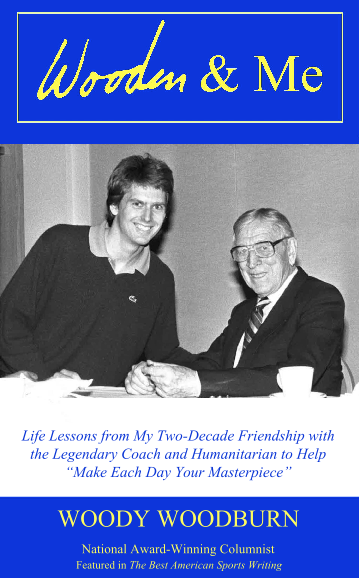
Monday – October 14 – would have been John Wooden’s 103rd birthday. Below, excerpted from my new memoir Wooden & Me: Life Lessons from My Two-Decade Friendship with the Legendary Coach and Humanitarian to Help “Make Each Day Your Masterpiece” (signed copies available at WoodyWoodburn.com and unsigned paperbacks at Amazon.com), is an example of how he walked his talk.


* * *


The next time I joined Coach John Wooden for a brisk morning walk, I did something I embarrassingly neglected to do in all my excitement the first time: I brought a gift of thanks for his hospitality.


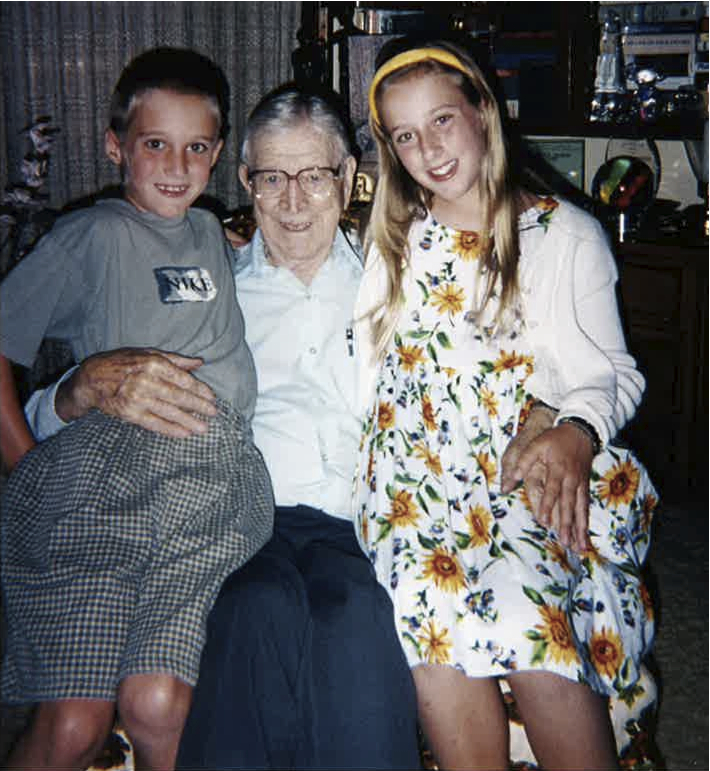
Coach with two very happy young visitors in his home: my son Greg and daughter Dallas.


Coach thanked me for the book while insisting a gift was completely unnecessary. Shortly thereafter I received a handwritten thank-you note; included within was a postcard-sized printed poem authored by Wooden titled “On Friendship”:


At times when I am feeling low, / I hear from a friend and then


My worries start to go away / And I am on the mend


No matter what the doctors say – /And their studies never end


The best cure of all, when spirits fall, / Is a kind word from a friend


More prized than the signed poem is that over the ensuing years Coach would turn the words into deed when my spirits fell – particularly when my mom passed away in 1992 and when I was severely injured by a speeding drunk driver in 2003.


Even when my spirits were already high, Coach had a gift for raising them further. For example, when I next visited him he recited a poem from the Rumi volume I had given him. I must confess I did not know whom Coach was quoting until he told me. It was not surprising, however, that his selection was titled “Love” since Coach always insisted it was the most important word in the English language.


What a thoughtful and eloquent gesture, what rare grace. It was a simple reminder that saying “thank you” is nice, but to show thanks is far better. Write a note of thanks, certainly, but also wear a new sweater or necklace the next time you see the person who gave it to you; put a gift vase on proud display before the giver visits; memorize a poem or line from a book given to you. Time and again in ways big and small, Coach put into practice the fifth rule printed on his father’s seven-point creed: “Make friendship a fine art.”


One of Coach’s many exceptional qualities was how he made people feel special by giving each individual he was interacting with his undivided attention. For example, he was perhaps the slowest, and the most gracious, autograph-signer in history because he made a conscious effort to engage each fan in a brief conversation.


Similarly, Coach always gave his full attention on the phone and never seemed in a hurry to hang up. Indeed, if he was too busy to talk he would simply not answer the phone in the first place rather than risk the prospect of having to be in a rude rush.


I fondly remember visiting Coach when the phone rang and he let the call go through to his answering machine. The message conveyed was that I was his guest and thus merited his complete focus. This unspoken kindness became even greater seconds later after the “Beep!” when a very familiar voice could be heard leaving a message.


“That’s Bill Walton!” I said, excitedly. “You’d better answer it!”


Coach did not move towards the phone and instead replied with a devilish smile: “Heavens no! Bill calls me all the time. If I pick up he’ll talk my ear off for half an hour and then you and I won’t get to visit. I’ll talk with him later.”


*


Woody Woodburn writes a weekly column for the Star and can be contacted at WoodyWriter@gmail.com. WOODEN & ME is available at www.WoodyWoodburn.com and Amazon.com.


Guest Review of “Wooden & Me”

“Wooden & Me” is the Playbook for Readers’ Lives

By KEN McALPINE

John Robert Wooden was teacher, mentor and friend to many, but few have gotten to the heart of Wooden (and, with Wooden, it’s the heart that matters) like Woody Woodburn.

Woodburn’s new memoir “Wooden & Me: Life Lessons from My Two-Decade Friendship with the Legendary Coach and Humanitarian to ‘Help Make Each Day Your Masterpiece’ ” is a marriage made in writing heaven. Two men cut from the same Midwestern cloth — woven with integrity, honesty and a need to do for others — Woodburn, a national award-winning columnist, and UCLA coaching legend Wooden forged a special bond, and a friendship that lasted over 20 years.

Wooden-&-Me-cover-mock-upWoodburn first met Wooden as a youth basketball camper in 1975 and the magic begins here. But this is not a book about basketball. Wooden’s gift was to see the bigger picture, and Woodburn possesses the same gift. The result is a book that moves and motivates and makes you care about the not-so-simple values that make this world a better place.

John Wooden’s sporting accomplishments were almost beyond belief. His won-loss record, his NCAA championship wins, we could list the numbers here, but Coach made little of these accomplishments. “What was the biggest highlight of your career?” he was once asked, Woodburn shares. “When Nellie married me,” he said.

This was a man, writes Woodburn aptly, of “rare grace.”

Woodburn’s prose also is rare grace. Wooden was larger than life because he didn’t try to be; Woodburn writes a lovely book because he has a simple, unselfish aim.

“Coach helped shape my life, and grandly,” writes Woodburn. “My friendship/mentorship with him was a precious gift, one that came wrapped with a bow of responsibility to share with others the life lessons he shared with me the best I can strive for is to pay forward in some small measure by sharing his wisdom with others ”

That Woodburn knew Wooden doesn’t distinguish him from hundreds of others: what distinguishes Woodburn is he cares about people and good things. Wooden knew this, and so the two became real friends (Woodburn has a stack of letters from Coach that he keeps in a fireproof safe along with other pen-and-paper family heirlooms).

Wooden’s friendship deepened to include Woodburn’s two children through their growth into young adulthood. Because they were real friends, “Wooden & Me” touches every chamber of the heart. At times the book is funny and upbeat, at times, poignant and sad. Woodburn often got through his own difficult times with help, actual and inspired, from Coach, and Woodburn returned the favor. Together they raised friendship to an art.

The value of friendship, honesty, integrity and hard work, these are things that always merit reminding and are evident throughout the pages of “Wooden & Me (currently available through www.WoodyWoodburn.com). Indeed, Woodburn turns the lessons he learned from Wooden into lessons we can all use.

“Remember, Woody,” Coach told him more than once, “good things take time — and good things should take time. Usually a lot of time.”

This book is a very a good thing.

*

Ken McAlpine is the author of the novels Together We Jump and FOG and the nonfictionbooks Off Season: Discovering America on Winter’s Shore and Islands Apart: A Year on the Edge of Civilization.

Column: Trophies Don’t Tarnish Kids

Trophy Generation is older than you think


“Our youth now love luxury. They have bad manners, contempt for authority; they show disrespect for their elders and love chatter in place of exercise; they no longer rise when elders enter the room; they contradict their parents, chatter before company; gobble up their food and tyrannize their teachers.”


            Some complaints never change, although if Socrates made his above cavil today he would surely add, “And why do kids always get awarded trophies?” Trophy


            Interestingly, this latter grievance about the Millennial Generation and Generation Z is often made by men remarried to young “trophy” wives or women wearing jewels they didn’t get for winning a 5K race or tennis tournament. Indeed, Boomers and Gen X might be the real Trophy Generations. But I am getting ahead of myself.


            It has become a regular occurrence writers and TV talking heads to publicly take today’s youth to task for being raised on praise, feeling entitled, being lazy, loving luxury (and video games), having bad manners and gobbling up their junk food.


These generalities are, to quote Wonderland’s Alice, “stuff and nonsense.” Sure, plenty of kids are spoiled punks – and thus it has always been as Socrates suggests – but so are a lot of adults.


            Most recently, Ashley Merryman, co-author of “NurtureShock: New Thinking About Children” went all Socrates on kids in an Op-Ed essay in the New York Times headlined: “Losing Is Good For You.”


            Merryman un-merrily opened her missive: “As children return to school this fall and sign up for a new year’s worth of extracurricular activities, parents should keep one question in mind. Whether your kid loves Little League or gymnastics, ask the program organizers this: ‘Which kids get awards?’ If the answer is, ‘Everybody gets a trophy,’ find another program.”


            You would think trophies are as dangerous as extra chunky Jif is to a school kid with a peanut allergy.


            Merryman continued: “Today, participation trophies and prizes are almost a given, as children are constantly assured that they are winners.”


            And: “If I were a baseball coach, I would announce at the first meeting that there would be only three awards: Best Overall, Most Improved and Best Sportsmanship. Then I’d hand the kids a list of things they’d have to do to earn one of those trophies. They would know from the get-go that excellence, improvement, character and persistence were valued.”


            Here’s the thing: kids aren’t stupid despite what some clueless adults think. Kids know that excellence, improvement, character and persistence are valued. They also know that receiving a participation trophy at an AYSO season-ending banquet doesn’t mean they were their team’s superstar.


The same may not be said for many adults who equate driving a flashy, expensive car with being an MVP. And isn’t the workplace replete with participation trophies like reserved parking spaces and Christmas bonuses awarded for time on the job rather than job excellence?


If prizes should be given only to “Best Overall” or for true “excellence,” then aren’t today’s adults showered with undeserved trophies considering everyone who finishes a marathon – even if they walk the entire way – receives a medal the size of a hubcap? How is this different than a Little League “participation trophy” or a “participation certificate” in a school spelling bee?


Another curmudgeonly “Hey-kids-get-off-my-lawn!”-like complaint Merryman and her ilk make is that today’s youth feel entitled to good grades. I’m guessing that Merryman – like most every employee between the ages of 30 and retirement in all professions – feels they have been greatly wronged upon receiving anything less than a sterling annual work review.


Merryman concludes: “. . . we need to refuse all the meaningless plastic and tin destined for landfills. We have to stop letting the Trophy-Industrial Complex run our children’s lives. This school year, let’s fight for a kid’s right to lose.”


A plastic trophy isn’t meaningless – nor all meaning. It’s merely a nice memento, like a team photo or 10K finisher’s medal.


This school year, let’s fight for a kid’s right to have adults lose the Socrates-like contemptuous chip on their shoulders.


*

Woody Woodburn writes a weekly column for the Star and can be contacted at WoodyWriter@gmail.com. His new memoir WOODEN & ME is now available at www.WoodyWoodburn.com and Amazon.com.


Column: Different Slant On Autographs

A Different Slant On Autographs


The Black Death had a rival scourge in the Middle Ages. Call it The Black Ink because according to historians the pursuit of autographs dates back to this period. It seems the hunt for signatures of the famous came about after the hunt for religious relics waned.


Centuries after bubonic plague had been largely erased, Albert Einstein weighed in with his scientific view on the autograph terming it the last vestige of cannibalism.Hancock


After 25 years of watching the signature savageness as a sports columnist, including seeing grown men push children out of the way in pursuit of autograph, I think Einstein was being too kind.


But something really cool happened last weekend that changed my viewpoint. An autograph show was held in a hotel lobby in the historic town of Gettysburg and instead of home-run heroes and Hall-of-Fame slam dunkers and Olympic gold medalists, the “heroes” signing their signatures truly were heroes. Specifically, they numbered nearly half of the 79 current surviving recipients of the Medal of Honor – our nation’s highest military award.


If I collected inked autographs, these warriors’ John Hancocks would be on my Most Wanted List.


Instead, over the years I have collected autograph of a different slant: oddball stories from athletes I’ve interviewed. Let me share a few.


“I am frequently asked to sign Pennzoil cans,” shared Arnold Palmer, who has done countless TV commercials for the petroleum product.


Similarly, Hall of Fame pitcher – and Advil pitchman – Nolan Ryan said he often gets asked to autograph bottles of the pain reliever.


“I enjoy people, so I don’t mind autograph requests at all,” legendary broadcaster Vin Scully began. “Why not sign? They’re paying me a compliment by asking.”


And what are some of the stranger “compliments” he’s had?


“I’ve signed a lot of baseballs as you can imagine, but also golf balls and even a hockey puck which is sort of strange, I should think.


“Paper napkins seem popular,” Scully continued, “even dirty napkins. I think it’s all they have on hand. I don’t expect them to keep it, but I sign anyway because hopefully they will keep the moment.”


“I’ve signed dollar bills for homeless people who you know were going to spend it and not save it,” echoed Olympic gymnastics champion Kerri Strug. “And I’ve signed first-graders’ body parts with pencils – which is hard to do.”


Skin is popular from head to toe. I’ve seen Magic Johnson sign a bald head with a black Sharpie marker and Muhammad Ali do so on kids’ arms, legs and feet. But the most memorable thing I saw Ali autograph was a jogging bra . . .


. . . being worn by the young woman.


Speaking of dirty laundry, Olympic softball gold medalist Kim Maher added this footnote to my signature collection: “A kid handed me a sock to autograph – a gross, dirty sock!”


Did the former Buena High star sign it?


Maher: “Oh, yeah, of course.”


Olympic marathon champion Frank Shorter can relate: “Over the years I’ve been asked to sign some pretty grungy running shoes.”


Echoed Billy Mills, America’s last Olympic gold-medal winner in the 10,000 meters in 1964: “I was asked by a school fundraiser to send an autographed pair of shoes. ‘The worse-smelling the better,’ they said.” He sent a pair he’d worn only a couple times.


More memorable laundry. “The oddest thing I’ve been asked to autograph is a diaper,” Carl Lewis replied, chuckling at the memory. The nine-time Olympic gold medalist went on: “Luckily it wasn’t on the baby at the time – the mom pulled it out of a bag. I’d have had to draw the line at signing a dirty diaper, I think.”


Fellow Olympic sprinter Jon Drummond might have crossed that line, noting: “I was once asked to sign a baby’s diaper – while the baby was wearing it.”


Bottom line, did he sign?


“Yep,” Drummond answered. “If they kept the autograph, I hope they changed the diaper before it was too late.”


What would Einstein think?


I think a soiled napkin suddenly seems like a nice keepsake.


*


Woody Woodburn writes a weekly column for the Star and can be contacted at WoodyWriter@gmail.com. His new memoir WOODEN & ME is now available at www.WoodyWoodburn.com.